
Parks Associates: 16% of US Internet Households Have Cancelled Pay TV and Returned
Source: PR Newswire
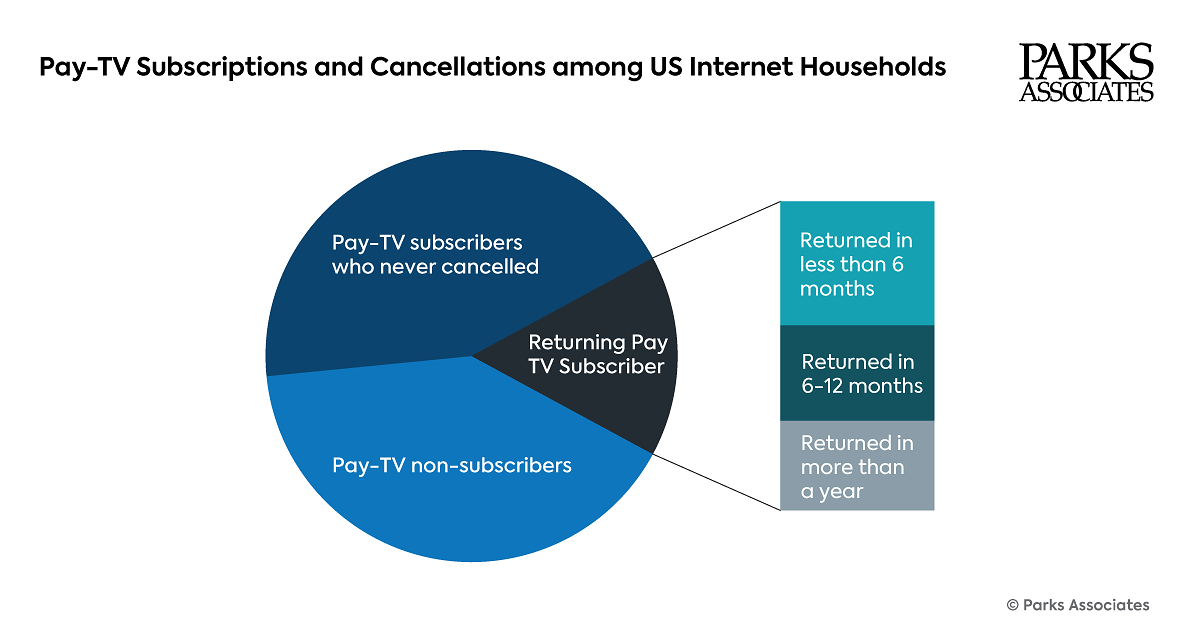
Parks Associates' survey of 8,000 US internet households found 16% had cancelled pay TV and later returned; 40% of returning households came back within six months, while 29% returned after more than a year. Pay-TV penetration is now 57% of all US households, while SVOD adoption exceeds 90%; live sports were cited by 37% of returning subscribers and local news or live TV by 29%. The findings point to potential subscriber winbacks but intensifying competition for entertainment spending and a shift toward virtual multichannel providers among longer-term returners.
Analysis
Implications: The investable signal is not that pay-TV has found a durable growth engine; it is that churn can be a recurring reacquisition pool. Providers with customer-level churn data and flexible packaging may recover households more efficiently than they can win entirely new ones. YouTube TV (Alphabet, GOOG) is positioned for consumers returning after a longer break; Charter (CHTR) can use broadband relationships and packaging to defend video attachment. But sports-led reacquisition can destroy value if rights costs and promotional discounts exceed the lifetime contribution of a returning customer. Sports-rights owners may gain negotiating leverage, while traditional large bundles remain exposed to substitution by narrower offers.
Timing and contrarian view: The conference is a modest near-term information event, not an earnings catalyst. Over 1–3 months, watch for provider-specific churn, win-back rates, and video ARPU; over 6–18 months, the structural test is whether slimmer bundles retain customers without escalating content costs. The headline return statistic may overstate the monetizable opportunity: it is cumulative and household-level, not a provider-level measure of profitable reacquisition. It does not establish that returns offset current losses or that sports-driven subscribers stay after a season. No immediate directional trade is justified by this survey alone.
AllMind Terminal
AI-powered research, real-time alerts, and portfolio analytics for institutional investors.
Request TrialMarket Sentiment
Overall Sentiment
neutral
Sentiment Score
0.00
Ticker Sentiment
Key Decisions for Investors
- No trade on the survey alone. Treat the November conference as a source of diligence, not a catalyst to front-run; the release provides no provider-level economics or evidence of a guidance impact.
- Watch GOOG/YouTube TV as a potential share gainer if returning customers increasingly choose vMVPDs. Upgrade the thesis only with evidence of net additions and sustainable retention; reverse it if sports-driven adds fade after the season or acquisition costs rise.
- For CHTR, monitor video subscriber trends alongside broadband churn and bundle economics. A video win-back that protects broadband relationships could be strategically useful; persistent video losses without broadband retention would strengthen the underperformance case.
- Before positioning, verify provider-level win-back rates, time-to-return, retention after sports seasons, promotional pricing, and content cost per subscriber. A deterioration in CHTR video/broadband bundle metrics or a clear improvement in GOOG’s paid-TV economics would be a more actionable trigger than the aggregate survey.
More News
- Apple’s new home devices are a bet on its upgraded Siri AI
- Apple’s smart home event: All 7 devices, prices, and release dates
- Apple makes another push into the smart home market with HomeView
- The Apple HomeView Is Like a Giant Apple Watch for the Home
- Apple Reboots Its Smart-Home Strategy With New Hardware and a ‘Home Collection’
- Netflix double downgraded at Huber Research amid engagement, pricing concerns
From AllMind Research
- Anthropic IPO Preview: Valuation, Timing, and What to Watch
- Shein After the IPO: Venue, Valuation, and What Must Be Proved
- What AI Research Tools Should a Small Hedge Fund Buy First?
- How to Search Earnings Call Transcripts With AI
- What a Concept From Nature Tells Us About How C-Suite Executives Actually Think About AI