
Political Uncertainty Puts Some U.S. Companies' Hiring Plans on Hold
Source: PR Newswire
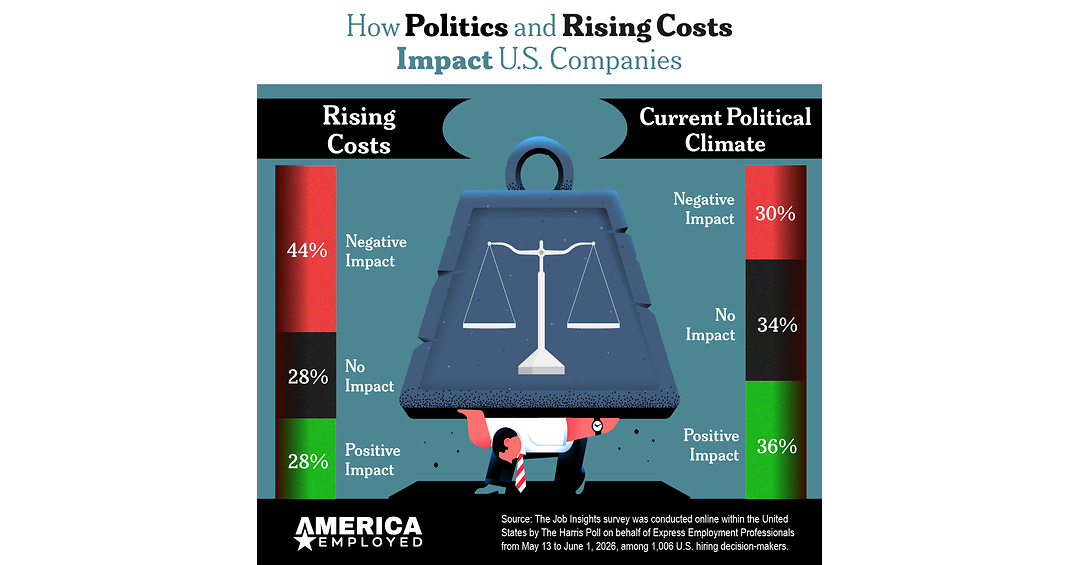
A Harris Poll found rising costs are affecting 72% of U.S. companies’ ability to operate or grow; 44% report a negative effect, and 35% say their company may not survive much longer if wages or costs keep rising quickly, down from 47% in spring 2022. Political conditions are also complicating hiring: 32% of hiring managers cite recession or policy concerns as a major hiring challenge, while some firms are delaying hiring pending government or economic clarity.
Analysis
Treat this as a weak, lagging signal—not a payroll forecast. The poll is self-reported, commissioned, and based on May–June responses; it does not establish that hiring plans have translated into lower employment or quantify company-level cost exposure. The near-term market mechanism is nevertheless plausible: deferred hiring can protect margins before it shows up in layoffs, while rising compensation and benefits costs pressure labor-intensive, lower-margin businesses that cannot pass costs through. Staffing demand is two-sided: clients may defer permanent hiring but use temporary labor for flexibility, so the survey alone does not support a directional call on staffing providers.
Over 1–3 months, corroboration matters more than the poll: watch BLS temporary-help employment, JOLTS openings and quits, payroll growth, wage measures, and small-business hiring plans. A clear improvement in policy visibility could release postponed requisitions; continued uncertainty or weak demand could instead convert delay into cancellations. Over 6–18 months, persistent labor-cost pressure favors automation and productivity investment, but that is a gradual substitution story, not an immediate earnings catalyst.
Contrarian read: the reported vulnerability may overstate imminent distress. Survey sentiment is not insolvency, and businesses can adapt through price increases, reduced hours, or productivity measures. The absence of a clear consensus direction in the responses also argues against a broad macro trade. The signal is falsified as a deterioration thesis if hard labor data remain resilient and company guidance shows stable hiring and margins; it strengthens if temporary-help employment and openings fall alongside downward revisions to labor-intensive firms’ guidance.
AllMind Terminal
AI-powered research, real-time alerts, and portfolio analytics for institutional investors.
Request TrialMarket Sentiment
Overall Sentiment
mildly negative
Sentiment Score
-0.20
Key Decisions for Investors
- No standalone trade on this survey. Keep exposure decisions tied to observed labor data and company guidance; the article supplies neither an earnings estimate nor a measurable change in hiring.
- For the next 1–3 months, monitor temporary-help employment, JOLTS openings, wage growth, and small-business hiring plans. A sustained decline across these measures would support reducing exposure to labor-intensive, low-pricing-power businesses; resilient readings would argue against that move.
- Prefer a relative-quality screen over a broad short: favor businesses with demonstrated pricing power or labor-productivity gains over labor-heavy firms with limited pass-through. Require evidence of margin or guidance deterioration before initiating shorts.
- Set a catalyst alert for policy clarity or a meaningful change in hiring plans. If postponed requisitions convert into actual orders, staffing and recruiting demand could rebound; verify client order trends before positioning for that upside.
More News
- Anthropic's third-quarter revenue is said to hit $16.8 billion ahead of IPO
- Why is Samsung Electronics stock plunging today?
- SK Hynix plunges 8% amid Asia tech rout as Fed rate hike fears, AI funding worries mount
- SK Hynix seeks U.S. chip equipment exports to China tied to new factory
- Hot September CPI Spurs Fed Rate Hike Fears
- Dell stock plunges 11%, leading data center sell-off on concerns about 'enterprise AI timing'