
STL macht einen großen Schritt in Richtung Dekarbonisierung und schafft durch die Umstellung auf 100 % „Grünstrom" die Grundlage für ein umweltfreundliches Produktportfolio
Source: PR Newswire
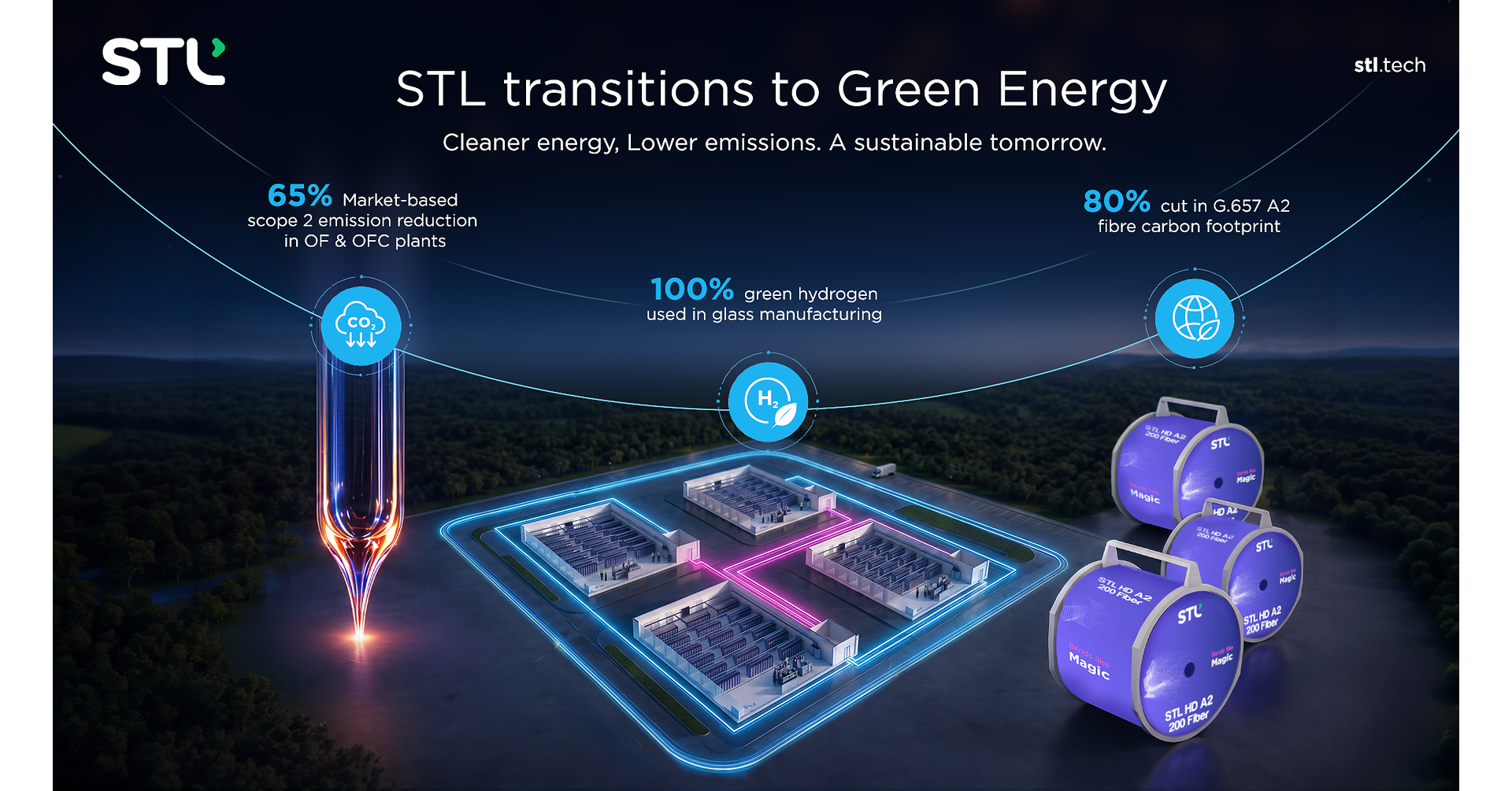
STL announced decarbonization progress including switching all four India production sites in Maharashtra to 100% wind/solar-based “green power,” expected to cut marktbasierten Scope-2 emissions in its OF/OFC works by ~65%. For its G.657.A2 fiber, STL reduced the product CO₂ footprint from 4.7 kg CO₂e/fkm to 0.9 kg CO₂e/fkm (~80% reduction) and moved glass manufacturing to 100% green hydrogen. The update is ESG-positive but not indicative of near-term financial earnings changes, so likely limited immediate market impact.
Analysis
This is more a vendor-qualification signal than a near-term earnings event. The operational message is that STL is trying to convert ESG into a procurement advantage in hyperscale and telecom tenders, where carbon reporting is increasingly part of the scorecard but usually not the decisive factor unless pricing is close. For buyers like GOOGL, the economic benefit is indirect: broader supplier optionality and lower Scope 3 friction, not a measurable reduction in capex or opex.
The second-order effect is competitive, not financial: firms that can prove lower embedded emissions may win share in environmentally sensitive bids, especially in Europe and large data-center builds where customer reporting is tightening. That could pressure legacy fiber and connectivity suppliers with less credible decarbonization narratives, but only if STL can sustain the claims through third-party verification and not just PR. The real test is whether this translates into faster bookings or better mix, because sustainability language alone rarely moves margin.
Time horizon matters: over days, there should be little direct price discovery in GOOGL. Over 1-3 months, watch for procurement-language changes in hyperscaler RFPs and any mention of green-premium pricing or preferred-vendor status. Over 6-18 months, if green hydrogen and green power reduce STL's cost base or improve plant utilization, it could modestly raise gross margin; if not, the initiative remains mostly a marketing and customer-retention tool. The thesis is falsified if STL cannot show order win-rate improvement or if the incremental cost of decarbonization offsets any pricing or volume benefit.
AllMind Terminal
AI-powered research, real-time alerts, and portfolio analytics for institutional investors.
Request TrialMarket Sentiment
Overall Sentiment
mildly positive
Sentiment Score
0.35
Key Decisions for Investors
- No direct trade in GOOGL on this release; treat the ESG-supply-chain angle as a procurement watch item rather than an earnings catalyst.
- Monitor upcoming hyperscaler capex/RFP commentary for mentions of low-carbon materials or supplier scorecards; if GOOGL or peers start embedding carbon intensity in vendor selection, reassess suppliers with the strongest certification moat.
- Relative-value watch: if STL's reported order intake or gross margin improves over the next 1-2 quarters, consider the read-through as mildly negative for less-credentialed fiber/connectivity peers; otherwise fade any ESG premium in the shares.
- Set an alert for third-party verification of the emissions claims and any disclosure of pricing premium/cost savings; without that, the market should assume minimal financial impact.
More News
- ‘If nothing is done, it’s almost inevitable’: Ukraine’s Yuriy Ryzhenkov on why steelmaking is on the brink of collapse as Russian bombing intensifies
- Why is LG Innotek stock plunging today?
- TotalEnergies, KKR expand U.S. solar venture with 700 MW addition
- Why is SK Hynix stock sliding today?
- TSMC expected to report sixth straight quarter of record profit thanks to AI boom
- Vår Energi cuts 2026 output forecast; Q3 production at 369,000 boepd