
Consumer Demand for Direct-to-Consumer Craft Spirits Shows Staying Power
Source: PRWeb
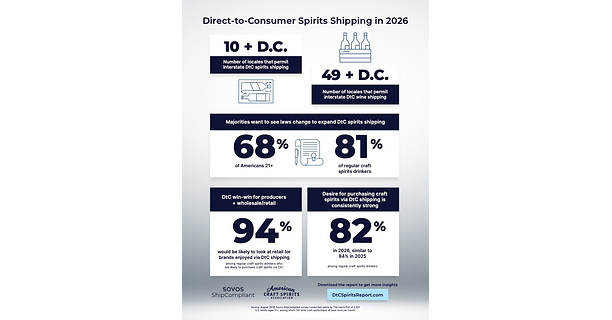
A survey of 2,001 U.S. adults found 68% of adults ages 21+ favor laws expanding direct-to-consumer spirits shipping, rising to 81% among regular craft spirits drinkers; 82% of regular drinkers want the ability to purchase craft spirits this way. The report also found that 94% of regular craft spirits drinkers likely to buy online would look for the brand in stores after trying it via DtC. Access remains limited to 10 states and Washington, D.C.; California’s law, under which 43 distilleries had obtained licenses by June 2026, is set to expire December 31, 2026, with no extension enacted in the 2026 legislative session.
Analysis
The investable signal is regulatory optionality, not demonstrated earnings growth. Stated purchase intent does not establish order frequency, shipping economics, repeat rates, or incremental category demand; the survey’s craft-drinker subgroup also has wider sampling uncertainty. Treat the retail halo as a hypothesis: DtC could lower trial friction and create brand discovery, but may shift purchases from local retailers rather than add them. That creates potential channel conflict with distributors and retailers even if some trial converts to store sales.
Near term, California’s year-end sunset is a binary access risk: absent an extension, licensed distilleries lose a meaningful test market just as they begin operating under the new framework. Over 1–3 months, legislative action in California and the four named watch states matters more than another favorable survey. Over 6–18 months, broader access could favor small producers with distinctive, hard-to-find products and compliance platforms, while established spirits companies may benefit selectively through discovery, acquisition, or portfolio reach. Neither effect is quantifiable from this release. Sovos’ broad compliance business makes any DtC-related revenue contribution unverified and likely not a standalone trading catalyst. The contrarian point: consumer preference is durable, but political support and profitable fulfillment are not; the report may overstate near-term commercial value by emphasizing intent over realized sales.
AllMind Terminal
AI-powered research, real-time alerts, and portfolio analytics for institutional investors.
Request TrialMarket Sentiment
Overall Sentiment
mildly positive
Sentiment Score
0.20
Key Decisions for Investors
- No immediate sector-wide long: the release provides no evidence of incremental sales, margins, or policy enactment. Keep craft spirits exposure on watch rather than paying for a demand narrative.
- Monitor California legislative action into December and the rules/outcomes in Missouri, Hawaii, South Dakota, and Iowa. A California extension plus additional state access would strengthen the 6–18 month thesis; expiration without replacement, or restrictive implementation, would falsify the near-term policy catalyst.
- Before underwriting distillery beneficiaries, seek shipment volumes, repeat-purchase rates, fulfillment and compliance costs, and evidence that DtC buyers add to—not merely displace—retail sales. Also verify which producers are licensed and have meaningful California exposure; the 43-license figure alone does not establish commercial scale.
- Potential relative-value watch: if access expands and reported DtC orders show incremental demand, favor differentiated craft producers over broad spirits exposure; if access contracts or retail conversion disappoints, avoid the small-producer demand premium. No named issuer or ticker is supported by the supplied company mapping, so this is not yet an executable single-name recommendation.
More News
- What investors need to know about Alphabet's stock-busting earnings report
- Our next steps for Alphabet stock after earnings disappoint at nearly every turn
- Wendy's shares jump 15% as Nelson Peltz's Trian offers $1.4 billion to buy burger chain
- GE Vernova shares slip despite a beat-and-raise. What the sellers are getting wrong
- Microsoft's Big Bets on AI Start to Pay Off
- Burnham’s government unveils its first UK budget: What to expect