
SpaceX (SPCX): Fresh Catalysts Ahead
Source: zacks.com
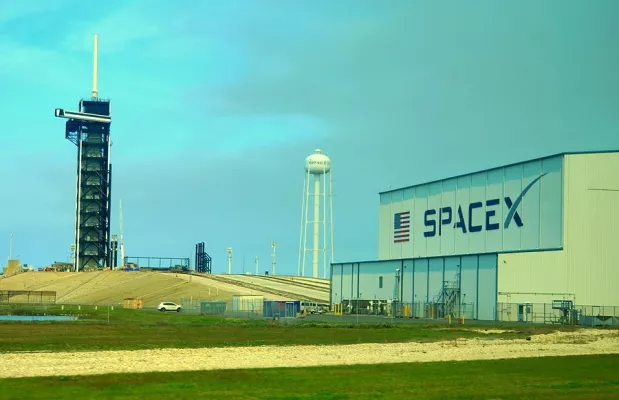
SpaceX shares stabilized after reaching an early-August low of $104.83, with the article citing Starship's first orbital mission and deployment of 26 next-generation Starlink V3 satellites as catalysts for lower-cost network expansion. Anthropic reportedly committed up to $84.5B through May 2029 for Nvidia-based AI infrastructure, while Zacks consensus projects SpaceX revenue growth of 147% in 2027. The article also cites a 63% Polymarket-implied probability of a SpaceX-Tesla merger by the end of next year, though this remains speculative.
Analysis
The investable signal is not the promotional growth narrative but whether launch cadence converts into lower Starlink cost per delivered Gb and sustained enterprise/defense subscriber additions. If verified, that would pressure conventional satellite operators with slower replenishment cycles and higher unit economics—most directly Viasat (VSAT), EchoStar (SATS), and potentially Eutelsat (ETL.PA)—while expanding the addressable market for ground equipment and space-grade components. Planet Labs (PL) is a modest read-through beneficiary only if lower launch cost broadens constellation economics; it does not validate an orbital-compute business model.
The claimed AI-infrastructure commitment and any filing-related figures require primary-source verification before underwriting revenue or NVDA demand. A multi-year capacity reservation can be economically weaker than a take-or-pay contract, and the key diligence items are payment obligations, cancellation rights, power availability, GPU procurement responsibility, and whether revenue is recognized gross or net. Over the next 1-3 months, independently verified backlog, launch reliability, and subscriber net-add disclosures matter far more than speculative merger odds; over 6-18 months, recurring broadband ARPU and capex intensity determine whether the business earns a telecom-like or software/infrastructure-like multiple.
Contrarian view: the proposed TSLA combination is more likely a valuation and governance overhang than a synergy catalyst. A transaction could import TSLA's cyclical auto margins, capital demands, and Musk-related governance discount into a business investors may otherwise value on scarcity and strategic infrastructure. For NVDA, incremental demand is not material without evidence that the relevant compute deployment is incremental to hyperscaler orders rather than merely a reallocation of already constrained GPU supply; the more immediate second-order winner from cheaper access to orbit could be defense and earth-observation demand rather than AI.
AllMind Terminal
AI-powered research, real-time alerts, and portfolio analytics for institutional investors.
Request TrialMarket Sentiment
Overall Sentiment
moderately positive
Sentiment Score
0.62
Ticker Sentiment
Key Decisions for Investors
- Do not initiate SPCX exposure solely on this article. Create a verification alert for SEC filings, audited segment revenue/backlog, contract counterparties, and launch-insurance terms; absent those, treat any sharp rally as promotional-flow risk rather than a fundamental entry point.
- Watch for a 1-3 month relative-value setup: long PL / short VSAT in equal dollar amounts only after two consecutive quarters of improving PL backlog or gross margin and confirmed increases in low-cost launch availability. Target 15-20% relative return; exit if PL guidance is cut or VSAT demonstrates comparable capacity expansion at lower-than-expected capex.
- Maintain NVDA as a core AI-infrastructure exposure rather than adding on this read-through. Add only if verified contracted GPU capacity is incremental and management commentary supports a supply-driven revenue uplift; otherwise the relevant risk is order timing, with a break below next-quarter data-center guidance as thesis falsification.
- Avoid TSLA merger-speculation longs. If transaction reporting becomes credible, consider a 3-6 month TSLA downside hedge via put spreads because dilution, governance scrutiny, and capital-allocation uncertainty can outweigh perceived hardware synergies; close if definitive terms establish cash-neutral consideration and accretion to TSLA free cash flow within 24 months.
More News
- Anthropic warns government attitudes may hurt customer ties, IPO prospectus shows: Reuters
- Stocks remain under the thrall of higher yields and higher oil. Here's what's ahead
- Broadcom, Amazon Test Limits of Investor Demand for AI Buildout
- Paramount and Warner Bros. Discovery to Merge Into Skydance (SKYD). Will Skydance Achieve David Ellison’s "Quality Storytelling" Vision?
- Nasdaq Index: Record High as Weak Payrolls Cut Rate-Hike Bets and Yields Fall
- Nvidia's AI Chips Reach China Despite US Curbs
From AllMind Research
- Anthropic IPO Preview: Valuation, Timing, and What to Watch
- Shein After the IPO: Venue, Valuation, and What Must Be Proved
- What AI Research Tools Should a Small Hedge Fund Buy First?
- AI Tools for Private Equity Due Diligence: A Buyer Workflow
- Weekly Update: In-App Tutorials, Futures Data, and Watchlist Enhancements