
Mindtrip Launches Personal Travel Assistant That Knows the Traveler, Not Just the Trip
Source: PR Newswire
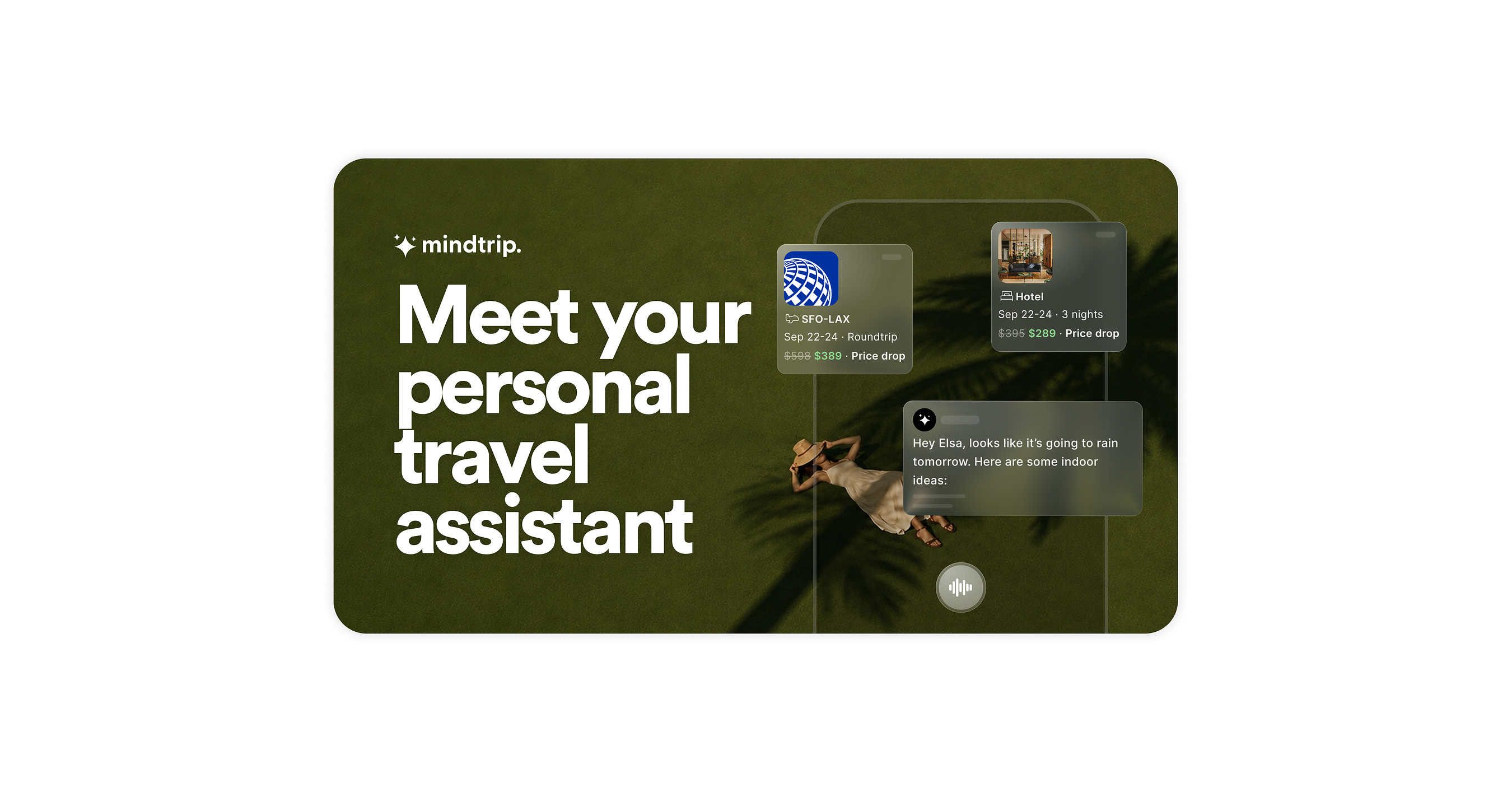
Mindtrip launched its Personal Travel Assistant, an agentic AI product that retains traveler preferences across trips and can monitor fares, hotel prices, destinations, and local activities. In beta, more than 18,000 travelers created an assistant, and users who did so were 3x more likely to create a trip over the past two weeks. The launch strengthens Mindtrip's personalized travel-planning, booking, and in-trip assistance proposition, though the announcement provides no revenue or broader market-impact metrics.
Analysis
This is strategically more relevant to online travel agencies than to public travel suppliers. Persistent preference data can reduce search friction and push booking share toward the interface that owns the traveler relationship, creating a potential long-term disintermediation risk for EXPE, BKNG and ABNB if AI-native products achieve meaningful repeat usage. The near-term economic impact is unproven: beta engagement is not evidence of paid booking conversion, customer-acquisition efficiency, take-rate, or supplier-funded revenue.
The key second-order issue is margin pressure in travel distribution. An assistant credibly optimizing across providers weakens opaque ranking economics, sponsored placement value and loyalty lock-in, while airlines and hotels may respond by restricting inventory/data access or offering direct-only perks. Conversely, incumbents have proprietary transaction histories, loyalty audiences and supplier integrations that a startup must replicate; this makes the likely initial outcome feature competition rather than rapid share loss.
No immediate trade is warranted from a private-company product release. Over the next 1-3 months, monitor whether BKNG, EXPE and ABNB disclose AI-driven conversion gains, lower service costs, or rising marketing spend to defend traffic; these are the investable read-throughs. Over 6-18 months, the differentiator will be whether agent-led booking shifts paid-search dependence and repeat-booking rates, not the quality of itinerary generation.
AllMind Terminal
AI-powered research, real-time alerts, and portfolio analytics for institutional investors.
Request TrialMarket Sentiment
Overall Sentiment
moderately positive
Sentiment Score
0.42
Key Decisions for Investors
- No position on this announcement alone; treat it as a watch signal rather than a catalyst given the absence of independently verified booking, retention, revenue, or unit-economics data.
- Monitor BKNG and EXPE quarterly for declining direct traffic, higher sales-and-marketing expense as a percent of gross bookings, or weaker repeat-booking commentary. Any two of these signals would support a 3-6 month underweight of EXPE versus BKNG, as EXPE has historically had greater dependence on marketing-led demand generation.
- Maintain a 6-18 month preference for BKNG over EXPE only if BKNG demonstrates that its loyalty/member ecosystem and supplier connectivity preserve conversion while AI search fragments top-of-funnel discovery. Falsify the relative thesis if EXPE materially closes booking-margin or direct-traffic gaps for two consecutive quarters.
- Watch GOOGL travel-query monetization and AI-search product changes: reduced referral traffic to OTAs would be a broader distribution-risk catalyst, but supplier booking data and OTA paid-search trends are required before initiating an OTA short.
More News
- South Korea’s exports hit record high on AI boom
- In photos: China's Xi hardens Taiwan warning as country celebrates week-long National Day holiday
- Asian stocks dip, bonds in focus after torrid September
- RAM supply set to worsen, says Micron, as CEO celebrates ‘much higher’ prices
- Tencent leases 100,000 chips from Oracle for $7 bln- FT
- Asia stocks rise on chipmaker gains, soft U.S. inflation; Nikkei outperforms