
Vertiv Announces Agreement to Acquire UtilityInnovation Group to Accelerate Time to Power for AI Data Centers
Source: PR Newswire
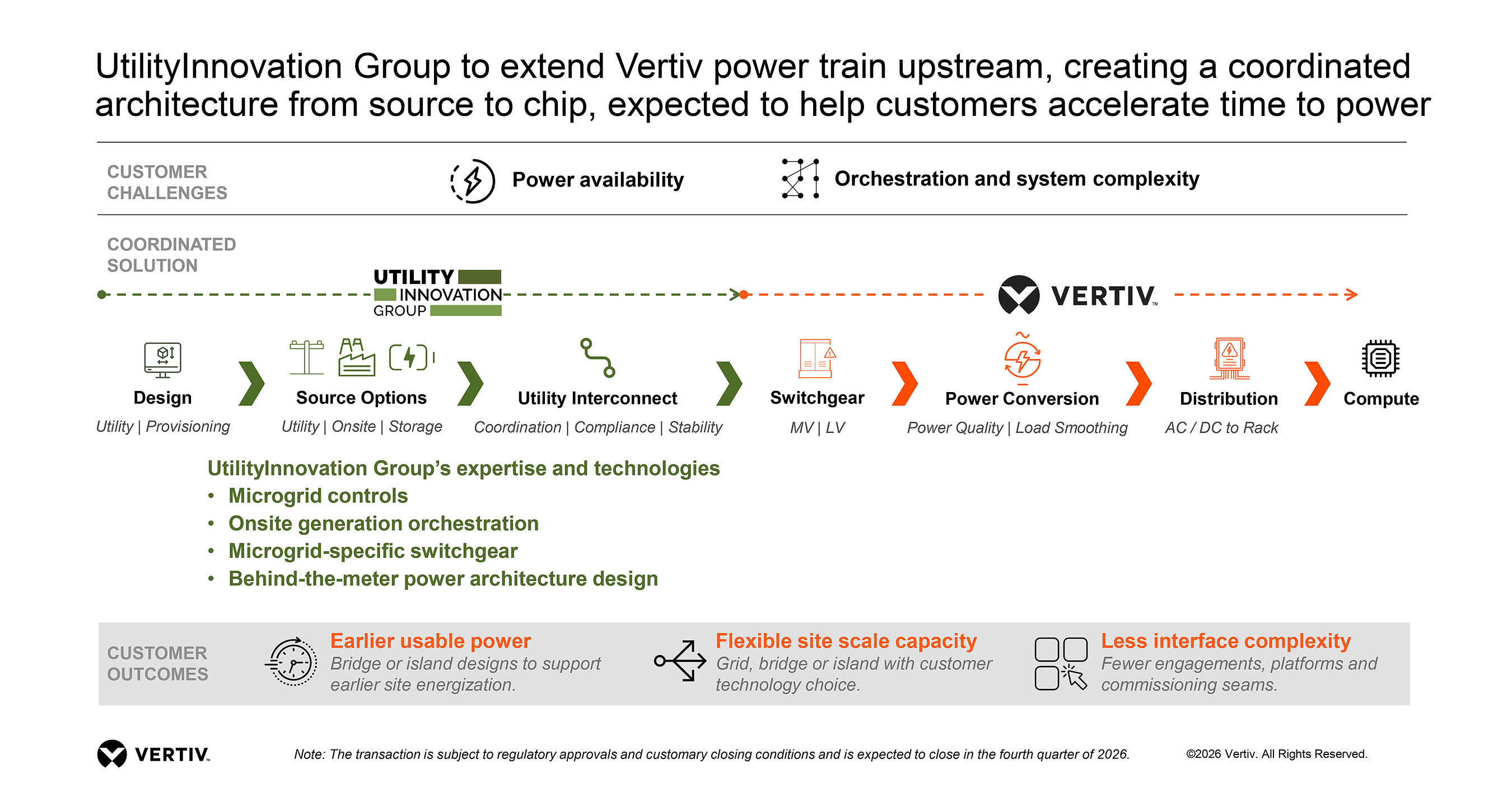
Vertiv (VRT) agreed to acquire Utility Innovation Group (UIG) for ~ $1.45B in cash at closing, plus an earnout up to an additional $1.15B tied to 12- and 24-month EBITDA targets, implying ~13x expected 2027 EBITDA (with a lower effective multiple if the full earnout is paid). The deal is expected to be accretive to adjusted EPS in the first year post-close, and expands Vertiv’s power capabilities upstream from grid interconnect to behind-the-meter microgrid controls and onsite generation orchestration. Management frames the move as a response to tightening power constraints limiting AI data center deployment, with expected benefits including faster time to power and scalability beyond utility interconnection timelines.
Analysis
This is less an earnings-event M&A and more a bid for control of the bottleneck. If VRT can own the architecture decision before the utility queue, it moves from selling equipment into capturing the design standard, which should improve mix, raise switching costs, and pull more services/controls revenue forward. The strategic prize is bigger than the announced revenue base: it creates a wedge into site-planning budgets that competitors typically only see after power is already allocated.
The first-order losers are point-solution microgrid vendors and, secondarily, utilities that want to remain the gatekeeper to incremental load. A more subtle loser is any vendor selling only at the rack or generator layer, because the procurement decision is moving upstream; once VRT is the single throat to choke, downstream pricing power shifts toward the platform owner. That said, the market may initially focus on cash outlay and earnout dilution rather than TAM expansion, so near-term multiple reaction can be noisy.
The real catalyst path is over 1-3 months: does management use this to reframe backlog quality and time-to-power conversion, or does it read like another expensive tuck-in? Over 6-18 months, the thesis is that power-constrained AI buildouts force more behind-the-meter spending, which structurally supports VRT’s growth algorithm. Falsifiers are straightforward: weaker-than-expected integration, earnout that implies overpayment, or any sign that interconnect timelines improve enough to reduce demand for onsite power workarounds.
AllMind Terminal
AI-powered research, real-time alerts, and portfolio analytics for institutional investors.
Request TrialMarket Sentiment
Overall Sentiment
mildly positive
Sentiment Score
0.35
Ticker Sentiment
Key Decisions for Investors
- Go long VRT on any post-announcement weakness; treat this as a 1-3 month relative-strength trade into the Q4 close, with upside if the next call shows cross-sell into earlier-stage site design.
- Use a small VRT / XLU pair if you want to express the disintermediation theme: long VRT, short utilities as a basket. This only works if behind-the-meter architecture continues to substitute for utility-led load growth; cover if utility interconnect timelines shorten materially.
- Do not chase MS on the headline. The advisory fee read-through is immaterial versus the sector-wide thesis, so this is not a bank-P&L trade.
- Set an alert for the first post-close earnings call: if management does not show margin accretion or a measurable pipeline uplift, assume the deal is a strategic option, not a rerating catalyst.
More News
- CoreWeave Debt Stress; JB Hunt Falls on Rising Costs | Stock Movers
- Stocks making the biggest moves midday: CoreWeave, Moog, J.B. Hunt, Alcoa & more
- Here are Friday's biggest analyst calls: Nvidia, SpaceX, Tesla, Apple, Mobileye, EchoStar, Toll Brothers & more
- Morgan Stanley: Strong Earnings And More Growth Ahead At An Attractive Valuation
- Trump waives broad new Russia sanctions and tariffs under Graham Act, citing national interest
- ECB's Lagarde says bond selloff will slow inflation