
Huawei dévoile sa nouvelle architecture informatique UnifiedBus pour les SuperPoD et les grappes de serveurs
Source: PR Newswire
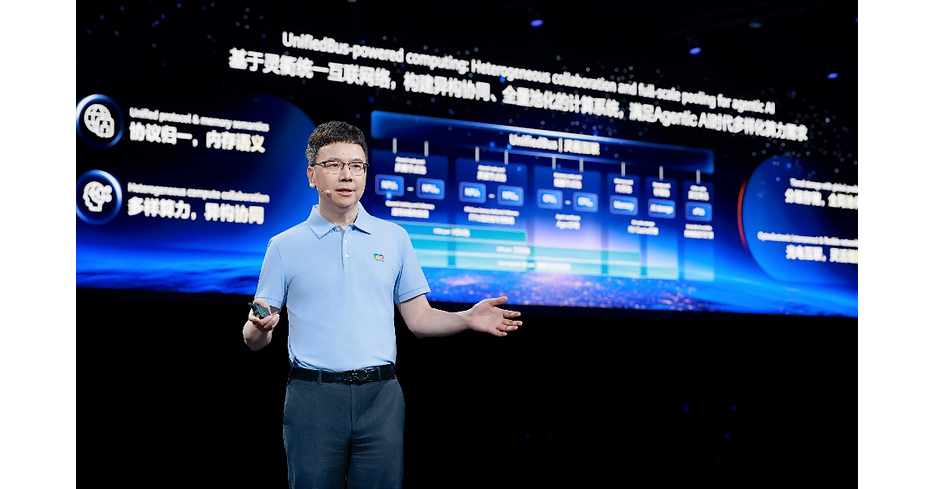
Huawei unveiled its UnifiedBus interconnect architecture and related hardware for AI SuperPoD and server clusters, targeting scalability from single cabinets to clusters of 1 million neural-processing units. The company says UnifiedBus lifts interconnect bandwidth from 100GB/s to multiple TB/s and cuts round-trip latency from 7 microseconds to as low as 2 microseconds. Its LinkDevice supports 176 1.6Tbps ports for 280Tbps all-optical interconnection, while the new TaiShan 950 and Atlas 960-based agentic AI supercluster targets models with tens of trillions of parameters.
Analysis
The investable implication is less about Huawei hardware revenue than a potential reduction in China’s dependence on the Nvidia/CUDA–InfiniBand stack. If the architecture delivers materially better accelerator utilization, Chinese cloud and sovereign-AI buyers can accept an inferior per-chip performance profile because effective cost per trained token falls. That is strategically negative for NVDA’s China optionality and for AVGO/ANET’s high-end AI-fabric attach rates, although export restrictions already make the direct near-term revenue exposure limited.
The more immediate beneficiaries are domestic Chinese component and systems vendors with exposure to optical interconnects, switching, server assembly and memory pooling: the architecture shifts value from standalone accelerators toward rack-scale integration. Conversely, a proprietary interconnect risks recreating the software-friction problem that constrained prior non-CUDA alternatives; claimed performance should not be capitalized until independent measurements show model throughput, fault-domain recovery and power efficiency under production workloads. The key commercial proof point over the next 1-3 months is named external deployments and repeat orders rather than Huawei’s internal specifications.
Consensus may underappreciate the second-order effect on HBM demand. Greater use of pooled conventional memory can lower HBM capacity per accelerator for certain inference and retrieval workloads, pressuring the most aggressive HBM-content assumptions embedded in SK Hynix and Micron estimates if replicated broadly. But training remains bandwidth-sensitive, so this is a workload-mix risk over 6-18 months, not an imminent demand collapse; it may instead expand total deployed accelerators by lowering system cost.
The cleanest expression is a China-AI substitution basket rather than a directional short in US AI leaders. Export-control tightening, weak open-source tooling compatibility, or inability to source advanced optics/memory would quickly invalidate the localization thesis and preserve the incumbent ecosystem moat.
AllMind Terminal
AI-powered research, real-time alerts, and portfolio analytics for institutional investors.
Request TrialMarket Sentiment
Overall Sentiment
strongly positive
Sentiment Score
0.58
Key Decisions for Investors
- Do not initiate a standalone trade on the announcement; set a 90-day alert for independently audited throughput-per-watt, named third-party SuperPoD customers, and evidence of software portability from CUDA-based workflows. Absence of external deployments by the next Huawei product cycle is thesis-negative.
- For a 6-12 month relative-value position, consider long a liquid China AI-infrastructure basket (KWEB or CQQQ as imperfect proxies, supplemented by investable domestic optical/networking names subject to liquidity review) versus short SMH in equal beta-adjusted notional. Target 10-15% relative outperformance; stop if US export rules are eased materially or Chinese procurement data fail to accelerate.
- Maintain, rather than add to, NVDA and AVGO shorts solely on this development: their ex-China hyperscaler demand and software ecosystems remain the dominant earnings drivers. Reassess only if management commentary shows China-related mix erosion or Chinese alternatives win export-control-compliant markets outside China.
- Watch MU and SK Hynix quarterly guidance for HBM bits per accelerator and inference-memory mix. A disclosed shift toward DDR/CXL-style pooling at major cloud customers would support trimming HBM-premium exposure; unchanged HBM content would falsify the memory-substitution concern.
More News
- All Iranian airlines to be 'shut down' from Wednesday, Bessent tells CNBC
- Taiwan benchmark Taiex rises to record intraday high as tech stocks advance
- AMD joins the $1 trillion club as chip rally surges - our AI Strategy saw it early
- Jamie Dimon says hyperscaler AI spending could hit $1 trillion next year
- Factbox-Key issues for this week’s Trump-Xi summit in Washington
- Here's who we know is going to the Trump-Xi dinner so far