
IEEE Study Explores New Photonics Breakthrough: Topology Imprinting in Nonlinear Metasurfaces
Source: PR Newswire
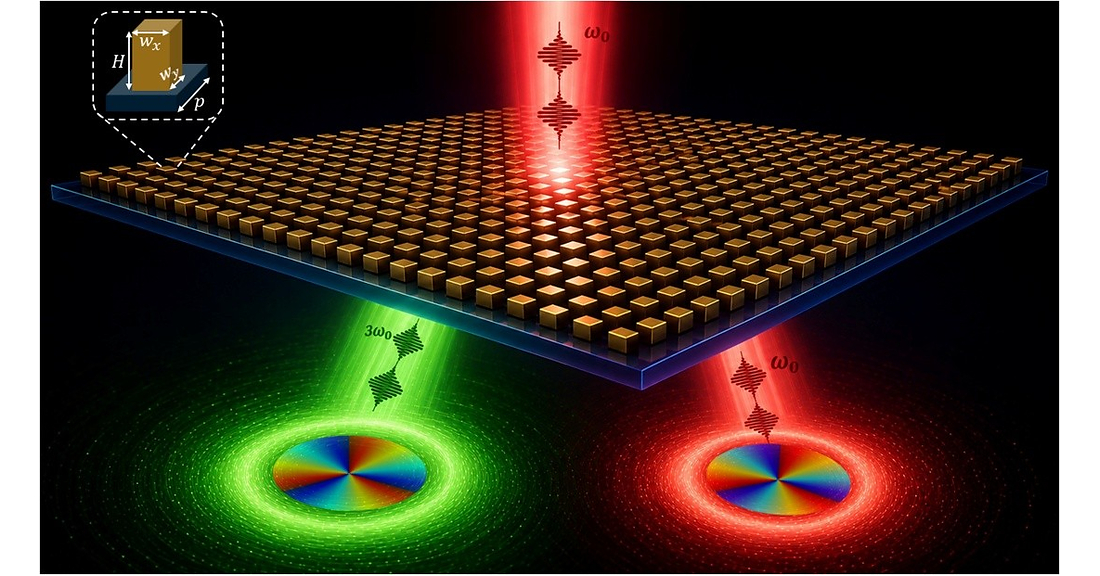
An IEEE Photonics Journal review highlights topology imprinting in nonlinear metasurfaces, a technique that transfers an optical field's spatial topology to harmonic radiation and could simplify generation of structured light at new wavelengths. Experimental all-dielectric metasurfaces preserved complex fields, including orbital-angular-momentum vortex beams, with potential applications in holography, optical communications, quantum photonics and imaging. The technology remains early-stage, with nonlinear-material efficiency, absorption, tunability and fabrication challenges still to be addressed; machine-learning-assisted design is identified as a future development path.
Analysis
There is no near-term public-equity read-through: this is a review of an early-stage research direction rather than evidence of manufacturable devices, customer adoption, unit economics, or defensible IP ownership. The likely bottleneck is not optical functionality but repeatable wafer-scale fabrication, nonlinear conversion efficiency, thermal stability, packaging, and integration with lasers/detectors; those constraints favor established silicon-photonics and compound-semiconductor ecosystems over standalone metasurface concepts.
If topology-preserving wavelength conversion becomes commercially viable, the first economic value would accrue in specialized sensing, machine vision, optical interconnects, and quantum-optics subsystems—not broad communications hardware. Potential second-order beneficiaries include Coherent (COHR), Lumentum (LITE), and IPG Photonics (IPGP) through higher-value laser/source content, while semiconductor-foundry and design-tool exposure could emerge through GlobalFoundries (GFS), Tower Semiconductor (TSEM), Cadence (CDNS), and Synopsys (SNPS). However, these companies have negligible earnings sensitivity until prototypes convert into qualified design wins.
Consensus risk is to extrapolate laboratory demonstrations into an AI-data-center photonics narrative prematurely. Datacenter buyers prioritize loss, reliability, power, yield, and total cost of ownership; improved beam topology alone does not solve the optical-I/O bottleneck. A credible rerating catalyst over the next 6-18 months would require independently replicated conversion-efficiency data, compatibility with CMOS-scale processes, and disclosed commercial partnerships or funded pilot production rather than further academic publications.
AllMind Terminal
AI-powered research, real-time alerts, and portfolio analytics for institutional investors.
Request TrialMarket Sentiment
Overall Sentiment
mildly positive
Sentiment Score
0.30
Key Decisions for Investors
- No standalone trade on this item; treat it as a technology watchlist signal rather than an earnings catalyst over the next 1-3 months.
- Monitor COHR and LITE for disclosed nonlinear-photonics or advanced-imaging design wins over the next 6-18 months; only consider longs after a customer-funded program or production qualification establishes revenue visibility.
- For broader photonics exposure, prefer a basket long of COHR/LITE versus a short of a high-multiple, pre-revenue optical-component name only if valuation dispersion widens on speculative metasurface headlines; size small because commercialization timing is highly uncertain.
- Set a diligence trigger for reported device-level conversion efficiency, wafer-scale yield, and operating lifetime. Absent material improvement in all three, assume academic progress has no investable impact; a major customer pilot or foundry PDK inclusion would falsify that restraint.
More News
- China's AI leaders keep quiet despite U.S. 'publicity' on tech risks
- Karin Rådström is steering Daimler Truck in a new direction as the world’s biggest truckmaker faces a growing challenge from China
- U.S. stock futures drift higher with Fed rate hike in focus
- AWS says it can't restore service to Bahrain, UAE facilities 6 months after Iran strikes
- Treasury yields are hovering above a critical threshold. Here's what it means for stocks
- Factbox-How AI leaders and world governments react to ’AI doom’ fears
From AllMind Research
- Anthropic IPO Preview: Valuation, Timing, and What to Watch
- Shein After the IPO: Venue, Valuation, and What Must Be Proved
- What AI Research Tools Should a Small Hedge Fund Buy First?
- AI Vendor Landscape for Institutional Investment Teams
- AllMind Fixed Income Compass for October 2025: Navigating Policy Divergence and Political Risk