
EyeROV : une start-up indienne spécialisée dans les technologies de pointe présente ses drones sous-marins aux dirigeants mondiaux
Source: PR Newswire
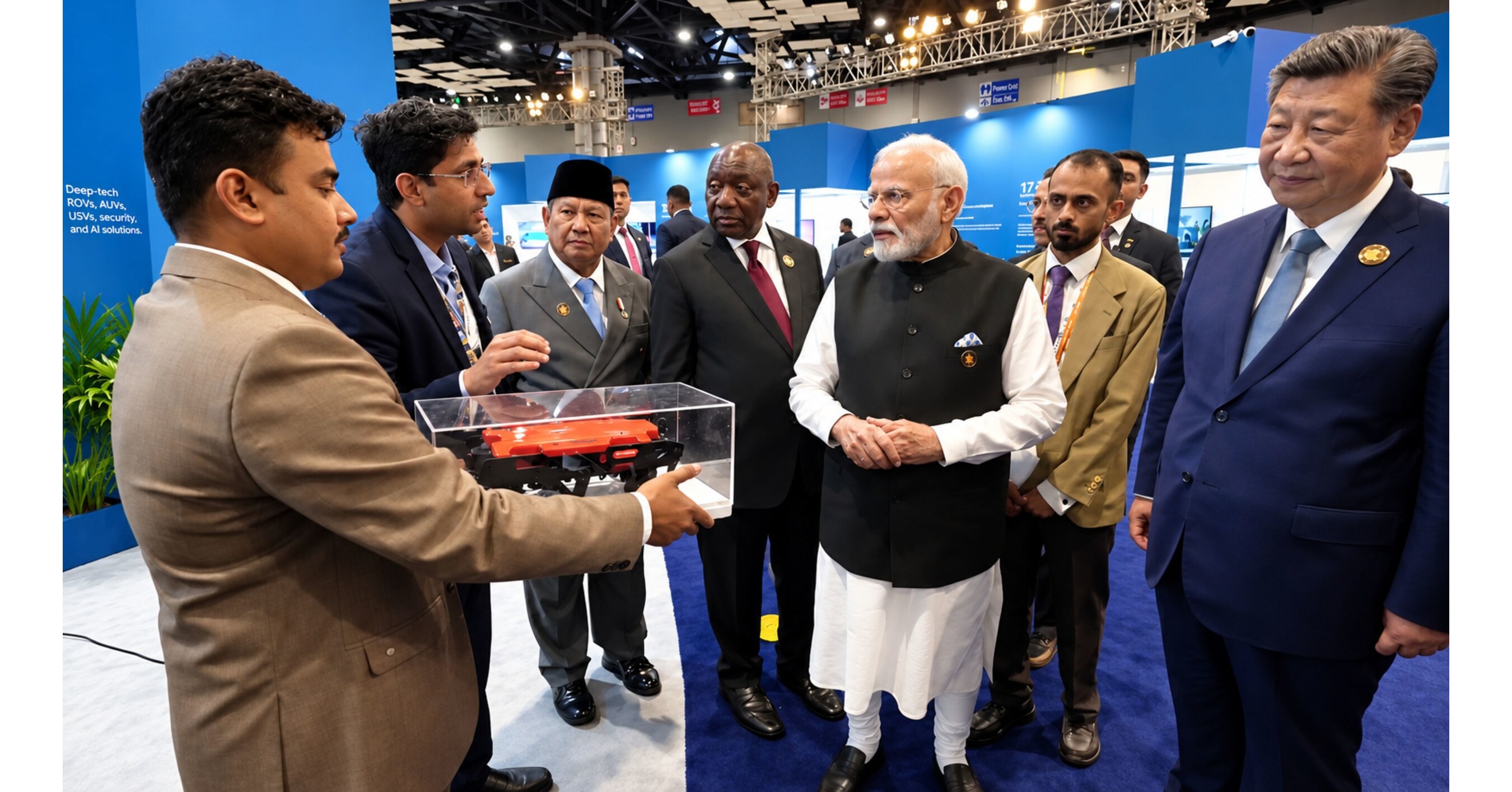
Indian marine-robotics startup EyeROV showcased its remotely operated underwater vehicle technology to BRICS leaders, including Narendra Modi, Vladimir Putin and Xi Jinping, at the Bharat Innovates exhibition in New Delhi. The company develops ROVs, autonomous underwater vehicles, unmanned surface vehicles and AI-based data-analysis tools for infrastructure inspection, defense, maritime security, energy and marine research. The visibility supports EyeROV's international expansion ambitions, but the release disclosed no contracts, funding, revenue or financial metrics.
Analysis
This is not a monetizable company-specific signal: a private-company demonstration provides no evidence of orders, qualification status, unit economics, or export approvals. The relevant listed exposure is Indian maritime indigenization, where Cochin Shipyard (COCHINSHIP), Mazagon Dock (MAZDOCK) and Bharat Electronics (BEL) could benefit if underwater inspection, harbor-security and autonomous-systems procurement moves from prototypes into fleet programs. The larger value pool is likely systems integration, command-and-control software, naval platforms and lifecycle service rather than the vehicle hardware itself.
Near term, the announcement is unlikely to alter estimates for any public proxy. Over 1-3 months, watch Indian Ministry of Defence and port/energy tender databases for named ROV/AUV, unmanned surface vessel, underwater-domain-awareness, or offshore inspection awards; a funded program with local-content requirements would be a tradable catalyst for BEL and shipyard primes. Over 6-18 months, domestic suppliers could take share from imported inspection equipment, but execution risk is high because subsea sensors, communications, battery endurance and reliability qualification remain the binding constraints.
The consensus risk is treating high-level political visibility as an order signal. Procurement cycles are long, defense exports face clearance and financing friction, and private technology vendors can be bypassed by incumbent integrators or state-linked laboratories. A more constructive thesis requires evidence that a listed prime has disclosed an addressable contract, backlog addition, or recurring maintenance/service economics—not merely an innovation showcase.
AllMind Terminal
AI-powered research, real-time alerts, and portfolio analytics for institutional investors.
Request TrialMarket Sentiment
Overall Sentiment
mildly positive
Sentiment Score
0.35
Key Decisions for Investors
- No immediate directional position on this item; classify as a procurement-monitoring event rather than a catalyst.
- Set a 90-day alert for Indian defence, port-authority and offshore-energy tenders above INR 500m involving ROV/AUV/USV or underwater surveillance. Consider a tactical long BEL only after a disclosed award or order-book increment; invalidate if no contract conversion emerges within two tender cycles.
- Maintain COCHINSHIP and MAZDOCK on watch as higher-beta maritime-indigenization proxies, but do not chase political-event strength: enter only on a contract-backed backlog catalyst or a 10-15% pullback with unchanged order-book guidance.
- For global relative value, monitor Kongsberg Gruppen (KOG.OL) and Teledyne Technologies (TDY) for any evidence of Indian localization pressure. A sustained shift toward mandated local sourcing would be a modest medium-term headwind to imported subsea-equipment share, not yet sufficient for a short.
More News
- AI’s Grip on Financial Markets Was Never Clearer on the Way Down
- Tech stock rout, driven by US AI fears, continues in Asian trading
- Asian Markets Tally Losses From Worsening Global Rout
- Magnificent 7 loses $1 trillion. The most eye-popping stats from Thursday's tech stock plunge
- Wall Street’s best post-midterm rally in 44 years lasted just one day—then $3 trillion vanished as chip stocks plunged over AI fears
- How Wall Street's postelection rally got obliterated — and what's next