
Bitmine Immersion Technologies (BMNR) annuncia che le partecipazioni in ETH hanno raggiunto 5,98 milioni di token e che il valore complessivo delle disponibilità in criptovalute e liquidità ammonta a 17,1 miliardi di dollari
Source: PR Newswire
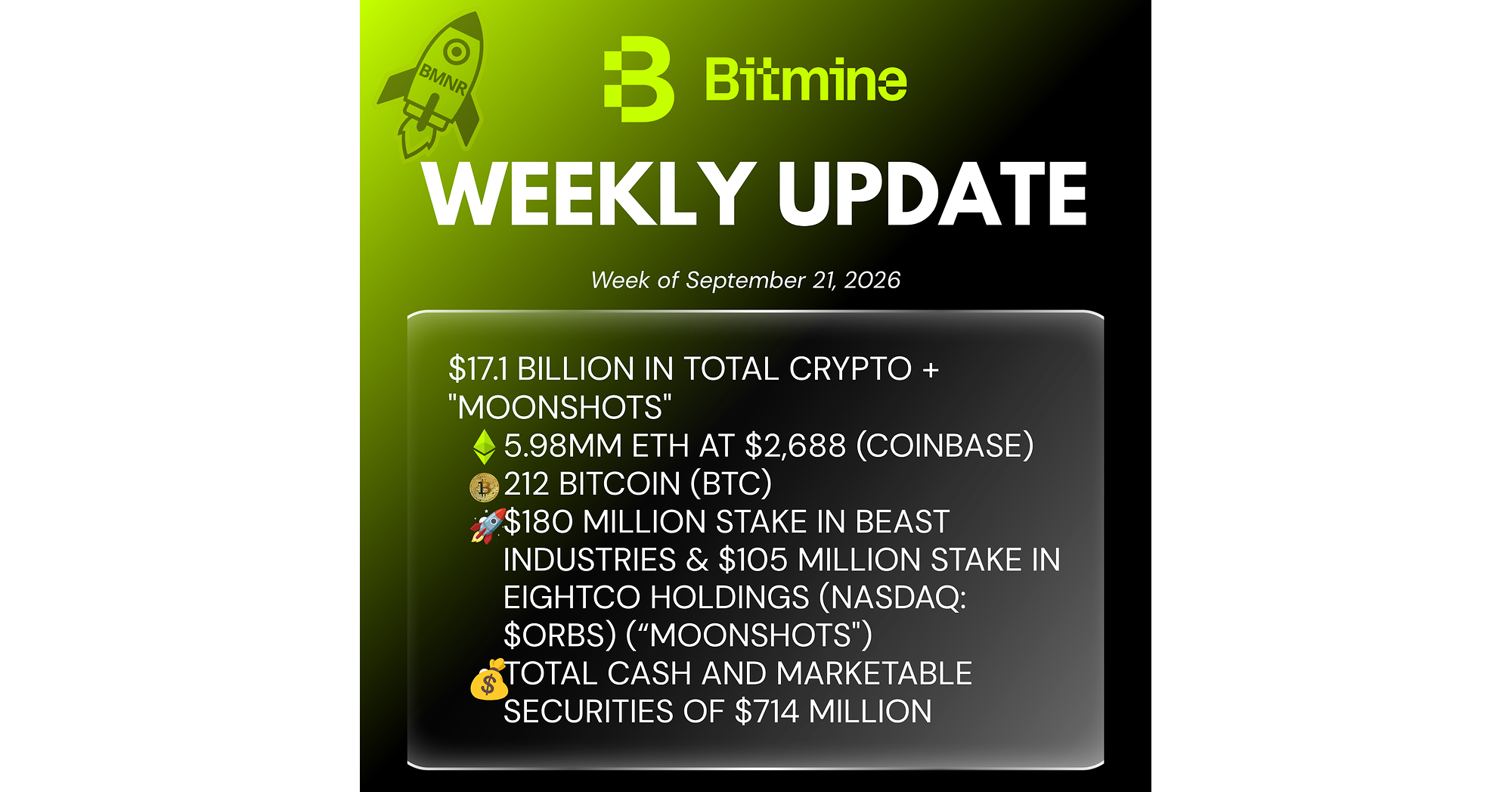
Bitmine reported $17.1 billion of crypto, cash, marketable securities and moonshot investments, including 5.98 million ETH—4.9% of Ethereum's 122.1 million-token supply—after buying 27,562 ETH during the past week. The company has staked 5.07 million ETH, or 85% of its ETH holdings, valued at $13.6 billion, and estimates current annualized staking revenue of $357 million, rising to $421 million if all ETH is staked. Management expects continued crypto strength after ETH outperformed the S&P 500 by 6,519bps in Q3 2026 to date, though the outlook remains highly dependent on ETH prices, staking yields and regulatory developments.
Analysis
BMNR is increasingly a leveraged, yield-bearing ETH closed-end vehicle rather than an operating-company valuation. The key variable is its premium/discount to marked net asset value: a persistent premium enables accretive equity issuance and further ETH purchases, while a discount shuts off the acquisition flywheel and makes the fixed operating cost, preferred dividend burden, and illiquid “moonshot” marks more visible. The staking yield is economically modest relative to NAV volatility: a 20% ETH drawdown would erase multiple years of projected staking income, while any validator/slashing event would damage the institutional-infrastructure narrative disproportionately.
The non-obvious market effect is Ethereum supply concentration. A large holder staking most of its inventory reduces immediately tradeable float, potentially amplifying upside during ETF/institutional inflows; conversely, it creates a concentrated source of forced or discretionary supply if BMNR must defend liquidity, redeem preferred capital, or sees its equity discount widen. This is supportive for ETH beta and selectively for COIN/GLXY volumes in a risk-on phase, but less clearly positive for MSTR: investors seeking listed crypto-treasury exposure can rotate from BTC proxy exposure into a higher-beta ETH proxy, compressing MSTR’s relative premium.
Near term, the conference appearance is primarily a retail-flow/liquidity catalyst, not a fundamental catalyst. Over 1-3 months, the investable question is whether reported NAV is independently reconciled and whether share issuance remains accretive after accounting for preferred claims and non-crypto investments. The bullish consensus likely overweights the mechanical scarcity narrative and underweights reflexivity: ETH gains expand BMNR’s equity-raising capacity, but the same mechanism reverses sharply if ETH weakens or BMNR trades below NAV.
A structural 6-18 month bull case requires MAVAN to win third-party assets, converting staking from internal treasury yield into recurring fee revenue. Without disclosed external assets under management, fee take rate, validator uptime, and customer concentration, MAVAN should not receive a meaningful standalone infrastructure multiple. ORBS exposure is venture-style optionality rather than clean AI exposure and should be haircut heavily in NAV work.
AllMind Terminal
AI-powered research, real-time alerts, and portfolio analytics for institutional investors.
Request TrialMarket Sentiment
Overall Sentiment
moderately positive
Sentiment Score
0.67
Ticker Sentiment
Key Decisions for Investors
- Do not chase BMNR on the release; establish a NAV monitor using independently sourced ETH prices, fully diluted shares, preferred liquidation preference/dividends, and conservative haircuts to private/“moonshot” holdings. Go long BMNR only if it trades at or below conservative NAV while ETH momentum remains positive; avoid if premium exceeds 25-30% without evidence of accretive issuance.
- For 1-3 month directional crypto exposure, prefer long ETH or a liquid ETH proxy over BMNR unless BMNR’s NAV discount is verified. BMNR adds equity-financing, governance, staking, and mark-to-model risk that is not compensated at a large premium.
- Consider a tactical long BMNR / short MSTR pair only after calculating beta-adjusted hedge ratios and only if BMNR trades near NAV while MSTR maintains a material premium; thesis is ETH-proxy substitution. Exit if BMNR premium expands above 30%, ETH/BTC reverses materially, or MSTR’s premium normalizes first.
- Treat ORBS as a watch item rather than an AI trade. Require audited evidence of the economic linkage to OpenAI and updated fair-value disclosures before assigning more than a distressed venture-value haircut; ORBS liquidity and valuation risk can contaminate BMNR’s reported NAV.
- Thesis falsifiers: a sustained ETH decline of 20%+, BMNR equity trading at a persistent NAV discount that prevents capital raises, staking yield materially below the indicated run-rate for two reporting periods, or disclosure of validator downtime/slashing or significant related-party/custody concentration.
More News
- U.S. regulators rush to write crypto rulebook after Clarity Act stalls in Senate
- Bitcoin steady near $87k as ETF inflows soar; Trump-Xi summit in focus
- Microsoft and Coinbase probe leads to arrest of crooks behind ‘EvilTokens’, a DIY phishing network powered by AI
- ‘We believe in college’: inside Andreessen Horowitz’s $42m unaccredited academy that will charge Harvard prices without degrees
- UK Cops arrest 2 EvilTokens suspects, Microsoft seizes 50 phishing kit websites
- Quantum computing stocks vs. crypto stocks: a value comparison
From AllMind Research
- Anthropic IPO Preview: Valuation, Timing, and What to Watch
- Shein After the IPO: Venue, Valuation, and What Must Be Proved
- What AI Research Tools Should a Small Hedge Fund Buy First?
- What a Concept From Nature Tells Us About How C-Suite Executives Actually Think About AI
- How to Track Earnings Call Sentiment Across Companies