
MoleculeMind's New MMDesign Technical Report Demonstrates 94.7% Campaign Success Rate Across Diverse Molecular Targets and Modalities
Source: PR Newswire
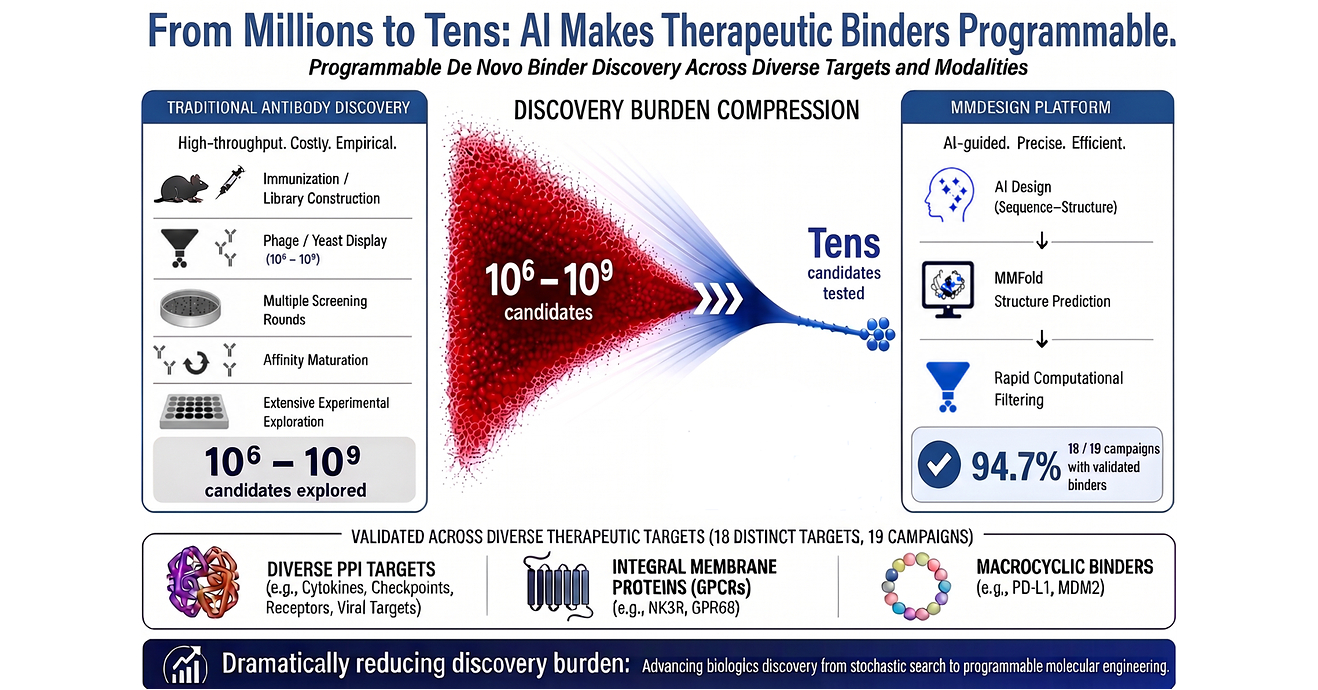
MoleculeMind reported that MMDesign produced confirmed binders in 18 of 19 campaigns across 18 targets, with a 94.7% campaign success rate and 139 binders from 453 tested candidates (30.7% candidate hit rate). The platform found binders for all six tested GPCR targets; for NK3R, all 30 candidates tested bound, while PDGFR’s hit rate rose from 4.0% to 21.1% and its best measured KD improved from 150 to 37 nanomolar in a subsequent round. The company also reported positive macrocyclic-peptide results and stronger benchmark scores for its MMFold model than AlphaFold 3 in the cited comparison; these are company-reported research findings, not evidence of clinical efficacy.
Analysis
Analysis
The investable signal is narrower than the platform narrative: computational candidate selection may reduce early discovery screening burden, but binding in an assay is several gates away from a drug. The value-capture bottleneck likely migrates toward target biology, functional activity, developability, and in-vivo validation—not disappears. That favors organizations with differentiated assays and translational capabilities as potential collaborators, even as it pressures discovery models whose economics depend on large-scale library screening. Net impact on CRO demand is ambiguous: fewer initial candidates could be offset by more design cycles and downstream validation.
Treat the reported results as company-generated technical evidence, not yet evidence of lower cost per validated lead, licensing revenue, or clinical success. Campaign-level hit rates also do not establish performance on a new target chosen independently of the company. The macrocyclic-peptide examples appear earlier-stage than the binding results alone may imply.
Timing / contrarian view: Near term, this is not a standalone public-equity catalyst; no company identities or tickers are supplied, and MoleculeMind’s commercial terms and independent replication are not disclosed. Over 1–3 months, partnership announcements and external replication matter more than another benchmark. Over 6–18 months, the test is whether designed molecules advance through functional and developability gates into funded programs. Consensus may over-credit model accuracy and underweight target selection, assay design, and downstream attrition. Conversely, dismissing the result as only a press release misses the possibility that repeated design-build-test cycles expand the number of economically viable early programs.
AllMind Terminal
AI-powered research, real-time alerts, and portfolio analytics for institutional investors.
Request TrialMarket Sentiment
Overall Sentiment
moderately positive
Sentiment Score
0.55
Key Decisions for Investors
- No immediate directional trade: the report does not establish a listed-company earnings impact or a measurable displacement of conventional discovery spend. Avoid treating the headline campaign success rate as clinical or commercial validation.
- Put AI-enabled biologics discovery and discovery-service providers on a watchlist; reassess only with independently replicated results, disclosed partner economics, or evidence of lower cost and cycle time per functionally validated lead. Do not assume CRO demand falls—track whether design iteration increases downstream assay volumes.
- For a 1–3 month catalyst check, verify whether third parties reproduce results on prospectively selected targets and whether partners fund programs beyond binder discovery. A lack of such evidence, or no disclosed progression into functional assays, would falsify the near-term commercialization thesis.
- For a 6–18 month structural thesis, monitor lead-to-candidate progression, developability and in-vivo data, and repeat business. Weak progression despite strong binding results would indicate that assay hit rates are not translating into pipeline value; multiple independently funded programs would strengthen the case.
More News
- Binance co-CEO Richard Teng says hackers used fake job interviews, AI tool to steal $6.3 billion in crypto 108511116
- AMD stock jumps 7% on earnings as data center revenue nearly doubles
- Marvell-Lumentum Deal Puts Optical Networking at the Center of the AI Boom
- Marvell Technology could plunge on latest multibillion-dollar acquisition
- Disney Plans Thousands of Layoffs Companywide
- AI Inference Startup Fal Raises Capital at $16 Billion Valuation