
Authenticx Expands Pharmacovigilance AI to Automate Downstream Safety Workflows With Accuracy
Source: PR Newswire
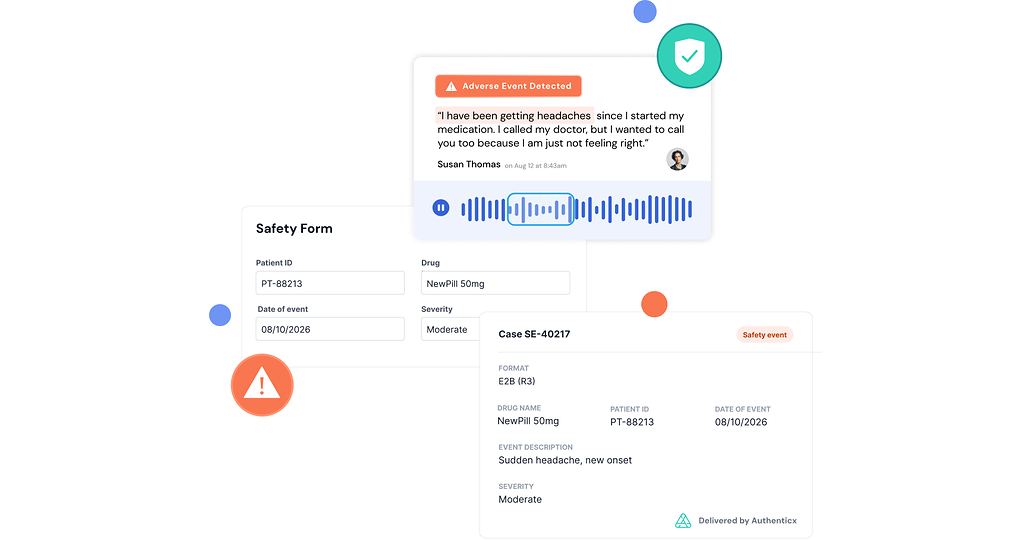
Authentx launched expanded Pharmacovigilance (PV) AI capabilities that pre-populate configurable PV forms from patient-service conversations and route qualified records into manufacturers’ systems of record (e.g., Oracle Argus, Veeva, Salesforce) for human review. The workflow targets regulatory timelines for adverse drug experience review (e.g., serious/unexpected events typically within 15 calendar days) while reducing manual handoffs. In a reported case study across 372,000+ chatbot/voicebot interactions, supervised AI cut manual review work by ~90% and reached 99% accuracy, and the customer has expanded usage of the new capabilities.
Analysis
This is more of a validation event than a true revenue step-change: it confirms that AI can be inserted into a regulated workflow without displacing human accountability. The economic value accrues to the platform that owns the audit trail and downstream workflow, not the conversation-intake layer, so VEEV is the cleanest relative beneficiary while CRM and ORCL are mostly incidental plumbing.
The second-order effect is margin leverage for workflow owners and labor-pressure for outsourced PV operations. If AI can reliably pre-populate cases, the bottleneck shifts from intake to qualification and submission governance, which tends to favor vendors with deep compliance data models and configurable controls. Over 1-3 months, this may support sentiment around healthcare IT AI use cases; over 6-18 months, the real question is whether this becomes an attach feature that expands module penetration or just a point-solution demo.
Contrarian view: the market may overestimate how quickly regulated buyers scale these tools. Adoption is constrained by validation, auditability, and liability, so the monetization path is likely slower than the PR tone suggests. The thesis is falsified if VEEV/CRM/ORCL management does not cite incremental deal wins, module attach, or faster deployment cycles tied to PV automation in upcoming quarters; absent that, this is a sentiment tailwind, not an earnings driver.
AllMind Terminal
AI-powered research, real-time alerts, and portfolio analytics for institutional investors.
Request TrialMarket Sentiment
Overall Sentiment
moderately positive
Sentiment Score
0.35
Ticker Sentiment
Key Decisions for Investors
- Prefer a relative-value long VEEV / short CRM pair over 3-6 months; VEEV has the highest probability of turning regulatory workflow AI into module stickiness, while CRM is mostly a generic endpoint. Risk/reward is modest but asymmetric if VEEV commentary starts reflecting healthcare workflow attach.
- Do not chase ORCL on this headline; treat it as infrastructure validation only. Wait for evidence in healthcare-specific cloud/workflow commentary or a measurable pipeline change before adding exposure.
- If already long VEEV, use any post-news strength to add only on pullbacks into the next earnings window; the catalyst is incremental attach, not immediate EPS upside. Falsify if management explicitly says PV AI is not moving deal size or retention.
- Watch for a read-through to outsourced PV labor vendors and BPO-heavy healthcare services over the next 6-18 months; if AI case intake scales, manual review hours are the vulnerable cost bucket, not the core software spend.
More News
- AI stocks plunge. Inflation heats up. Where we're still finding opportunities
- Apple, Salesforce Lead Five Stocks Near Buy Points
- Mark Zuckerberg’s Second Act?
- Oracle's Real Growth Story Is Hiding in Its $664 Billion Backlog
- Bending Spoons wants to revive software castoffs. Berkshire is backing the plan
- AI rapidly improving, could vastly boost U.S. GDP, Anthropic's Clark tells policymakers