
Global Sulfur Market Set to Reach USD 9.34 Billion by 2034 as Fertilizer Demand, Sulfuric Acid Production and Chemical Processing Strengthen, reports Maximize Market Research
Source: PR Newswire
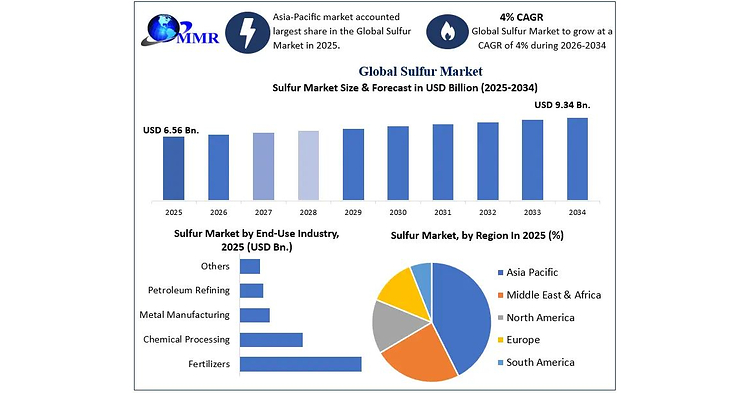
Maximize Market Research forecasts the global sulfur market to grow from $6.56 billion in 2025 to $9.34 billion by 2034, a 4% CAGR, supported primarily by fertilizer and sulfuric-acid demand. More than 55% of recovered sulfur is used in agricultural fertilizers, while 98.5% of elemental sulfur supply is recovered from refining, tying availability to oil, gas and petrochemical activity. Recent capacity additions include 165,000 tonnes per year of sulfuric acid in India, a planned 396,000-tonne expansion, and a 60,000-tonne-per-year sulfur facility in Dubai; Asia-Pacific remains the largest demand region.
Analysis
This is not a sulfur-price signal by itself: the cited long-duration market forecast is low-information for listed equities, and announced downstream capacity is more likely to redistribute regional margins than tighten global feedstock. The investable linkage is phosphate fertilizer economics. For MOS and NTR, sulfuric acid is a material conversion input; a sustained rise in sulfur/acid costs without a matching phosphate price move would compress margins, while integrated producers with captive sulfur or acid capacity gain relative purchasing power.
Near term (days to 1 month), no directional trade is warranted from this release. Monitor Tampa sulfur and sulfuric-acid benchmarks, DAP/MAP prices, China phosphate export policy, and India fertilizer subsidy/tender activity. A widening phosphate-price-versus-sulfuric-acid spread is the required confirmation for a fertilizer long; new Middle East/India processing capacity could instead cap regional acid premia over the next 6-18 months and favor import-dependent fertilizer blenders rather than upstream sulfur sellers.
The non-obvious exposure sits with refiners: recovered sulfur is a byproduct, so higher sulfur realizations are economically immaterial to CVX, XOM, VLO, MPC and SHEL relative to crack spreads, but stricter fuel sulfur specifications or weaker refining throughput can reduce physical sulfur availability even as fertilizer demand holds. That creates episodic acid-cost inflation for phosphate producers, not a durable refinery equity catalyst. Contrarian view: consensus may over-credit fertilizer companies for volume growth while overlooking that sulfur/acid availability can become the binding input during refinery-utilization downturns.
For 6-18 months, favor Yara (YAR) and ICL over MOS/NTR only if sulfuric-acid costs remain contained and crop-nutrient pricing improves: their differentiated nutrient portfolios and geographic diversity should better absorb input volatility. Falsify the relative thesis if DAP/MAP pricing falls while sulfuric acid rises for two consecutive months, or if India/China demand disappoints; in that case MOS and NTR's operating leverage turns negative first.
AllMind Terminal
AI-powered research, real-time alerts, and portfolio analytics for institutional investors.
Request TrialMarket Sentiment
Overall Sentiment
mildly positive
Sentiment Score
0.32
Ticker Sentiment
Key Decisions for Investors
- No immediate trade on the research release; set a 30-90 day alert for phosphate economics: consider long MOS only after DAP/MAP prices rise or hold while sulfuric-acid benchmarks remain flat-to-down for at least one monthly pricing cycle.
- Conditional pair: long YAR (or ICL) / short MOS in equal dollar exposure over 3-6 months if sulfuric acid rises more than phosphate pricing. Target 10-15% relative return; exit if phosphate prices accelerate enough to restore MOS gross-margin guidance.
- Do not buy CVX, XOM, VLO or MPC on sulfur optionality. Treat sulfur realizations as de minimis versus refining and upstream commodity exposures; use refinery utilization and crack spreads, not sulfur pricing, as the gating data.
- Watch China phosphate-export restrictions and Indian fertilizer procurement through the next planting/tender cycle. A tightening event paired with stable sulfur costs would upgrade MOS/NTR to longs; absent that confirmation, fertilizer exposure lacks a near-term catalyst.
More News
- ‘You need to clean up the mess your generation has left’: Volkswagen’s guilty boomer gets real about sustainability, China—and his spam folder
- ‘He sold his anti-communism to communists’: Former GOP Rep. David Rivera gets 10 years in prison for $50 million lobbying ‘from the Maduro regime’
- Morgan Stanley raises Legrand PT, keeps stock as top pick on growth
- Stock Movers: Nike, Seagate, Freeport-McMoRan (Podcast)
- Trump says Iran war could end after U.S. elections as Hormuz tensions persist
- EM Assets Find Relief as US Jobs Data Eases Rate Fears
From AllMind Research
- Anthropic IPO Preview: Valuation, Timing, and What to Watch
- Shein After the IPO: Venue, Valuation, and What Must Be Proved
- What AI Research Tools Should a Small Hedge Fund Buy First?
- The $4.7 Trillion Bet: When Does AI Capex Become AI Revenue?
- Equity Research Automation Statistics: A 2026 Evidence Check