
A Goldman M&A Banker Helped Bring the Olympics to Los Angeles
Source: Bloomberg
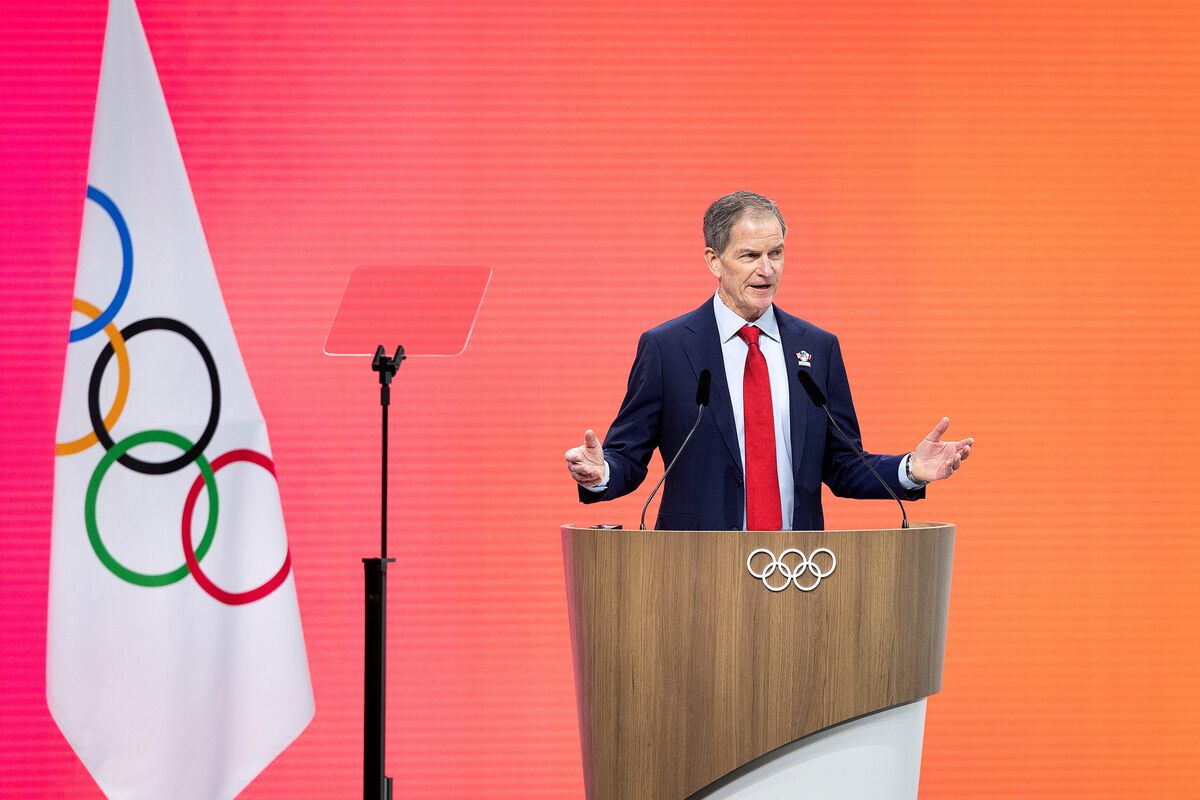
Goldman Sachs reported a record year for large-deal volumes as companies pursue megadeals partly to strengthen their competitive positions in artificial intelligence. The article profiles Goldman M&A co-head Gene Sykes, whose past transactions include Comcast's acquisition of Universal and Disney's Pixar buyout, and notes his role in securing Los Angeles as host of the 2028 Olympics. The discussion also examines Olympic-event financing and parallels between the early-2000s TMT cycle and the current technology environment.
Analysis
GS has meaningful operating leverage to a sustained strategic-M&A recovery, but the investable issue is whether announced deal activity converts into closed-fee revenue rather than remaining a boardroom response to AI disruption. Large-cap technology and media combinations face longer antitrust review, making the near-term benefit more visible in advisory backlog and sentiment than in quarterly revenue. A broad reopening of sponsor financing would be more material for GS than a handful of headline megadeals, because it lifts underwriting, leveraged-finance and alternatives realization activity simultaneously.
The second-order implication for DIS and CMCSA is less about renewed consolidation and more about their relative bargaining power in a capital-constrained media ecosystem. AI-related capex at hyperscalers raises the opportunity cost of funding legacy-content and linear-TV assets; that should pressure standalone media multiples unless a credible strategic buyer emerges. AAPL is the more plausible beneficiary of regulatory-constrained media fragmentation through services distribution and content licensing, rather than as an acquirer of a major studio.
Consensus may be over-extrapolating a cyclical M&A rebound into a durable fee-pool expansion. Deal volumes can rise while industry economics disappoint if competition for mandates compresses advisory fees and regulators extend close timelines; GS shares are already more sensitive to capital-markets expectations than to individual transactions. Over the next 6-18 months, the strongest confirmation would be improving sponsor deal announcements, tighter leveraged-loan spreads and a sustained increase in completed—not announced—transaction value.
AllMind Terminal
AI-powered research, real-time alerts, and portfolio analytics for institutional investors.
Request TrialMarket Sentiment
Overall Sentiment
mildly positive
Sentiment Score
0.20
Ticker Sentiment
Key Decisions for Investors
- Maintain a tactical long GS over the next 1-3 months only if leveraged-loan and high-yield spreads remain contained and management signals conversion of advisory backlog into 2026 fees; target a 10-15% upside versus a 7-8% stop if capital-markets activity weakens or guidance implies delayed closings.
- Prefer a pair of long GS / short KKR for a cyclical M&A and underwriting recovery: GS has more direct fee sensitivity to transaction execution, while KKR is more exposed to valuation marks and slower asset realizations if financing conditions deteriorate. Reassess if private-equity exit volumes accelerate materially.
- Do not position for a DIS or CMCSA takeout premium. Instead, treat any sharp rally on consolidation speculation as an opportunity to reduce exposure unless a buyer, financing source and regulatory pathway are explicit; extended review periods can erode the present value of any nominal premium.
- Set an alert for a sustained widening in high-yield spreads above 450 bps or a material reversal in syndicated-loan issuance; either would challenge the financing backdrop required for the GS thesis and warrant closing tactical long exposure.
More News
- Australia seeks big tech support for internet safety, AI regulation
- Paramount could settle with states over Warner Bros. as soon as this weekend, sources say
- Higher interest rates and AI safety fears put the stock market to the test last week
- Federal Reserve Inflation Outlook Signals a Critical Warning for Investors
- Inside U.S. oil’s return to global wildcatting: ‘It’s like geo-porn’
- A Goldman M&A Banker Helped Bring the Olympics to Los Angeles
From AllMind Research
- Anthropic IPO Preview: Valuation, Timing, and What to Watch
- Shein After the IPO: Venue, Valuation, and What Must Be Proved
- What AI Research Tools Should a Small Hedge Fund Buy First?
- State of M&A and Private Markets, June 2026: A $4.9 Trillion Rebound, Underwritten on Money That Never Got Cheaper
- Run Cost-Controlled Financial Research in AllMind Agent Studio