
Eagle Hill Retention Index Falls to Lowest Level Since 2024 as Employees Grow More Likely to Leave
Source: PR Newswire
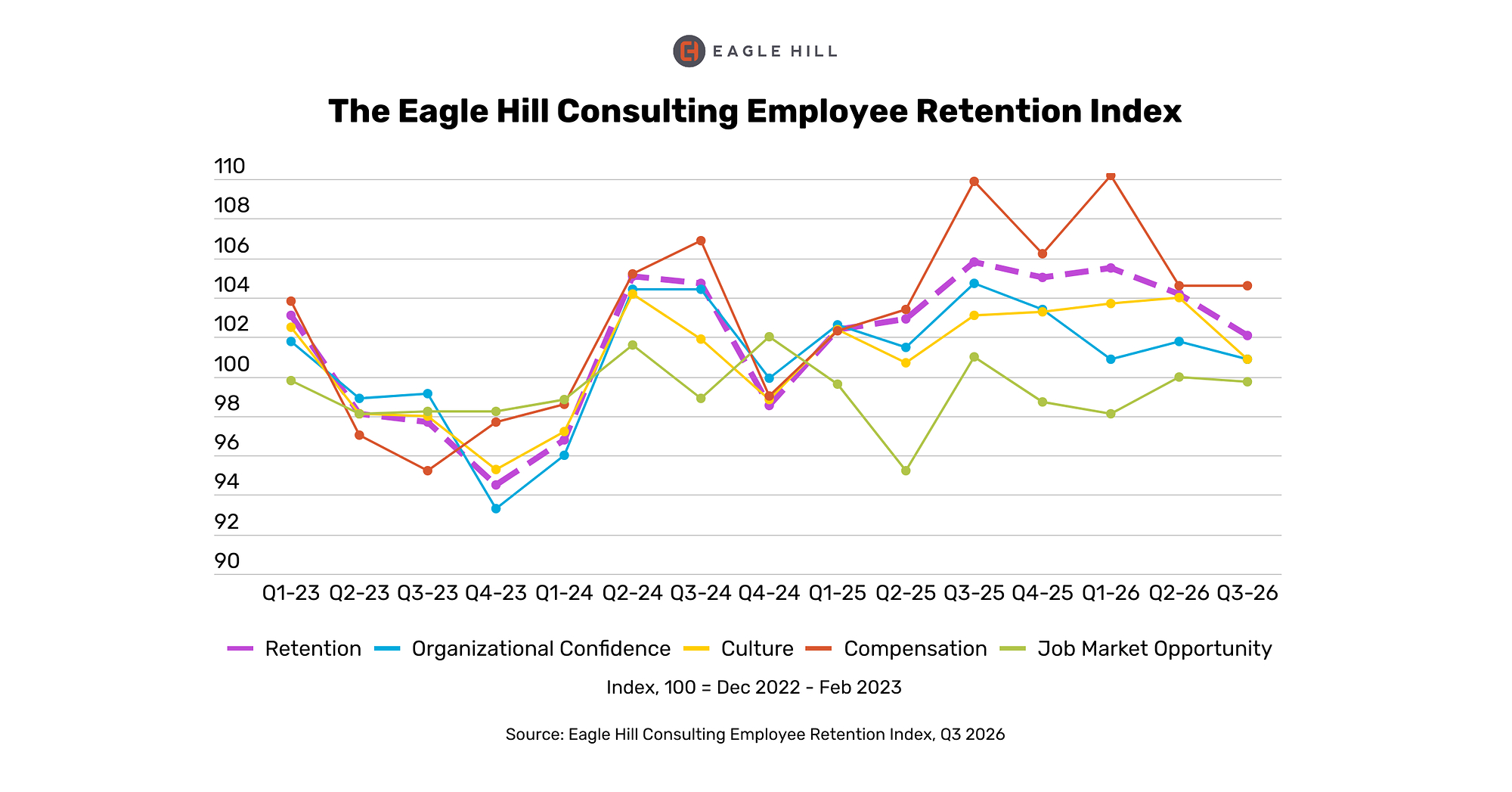
Eagle Hill Consulting's retention data show a record 22.3-point gap between Gen Z's index of 112.8 and Baby Boomers' 90.5; the Baby Boomer index fell 6.3 points and Gen X's fell 5.3 points. Workplace culture sentiment dropped 3.1 points to 100.9, while the overall labor market showed 7.1 million job openings in August and 29,000 jobs added in September, down from a revised 133,000 in August. The findings suggest weakening retention sentiment—especially among experienced workers—even as actual quits remained stable at 1.9%.
Analysis
The market mechanism is less an immediate wage shock than a lagged execution risk. A soft hiring market can suppress quits even as commitment erodes; if hiring later improves, departures may cluster in roles where tacit knowledge, customer relationships, or supervisory continuity are hard to replace. The first financial effects could therefore appear as service slippage, longer vacancy duration, overtime, and manager distraction before showing up in reported labor costs. That makes labor-intensive healthcare, business services, retail, and hospitality operators more exposed where staffing is already operationally critical—but the survey alone does not establish company-level exposure or predict near-term earnings.
For the next 1–3 months, actual quits and payroll data are more actionable than sentiment: weak external options could keep attrition contained, limiting an immediate sector trade. Over 6–18 months, a stronger hiring market could convert latent disengagement into turnover and replacement/training costs. The source is a consulting-firm survey, so treat it as a directional watch signal, not a validated earnings indicator. Contrarian angle: the broad labor-market slowdown may be cushioning employers from the operational consequences of poor retention; that cushion can disappear without a comparable deterioration in headline employment data. Thesis weakens if quits stay subdued as hiring firms, culture/retention readings recover, or company disclosures show stable attrition, vacancy duration, and service metrics.
AllMind Terminal
AI-powered research, real-time alerts, and portfolio analytics for institutional investors.
Request TrialMarket Sentiment
Overall Sentiment
mildly negative
Sentiment Score
-0.30
Key Decisions for Investors
- No broad trade on this release alone. Keep exposure decisions company-specific; do not infer a wage-cost or earnings shock from stated intent to leave.
- For the next earnings cycle, flag labor-intensive operators and track voluntary attrition, time-to-fill, overtime, labor expense as a share of revenue, and service-quality indicators. Escalate to an underweight only if those measures deteriorate alongside retention commentary.
- Treat staffing and recruiting names as a two-sided watch rather than an automatic long: subdued hiring can constrain near-term placement demand, while any later pickup in quits and hiring could improve volumes. Require confirmation from order trends and guidance before positioning.
- Potential falsifiers: quits remain low despite improving hiring, employers report stable staffing and customer/service outcomes, or subsequent survey readings show a sustained recovery in workplace sentiment.
More News
- Former world No. 1 Jon Rahm's lawyer tells court Spaniard is done with LIV Golf after three seasons
- Anthropic will be 'most ridiculous IPO' of year, analyst says
- Megacaps Are Back Driving the US Stock Rally in Hot-Running Economy
- Fed officials see another hike coming, but no sign as to when, minutes show
- Levi Strauss hikes profit guidance after tariff refunds, but its sales outlook is less optimistic
- Samsung Q3 profit surges to record high, but misses lofty expectations
From AllMind Research
- Anthropic IPO Preview: Valuation, Timing, and What to Watch
- Shein After the IPO: Venue, Valuation, and What Must Be Proved
- What AI Research Tools Should a Small Hedge Fund Buy First?
- How to Search Earnings Call Transcripts With AI
- What a Concept From Nature Tells Us About How C-Suite Executives Actually Think About AI