
1911 Gold's True North Resource Expansion Drilling Intersects up to 7.55 g/t Au over 5.00 m, Including 32.90 g/t Au over 0.50 m at the 710-711 Zone, and up to 21.20 g/t Au over 0.60 m at the 007 Zone
Source: PR Newswire
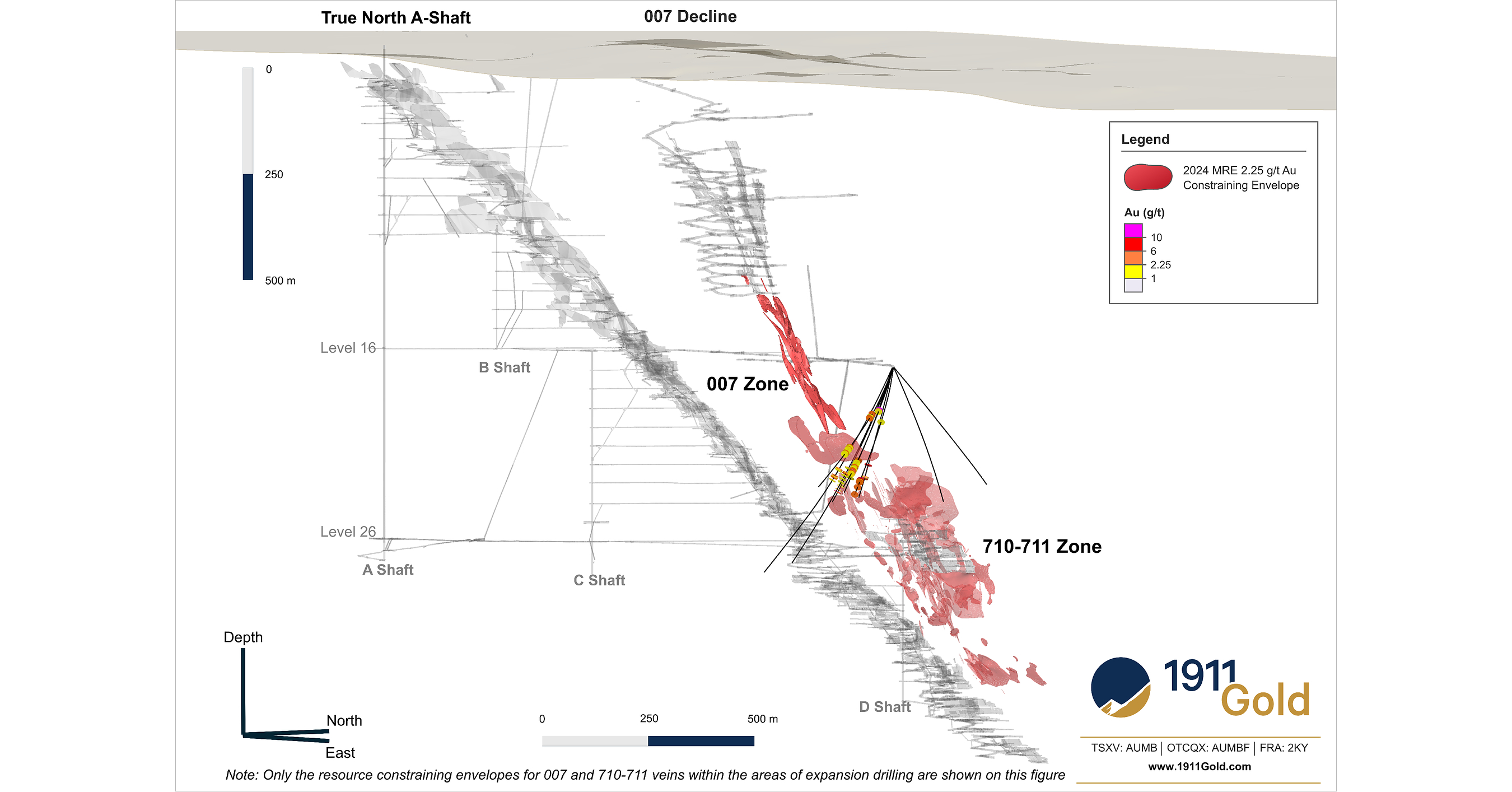
1911 Gold reported underground drilling extensions beyond the 2024 mineral resource estimate at True North, including 7.55 g/t gold over 5.00 m (with 32.90 g/t over 0.50 m) at 710-711 and 21.20 g/t over 0.60 m at the 007 zone. Mineralization was extended 60 m above the 710-711 resource limit and 120 m below the 007 limit; the company says the results support potential resource additions, not a production decision. An updated resource estimate incorporating these results and other zones is underway and scheduled for Q4 2026.
Analysis
The market mechanism is resource optionality, not near-term earnings: these intercepts can lift the value of a future mine plan only if continuity, true widths, dilution and recoverable tonnage survive incorporation into the Q4 2026 resource update. The 60–90% true-width estimate and absence of top-capping make headline grades a poor proxy for mineable grade; narrow high-grade veins can add ounces while still leaving mining costs or production scale unattractive. Some holes returned no significant values, so continuity risk remains.
Near term, AUMB may trade as a high-beta gold exploration proxy on assay enthusiasm, but the release alone does not establish economic value. Over the next 1–3 months, the resource update is the key catalyst: monitor net additions, category mix, grade/tonnage trade-offs and whether extensions are incorporated without excessive dilution. Over 6–18 months, the existing permitted mine and mill could be a meaningful advantage versus a greenfield project if rehabilitation, restart capital and operating economics prove manageable; permitting is not equivalent to a production decision.
Contrarian risk/reward is asymmetric both ways: investors may overvalue isolated high grades, yet underweight the option value of adding resources around existing infrastructure. A material reversal would be a resource update showing limited net ounces, weak confidence classification, or grades/geometry incompatible with the contemplated mine schedule. Gold-price weakness and any funding requirement would amplify downside; verify cash runway and financing terms before underwriting the catalyst.
AllMind Terminal
AI-powered research, real-time alerts, and portfolio analytics for institutional investors.
Request TrialMarket Sentiment
Overall Sentiment
moderately positive
Sentiment Score
0.48
Ticker Sentiment
Key Decisions for Investors
- Do not chase AUMB solely on the assay headlines. Treat any immediate spike as a possible liquidity-driven move; no valuation or trading-volume data are provided to establish an attractive entry.
- Catalyst watch: reassess after the Q4 2026 resource update. Require disclosed net resource additions, category breakdown, grade and geometry reconciliation, and evidence the new zones fit the mine plan before taking a directional position.
- For existing holders, consider reducing exposure into a sharp pre-update rally if the position is sized for exploration optionality rather than demonstrated economics. Falsification: a resource update with immaterial additions or materially weaker grade/confidence than implied by the intercepts.
- Before initiating or adding, verify cash runway, expected update timing, and any financing or restart-capital needs. A financing on dilutive terms, delayed resource update, or sustained gold-price weakness would weaken the risk/reward.
More News
- 1911 Gold drills high-grade extensions at True North in Manitoba
- Why Dangote’s Nigeria Refinery IPO Is Such a Big Deal for Africa
- Oman evacuates injured crew from attacked tanker in Strait of Hormuz
- Oil rises as concerns over Houthi attacks on Saudi Arabia eclipse supply recovery
- Australia top court rules against coal mine expansion, citing climate harm
- Diesel Price Surge Hits Farmers, Raising Food Inflation Risk