
GEEKOM regresa a IFA 2026 con IA local distribuida y ordenadores de última generación
Source: PR Newswire
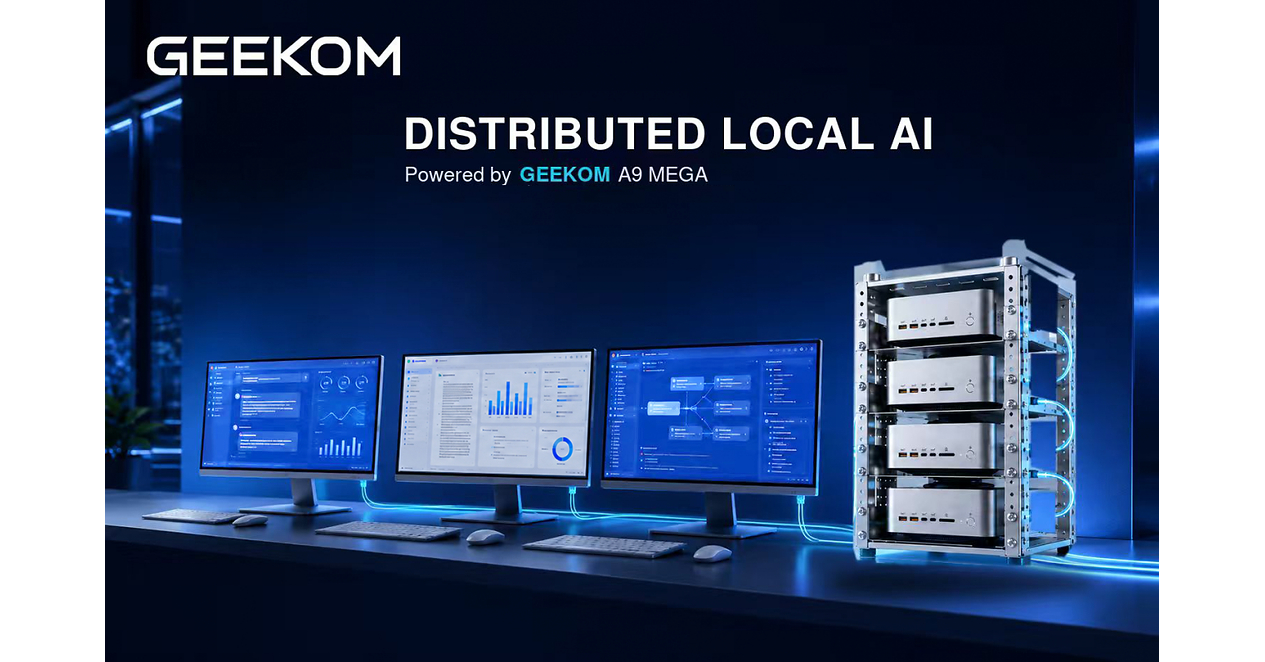
GEEKOM regresa a IFA 2026 en Berlín (4-8 de septiembre) destacando una solución de IA local distribuida que usa 4 mini PC A9 Mega con AMD Ryzen AI Max+ 395 y GPU Radeon 8060S conectadas por USB4 para ejecutar DeepSeek V4 Flash sin rack de servidores ni conmutador especializado. La compañía también presenta el GeekBook X16 Pro con Ryzen AI 9 HX 470 y Radeon 890M, y el Mini PC IT13 Mega con Intel Core Ultra X7 358H, además de una configuración A9 Mega con Ryzen AI Max+ 388 y SSD Phison capaz de ejecutar modelos de ~70B parámetros (64GB de memoria unificada). En conjunto, el anuncio es un impulso positivo de producto para despliegues privados de IA, con impacto probable limitado en el corto plazo.
Analysis
This is less a demand event than a proof-of-concept for on-device inference, which matters because it shifts the conversation from "AI PC branding" to workload enablement. The incremental revenue impact for the chip vendors is not the launch itself, but whether this kind of configuration improves attach rates for higher-margin SKUs and pulls forward premium notebook and mini-PC refresh cycles over the next 1-3 quarters.
Relative positioning favors AMD near-term because the messaging is centered on high-memory-bandwidth, GPU-accelerated local AI, where AMD’s APU narrative is cleaner and more differentiated. Intel gets some validation from being present in the stack, but the market is more likely to reward the vendor perceived as enabling the heaviest client-side models, especially if OEMs start using this as a shorthand for premium AI workstation replacements. Second-order winners are memory, SSD, and thermal/power suppliers; the loser is cloud inference at the margin, but only for niche private workloads.
The contrarian view is that investors may be overestimating the earnings relevance: enterprise buyers still care more about software support, battery life, and fleet manageability than about a demo that runs a large model locally. The thesis would be falsified if AI PC sell-through does not accelerate into the next two refresh windows, or if OEMs keep specifying Intel platforms in higher volumes despite the AI branding gap. Near term, this is mainly a sentiment catalyst; structurally, it only matters if it changes procurement behavior.
AllMind Terminal
AI-powered research, real-time alerts, and portfolio analytics for institutional investors.
Request TrialMarket Sentiment
Overall Sentiment
mildly positive
Sentiment Score
0.25
Ticker Sentiment
Key Decisions for Investors
- Tactically prefer long AMD / short INTC into the IFA window if the market starts paying up for AI PC optics; target a modest 3-5% relative move over 2-6 weeks, with a stop if Intel wins multiple visible premium OEM design wins or AMD commentary on AI PC demand softens.
- Do not chase a standalone long in either name off this release alone; treat it as a watch item unless channel checks confirm higher ASP mix or better notebook order momentum in the next quarterly guide.
- Use any post-event strength in AMD to sell short-dated upside against core holdings if the stock re-rates on narrative only; the upside is limited unless customer adoption evidence appears in the next earnings cycle.
- Watch for confirmation in PC supply-chain proxies rather than the OEM demo itself: if Micron/SSD vendors and notebook ODMs start guiding to better premium mix, the AMD thesis becomes more durable over 1-3 quarters.
More News
- Musk says Terrafab chip factory could outperform rivals despite challenges
- Nvidia GPUs are everywhere. Here are the ways companies are accessing them
- How Supreme Court justices are leaning in major 401(k) case over private funds and underperformance
- What's the difference between RAM and ROM memory?
- Better Artificial Intelligence Stock: Arm vs. Marvell Technology
- Broadcom vs. Intel: Which Chip Stock Is a Better Buy in 2026?
From AllMind Research
- Anthropic IPO Preview: Valuation, Timing, and What to Watch
- Shein After the IPO: Venue, Valuation, and What Must Be Proved
- What AI Research Tools Should a Small Hedge Fund Buy First?
- What a Concept From Nature Tells Us About How C-Suite Executives Actually Think About AI
- How to Track Earnings Call Sentiment Across Companies