
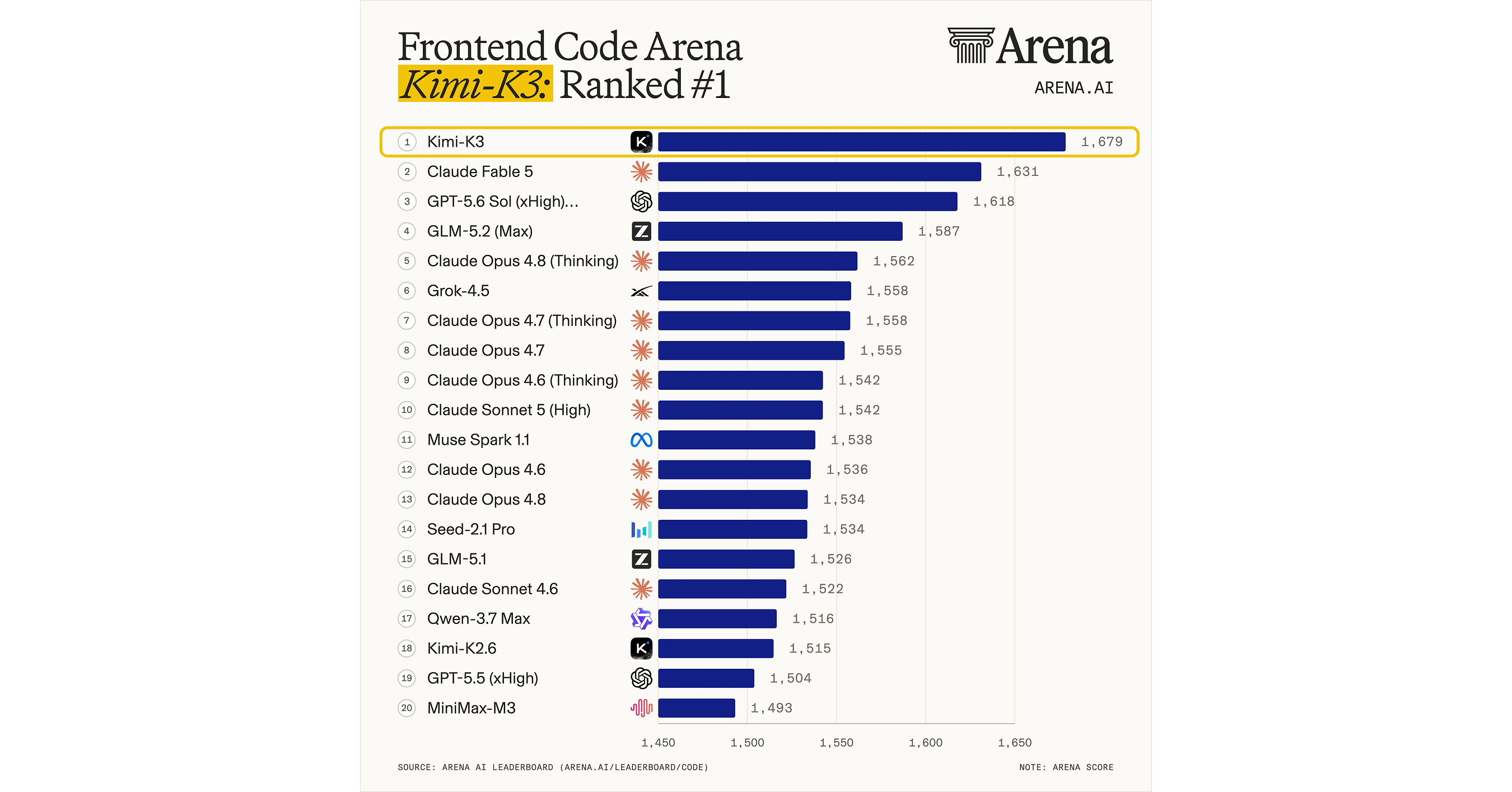
OrcaRouter announced availability of Moonshot AI’s Kimi K3 via a single OpenAI-compatible API endpoint, featuring a 2.8T-parameter model and a 1M-token context window. The offering includes intelligent routing, automatic fallbacks/load balancing, observability, and enterprise governance/spending controls to help developers integrate without rebuilding stacks or locking into a provider. Claims of “zero token markup” and escalation routing (start on cheaper models, escalate difficult tasks to Kimi K3) position the update as a modestly positive platform enablement for coding and long-context agentic workloads.
This is a negative read-through for any company trying to monetize proprietary model access at a premium. When enterprise developers can swap models through a single routing layer, pricing power migrates away from the base model and toward orchestration, governance, and distribution; that tends to compress gross margins in the model layer while expanding value capture in the middleware stack.
For GOOGL, the first-order risk is not near-term revenue leakage, but slower developer lock-in around Gemini and a harder time defending premium API pricing if customers increasingly treat frontier models as interchangeable inputs. The offset is that Google can still win if its models become one of several fallbacks in routed workflows, and any increase in multi-model usage could raise Cloud inference demand. The key question over 1-3 months is whether developer benchmarks translate into actual production traffic share; if not, this is mostly narrative, not earnings.
The contrarian point: the market may be overestimating how quickly open-weight performance converts into durable enterprise adoption. Routing and guardrails often favor incumbents with stronger compliance, latency, and uptime economics, so the real winner may be the control plane rather than the model itself. That means the structural implication is more about margin normalization across AI providers over 6-18 months than an immediate share shift.
Risk to the thesis: if Google responds with sharper pricing, tighter bundling into Vertex/Workspace, or materially better agent tooling, the commoditization pressure eases. Watch for any change in cloud AI attach rate, API growth commentary, or customer evidence that routed workflows are reducing single-vendor dependence.
AI-powered research, real-time alerts, and portfolio analytics for institutional investors.
Request TrialOverall Sentiment
mildly positive
Sentiment Score
0.18
Ticker Sentiment
