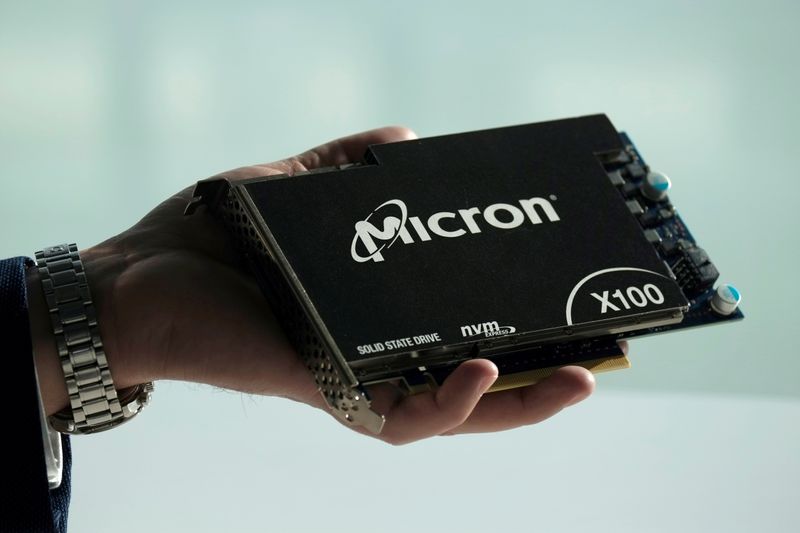
UBS says Micron could repurchase more than 40% of shares by 2028 after its buyback restriction ends on Dec. 9, 2026, potentially allowing the company to direct essentially all free cash flow to repurchases. UBS estimates Micron can generate over $400B in free cash flow through calendar year 2028. The note is a modest positive catalyst given current constraints on capital returns until the restriction expires.
The equity story here is less about an immediate capital-return catalyst and more about a delayed conversion of cyclical cash flow into permanent share count reduction. That matters because memory names usually earn their multiple from cycle duration, not from capital return certainty; if investors front-run a 2027-28 buyback wave, they may be paying for a state of the world that depends on both robust DRAM pricing and continued capital discipline.
Near term, the stock still trades on the memory cycle and AI server mix, not on repurchases. The second-order effect is competitive: if one large DRAM supplier eventually pivots excess cash into buybacks, it can signal that industry supply is finally rational enough to support returns rather than capacity grabs. But if the cycle rolls over before the restriction lifts, the buyback capacity becomes a backstop rather than an engine, and any multiple expansion should compress quickly.
The contrarian view is that this is more of a quality-screen support story than a fresh fundamental catalyst. Consensus may be underestimating how much of the projected cash flow is already embedded in sentiment, while overestimating how much of it can be safely distributed in a memory business that still has meaningful pricing volatility. The key falsifier is a downshift in DRAM/NAND pricing or capex re-acceleration that pushes free cash flow below the path required to actually retire >40% of shares by 2028.
AI-powered research, real-time alerts, and portfolio analytics for institutional investors.
Overall Sentiment
mildly positive
Sentiment Score
0.25
Ticker Sentiment
