
MediaTek Dimensity 9600 Pro Sets New Standard for Flagship Smartphone Chips
Source: PR Newswire
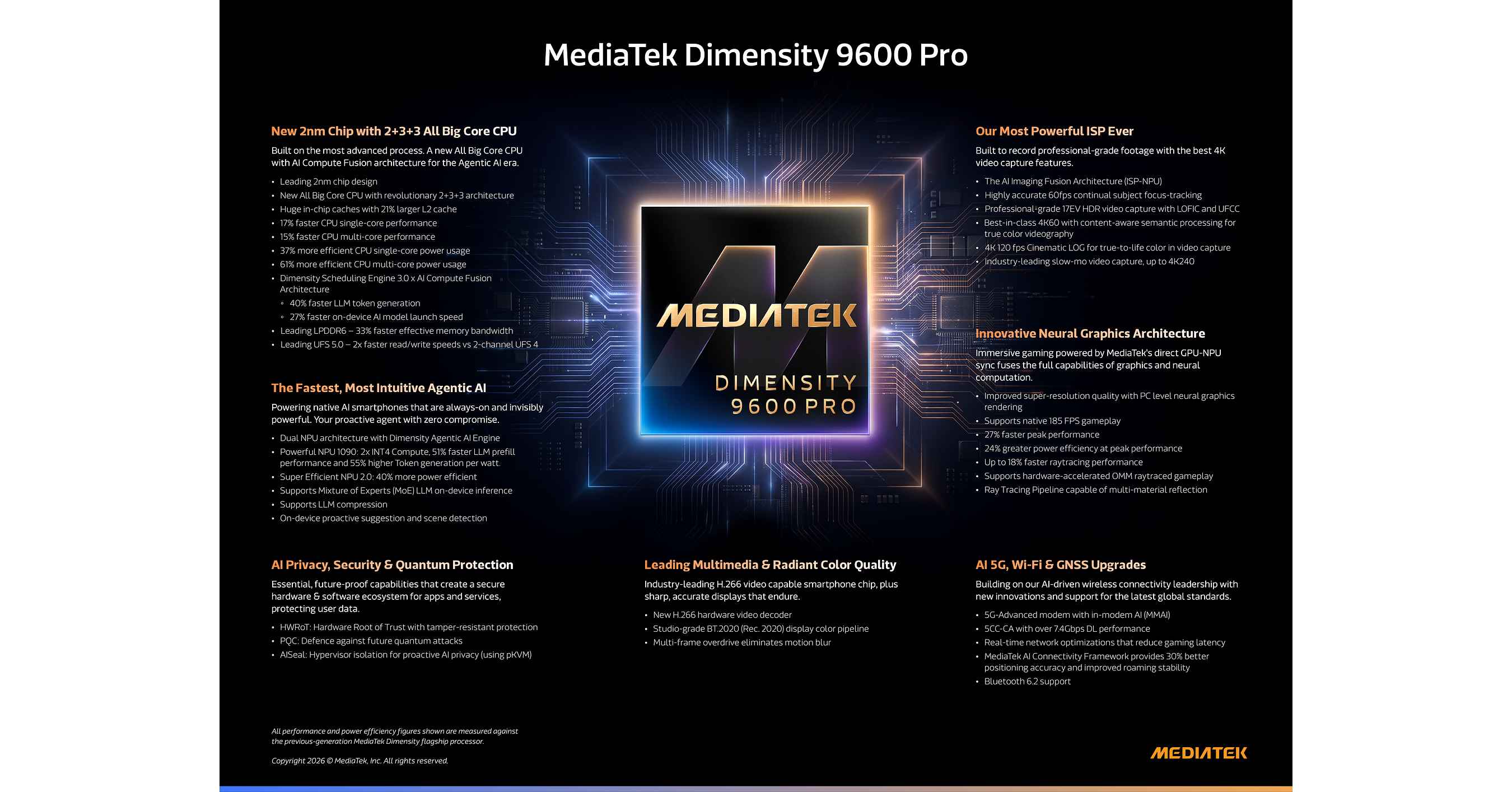
MediaTek launched its Dimensity 9600 Pro flagship smartphone SoC on a 2nm process node, claiming the first announced adoption of the technology in the segment. The chip delivers up to 17% higher single-core and 15% higher multi-core CPU performance while reducing multi-core power consumption by 61%; its AI engine also claims 51% faster LLM prefill performance and 55% higher token generation per watt. MediaTek expects the first smartphones using the 9600 Pro and lower-tier 9600M to launch this quarter, potentially strengthening its premium Android chipset positioning.
Analysis
The investable signal is not the benchmark claim; it is whether MediaTek can convert a leading-node design win into premium Android mix and gross-margin expansion. A successful ramp would pressure Qualcomm (QCOM) most in China-centric flagships, where OEMs have historically used MediaTek to lower bill-of-materials costs; the second-order beneficiary is TSMC (TSM), whose 2nm wafer allocation, yields and advanced-packaging attach rates become the binding constraint. LPDDR6/UFS 5.0 platform adoption could also pull forward content growth for memory suppliers, but only if handset OEMs ship sufficient premium volumes rather than reserve the feature set for showcase models.
Near term, this is a validation event rather than an earnings catalyst: design-win disclosure, teardown evidence and retail pricing over the next 1-3 months matter more than lab metrics. The key contrarian risk is that efficiency gains are competed away through lower OEM pricing and higher memory/display specifications, leaving handset battery life and retail ASPs unchanged. The thesis is falsified if initial devices use limited regional SKUs, if TSMC's 2nm ramp constrains supply or raises die costs materially, or if QCOM retains major flagship sockets through modem/RF integration and OEM subsidy economics.
Over 6-18 months, credible on-device AI usage could modestly improve flagship replacement demand, but a hardware feature alone will not sustain a rerating without software adoption and carrier-independent consumer willingness to pay. Consensus may overvalue peak performance leadership and undervalue the risk that Android OEMs fragment AI experiences, making the silicon differentiation difficult to monetize.
AllMind Terminal
AI-powered research, real-time alerts, and portfolio analytics for institutional investors.
Request TrialMarket Sentiment
Overall Sentiment
moderately positive
Sentiment Score
0.62
Key Decisions for Investors
- Watch-list long MediaTek (2454.TW) on confirmed top-tier OEM design wins and first-device teardowns; initiate only if management indicates premium-chip ASP/mix expansion rather than volume substitution. Target a 6-12 month rerating from margin leverage; exit on evidence of 2nm supply constraints or flat flagship gross-margin guidance.
- Prefer a 3-6 month long TSM / short QCOM pair after handset launch confirmations: TSM captures node demand independent of OEM share allocation, while QCOM faces the clearest Android flagship share risk. Keep sizing modest until regional SKU volumes and modem attach are known; cover the short if QCOM retains the major China flagship sockets or guides handset revenue higher.
- Do not buy memory exposure solely on this announcement. Set an alert for OEM bills of materials showing LPDDR6 and UFS 5.0 broad adoption; absent that evidence, higher-spec content is likely confined to low-volume halo devices and will not move earnings estimates.
- Monitor launch pricing and sell-through during the first 60-90 days. Premium-device ASP compression despite the new platform would imply OEMs are passing performance gains through to consumers, weakening the MediaTek margin thesis and favoring handset OEMs over chip vendors.
More News
- Grab aims for 'next level' in financial services with purchase of buy-now pay-later platform Atome
- China's AI leaders keep quiet despite U.S. 'publicity' on tech risks
- Exclusive-Malaysia talks to rival airlines as it monitors AirAsia’s financial health, sources say
- Karin Rådström is steering Daimler Truck in a new direction as the world’s biggest truckmaker faces a growing challenge from China
- China’s slower loan growth is the new normal, central bank governor says
- U.S. stock futures drift higher with Fed rate hike in focus
From AllMind Research
- Anthropic IPO Preview: Valuation, Timing, and What to Watch
- Shein After the IPO: Venue, Valuation, and What Must Be Proved
- What AI Research Tools Should a Small Hedge Fund Buy First?
- Augmented Intelligence: AllMind, Elevate Human Judgement With an Accessible, Powerful, Data-Driven Financial AI Toolkit
- AI Research Systems for Hedge Funds: A Pilot Design