
Can GFS' Marvell Deal for SiGe Capacity Expansion Accelerate Growth?
Source: zacks.com
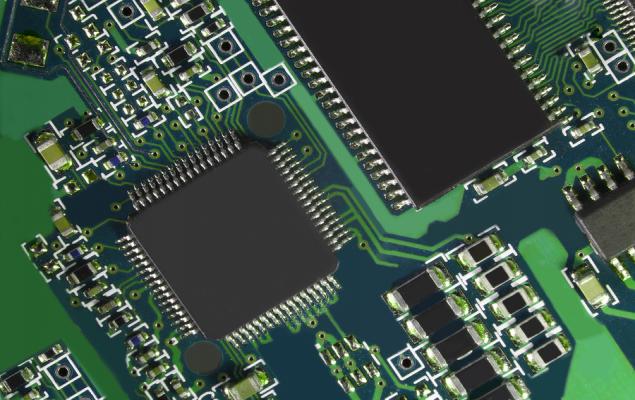
GlobalFoundries entered a multi-year agreement with Marvell to expand silicon-germanium production at its Burlington, Vermont facility for next-generation optical transceivers, near-packaged optics and co-packaged optics. The capacity expansion targets AI and cloud-data-center networking demand, with GFS currently supporting 200G-per-lane connectivity and pursuing faster generations. GFS shares have gained 39.3% over the past year, while 2026 and 2027 EPS estimates each rose 1.6% over 60 days to $1.96 and $2.61, respectively, although its 18.90x forward P/E exceeds the industry's 13.16x.
Analysis
The economic value of this arrangement hinges less on wafer volume than on whether GFS can convert a capacity reservation into durable utilization and pricing for differentiated RF/photonic-adjacent processes. If AI clusters migrate from copper interconnects toward optical links at shorter reaches, SiGe content can become a bottleneck-enabling technology; that would improve Burlington’s fixed-cost absorption and create upside to GFS’s specialty-foundry mix. MRVL benefits through supply assurance, but remains exposed to hyperscaler design-win concentration and the timing of co-packaged optics adoption.
The more investable second-order read is that optical interconnect demand broadens the AI spend universe beyond leading-edge logic. Lumentum (LITE), Coherent (COHR), Fabrinet (FN), and optical-component suppliers can capture higher near-term content as pluggables scale, whereas co-packaged optics is likely a 12-36 month architecture transition rather than an immediate volume event. TSM’s packaging and photonics investments make it the structural incumbent; GFS’s advantage is differentiated domestic capacity, but it does not establish parity in advanced packaging ecosystem depth.
Near-term upside in GFS is constrained by valuation: modest estimate revisions do not yet substantiate a sustained premium without disclosed take-or-pay terms, incremental capex, utilization impact, or margin contribution. Consensus may over-credit any optics announcement as incremental AI revenue while underweighting customer qualification cycles and the risk that next-generation architectures reduce demand for discrete components. Falsification for a constructive GFS view is no improvement in specialty utilization or gross-margin trajectory over the next two earnings reports, or a material MRVL optical revenue/guidance reset.
AllMind Terminal
AI-powered research, real-time alerts, and portfolio analytics for institutional investors.
Request TrialMarket Sentiment
Overall Sentiment
mildly positive
Sentiment Score
0.38
Ticker Sentiment
Key Decisions for Investors
- No immediate directional GFS trade on the announcement alone; set an alert for earnings disclosure of committed capacity, Burlington capex, specialty utilization, and gross-margin contribution. Upgrade only if management identifies a measurable 2027 revenue or margin impact.
- For a 6-18 month AI-networking allocation, prefer a basket long MRVL/LITE/COHR against a hedge in SOXX rather than concentrated GFS exposure; this captures optical-content growth while reducing broad semiconductor-beta risk. Reassess if hyperscaler capex guidance weakens or MRVL guides data-center revenue below expectations.
- Consider a 1-3 month relative-value pair: long TSM / short GFS only after GFS outperforms on announcement-driven momentum. The thesis is ecosystem and packaging leadership versus a premium valuation unsupported by contract economics; stop out if GFS reports quantifiable margin-accretive utilization gains or TSM’s advanced-packaging supply constraints worsen.
- Monitor MRVL’s next results for optical/interconnect backlog and customer concentration. A verified acceleration supports adding MRVL; a strong order signal without corresponding GFS utilization commentary would favor MRVL and optical-component suppliers over GFS.
More News
- Chair of the Taiwan Stock Exchange on the index’s near future
- Coherent's Datacenter Business Powers its Revenue Growth
- Global AI Infrastructure Spending Will Hit $31.6 Trillion by 2050. This Is the Stock That Could Benefit the Most
- Breakfast News: Week in Review
- Google's Gemini becomes latest AI model to break out and hack computer systems
- UBS now expects AI capex to reach nearly $1tn this year and around $1.4tn by 2027