
Jaguar Mining Commences New Underground Drilling Program Targeting Untested High-Grade Zones at Turmalina Mine, Brazil
Source: Newswire
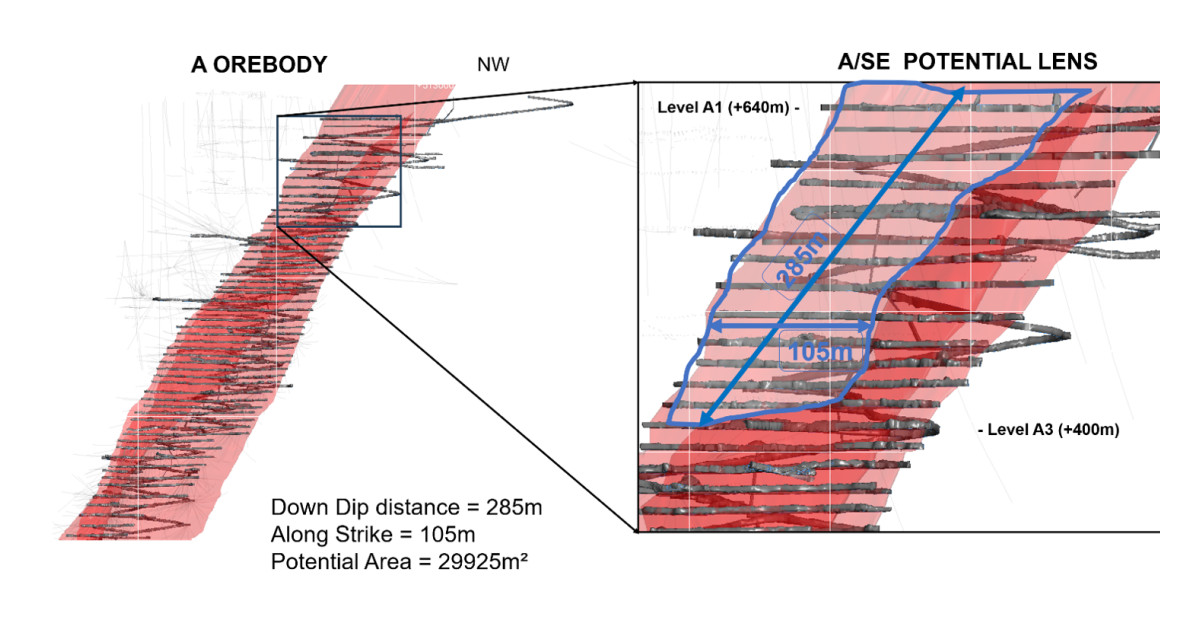
Jaguar Mining has launched an underground drilling campaign at Brazil's Turmalina mine targeting the untested A/SE2 extension of orebody A and the down-dip Faina extension. The program comprises 20 planned holes totaling approximately 2,380m from a new 80m exploration drift, while seven Faina holes totaling 2,024m have already been completed and await assay results. If mineralization continuity is confirmed, the company could add accessible in-mine gold ounces; orebody A has historically achieved average gold recoveries of 88.2%.
Analysis
This is an option-value catalyst rather than an NAV-changing event until assays establish grade, true width and continuity. The strategic value is potentially high because successful delineation could convert into mineable inventory with limited incremental surface infrastructure, improving capital intensity and potentially lowering fixed-cost absorption at Turmalina; however, a 50m drill grid is insufficient by itself to establish reserve-grade confidence in a structurally complex high-grade system.
The near-term equity reaction should be restrained: investors have repeatedly discounted junior-mine exploration narratives until a resource update, development schedule and production guidance quantify the impact. The 1-3 month catalyst path is assay cadence from both targets, with the key read-through being consistency across holes rather than isolated high-grade intercepts. Over 6-18 months, the relevant question is whether this inventory can offset depletion and coexist with capital demands for the planned Santa Isabel restart; otherwise, exploration success could raise sustaining/development capex before it raises free cash flow.
The contrarian risk is that the market may assign too much value to proximity to existing workings. Underground access reduces drilling and eventual development cost, but it does not eliminate geotechnical, dilution, ventilation, scheduling and metallurgical variability risks. A weak or discontinuous result would matter disproportionately because it would undermine the premise that near-mine exploration can extend operating life without a major capital reset, potentially increasing dependence on external financing if growth spending and the restart overlap.
AllMind Terminal
AI-powered research, real-time alerts, and portfolio analytics for institutional investors.
Request TrialMarket Sentiment
Overall Sentiment
mildly positive
Sentiment Score
0.32
Ticker Sentiment
Key Decisions for Investors
- Maintain JAG as watchlist/hold rather than initiating on the release; require assays showing repeatable economic widths and grades across multiple holes, followed by a quantified resource or mine-plan update, before underwriting incremental NAV.
- For a 1-3 month catalyst trade, consider a small long JAG position only after the first assay release confirms continuity in at least two adjacent drill sections; size as binary exploration risk, with exit on evidence of narrow, isolated mineralization or a material delay in assay reporting.
- Monitor JAG's next liquidity disclosure, sustaining-capex guidance and Santa Isabel restart budget. Avoid adding if combined growth commitments imply equity issuance or leverage expansion before the new zone contributes production.
- Use GDXJ as a partial sector hedge for a JAG long if the objective is to isolate company-specific drilling upside; gold-price downside and Brazil-specific operating risk remain imperfectly hedged.
More News
- Oil falls on increased Gulf supply and hopes for US-Iran talks
- Asia stocks ride tech wave higher, oil stays subdued
- South Korean solar stocks jump as curbs on Chinese sector expected to remain in place
- Latest Oil Market News and Analysis for Sept. 23
- Bank of America says Brent crude oil could top $150 a barrel if Iran war disruptions persist
- Paramount will need to release way more movies to make this merger work