
Benewake Brings NOVA20 Near-Field LiDAR to Embodied Robots for Safer Physical Interaction
Source: PR Newswire
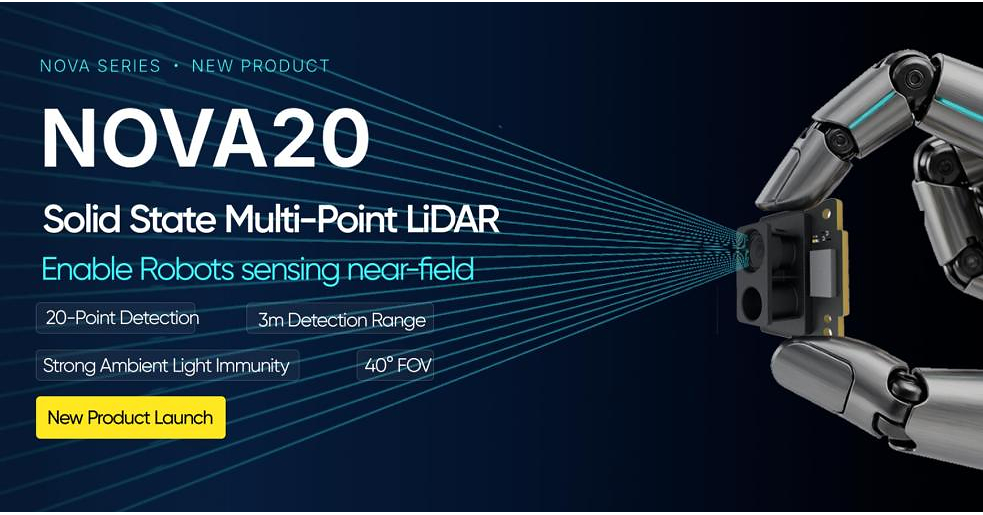
Benewake is bringing its NOVA20 solid-state near-field LiDAR to embodied-robot platforms, measuring distances from 5 cm to 1 m to support pre-contact safety. The sensor weighs less than 5 g, consumes less than 1 W, and uses a 20-point array with a 40° field of view; the announcement provides no sales, financial results, or customer commitments.
Analysis
The likely economic value is not a standalone sensor sale but a lower integration and safety-validation hurdle for robots operating near people and obstacles. If the unit performs as claimed, distributed placement could increase sensor content per robot; however, the 5 cm–1 m layer is complementary to cameras, longer-range sensing and contact sensors, not a substitute for them. That limits displacement risk to incumbent sensing architectures and makes adoption dependent on OEM integration rather than technical specifications alone.
Value capture is uncertain. Benewake is not represented in the supplied ticker mapping, and a product announcement provides no evidence of design wins, pricing, recurring revenue or production volume. Larger beneficiaries could be robot OEMs if reliable pre-contact sensing reduces deployment friction or incident exposure. Conversely, established industrial-sensing suppliers such as SICK, Keyence and Pepperl+Fuchs may face incremental competition if OEMs standardize compact distributed ranging; the effect is unlikely to matter absent meaningful robot volumes. More sensors also add calibration, wiring, software and validation work, potentially offsetting the claimed reduction in host processing.
Near term (days), this is not a tradeable public-equity catalyst on the information provided. Over 1–3 months, seek independent test results, named platform integrations, safety certifications and production orders. Over 6–18 months, monitor whether near-field sensing becomes a standard robot BOM item or remains a custom feature. The contrarian risk is that a technically credible component is being presented as a deployment enabler before the harder bottlenecks—system-level safety validation, reliability across surfaces and OEM economics—are demonstrated. Falsify adoption upside if evaluations do not convert to production programs or if OEMs retain existing sensing stacks.
AllMind Terminal
AI-powered research, real-time alerts, and portfolio analytics for institutional investors.
Request TrialMarket Sentiment
Overall Sentiment
mildly positive
Sentiment Score
0.20
Key Decisions for Investors
- No directional trade on this announcement: Benewake has no supplied public ticker, and there is no disclosed commercial evidence to support a revenue or valuation estimate.
- Place robot OEMs and sensing suppliers on a 1–3 month watchlist; upgrade only on named design wins, production volumes, safety certifications or independently verifiable field-performance data.
- Treat any broad robotics or AI-sensing rally as a potential fade absent commercial confirmation; the key check is whether distributed near-field sensing is added to production BOMs rather than merely evaluated.
- For diligence, verify false-trigger and missed-detection rates across reflective surfaces and outdoor light, plus integration cost and sensor count per robot. Failure on these measures would undermine the claimed safety and deployment benefits.
More News
- Why is Domino’s Pizza Enterprises stock sliding today?
- South Korean carmaker Hyundai plans 'strategic' investment of $15.5 billion in India by 2032
- Applied Materials’ $5 billion AI lab aims to cut chip development time in half—and restore Silicon Valley’s edge
- Wells Fargo CFO on Earnings, Deals, Consumer Strength
- Bank of America hit with more than $1.2 billion in penalties over money-laundering violations
- China's exports likely grew by double-digits in September