
Clarecast Hosts Grand Valley State University and Grand Rapids Chamber to Discuss AI & Predictive Intelligence in Action for West Michigan at Tech Week Grand Rapids 2026
Source: PRWeb
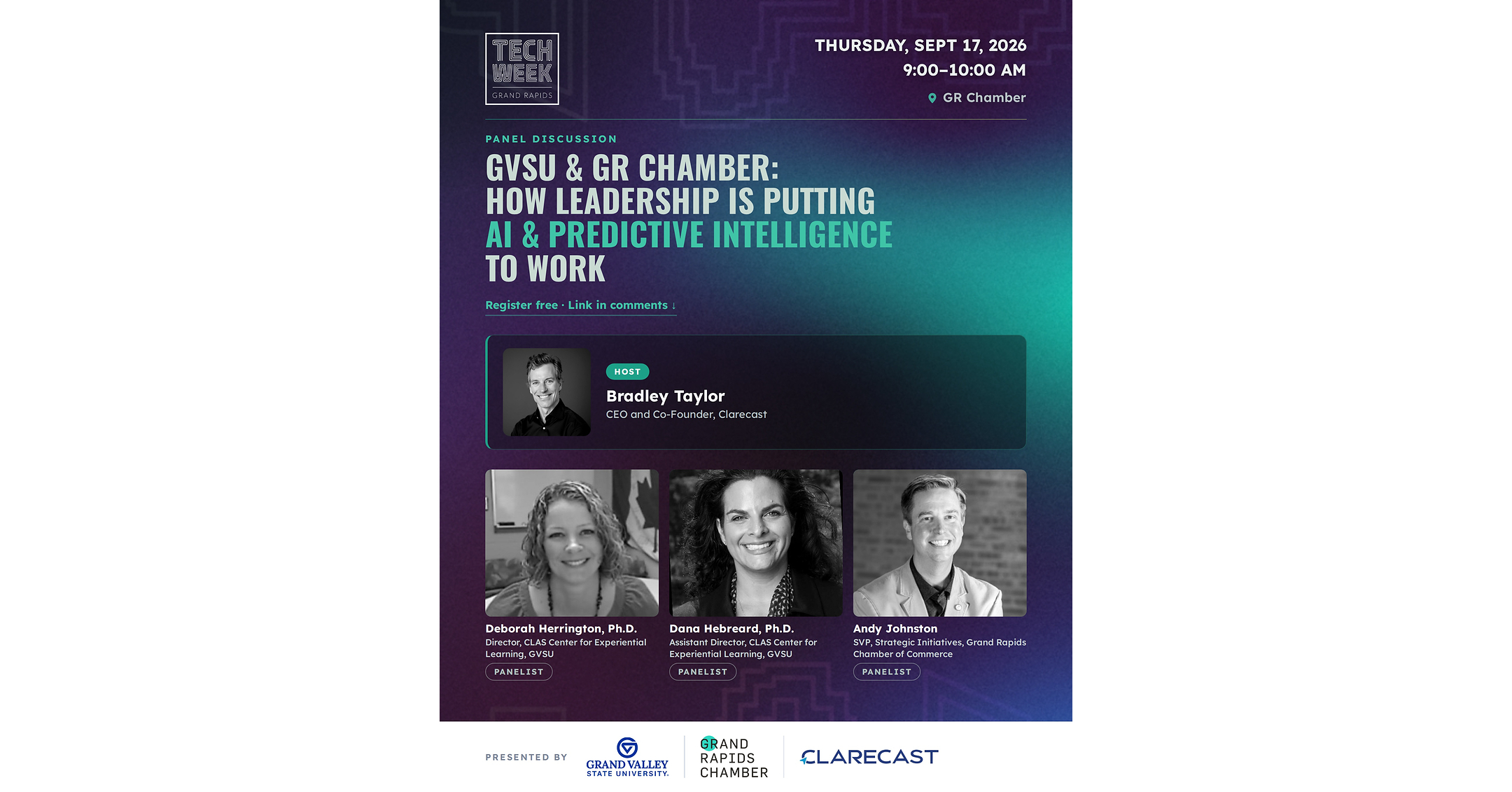
Clarecast will co-host a Sept. 17, 2026 panel at Tech Week Grand Rapids (9am–10am ET) with GVSU and the Grand Rapids Chamber, highlighting use of agentic AI/predictive intelligence for workforce planning. The platform cites scanning 18M+ company records, 300M+ employment profiles, and 1.8M+ job postings to produce headcount forecasts with 80%+ accuracy, applied to alumni career-path assessment and employer-demand-aligned academic programming.
Analysis
This reads as a commercialization signal for external-data AI, not a revenue event. The important second-order effect is that workforce forecasting is moving from bespoke consulting into repeatable software spend, which should help data infrastructure and workflow vendors with proprietary labor datasets, while pressuring labor-market intermediaries whose edge is manual interpretation. In public markets, the cleaner read-through is to AI/data stack names that monetize enterprise search, prediction, and enrichment; the weakest link is any staffing, recruiting, or research model that sells insight without owning the underlying signal.
Near term, I would not expect this to move prices materially. Over 1-3 months, the real catalyst is whether Clarecast can convert this kind of institutional validation into measurable customer adds, renewals, or channel partnerships; without that, it remains marketing. Over 6-18 months, the thesis only matters if external predictive data becomes embedded in budgeting, admissions, and hiring workflows at scale. The contrarian view is that small-market labor forecasts are noisy and cyclical; if hiring decelerates, forecast accuracy and willingness to pay can both deteriorate, making this more of a demo than a durable budget line. A clean falsifier would be a lack of repeat customer references or any evidence that the platform lifts retention/ARR.
AllMind Terminal
AI-powered research, real-time alerts, and portfolio analytics for institutional investors.
Request TrialMarket Sentiment
Overall Sentiment
mildly positive
Sentiment Score
0.18
Key Decisions for Investors
- No trade in TGT or TSTS on this headline; the signal is too indirect and the article is non-economic for public equity valuation.
- Add SNOW, PLTR, and MDB to the watchlist for any evidence that mid-market predictive analytics is becoming a repeatable selling point; only act if management commentary starts quantifying pipeline/seat expansion tied to AI forecasting use cases.
- If you want an expression trade, prefer a small basket long SNOW / short RHI or MAN over 1-3 months: the long leg benefits from data-layer adoption, while staffing/recruiting intermediaries are more exposed if customers self-serve hiring insight. Tight stop if staffing commentary shows no slowdown in demand.
- Do not short HCM/ADP purely on this news; the earliest likely benefit is actually stickier workforce data integration, not displacement. Reassess only if channel checks show budget shifting away from human-heavy advisory toward software subscriptions.
More News
- CoreWeave credit default swaps hit distress levels as investors sour on AI debt
- Treasuries Soar as Tech Slump Threatens Growth
- Blackstone President Jon Gray Bets Big on AI Boom
- Suddenly, Wall Street is worried that the U.S. economy is more ‘vulnerable’ than it looks
- Ukraine to resume strikes on Russian refineries, shattering hopes of an 'energy ceasefire'
- AI Selloff Deepens in Asia as Funding Fears Mount