
Oxipital AI Launches Foreign Material Detection Solutions at Pack Expo, Raising the Standard for Food Safety Inspection
Source: PR Newswire
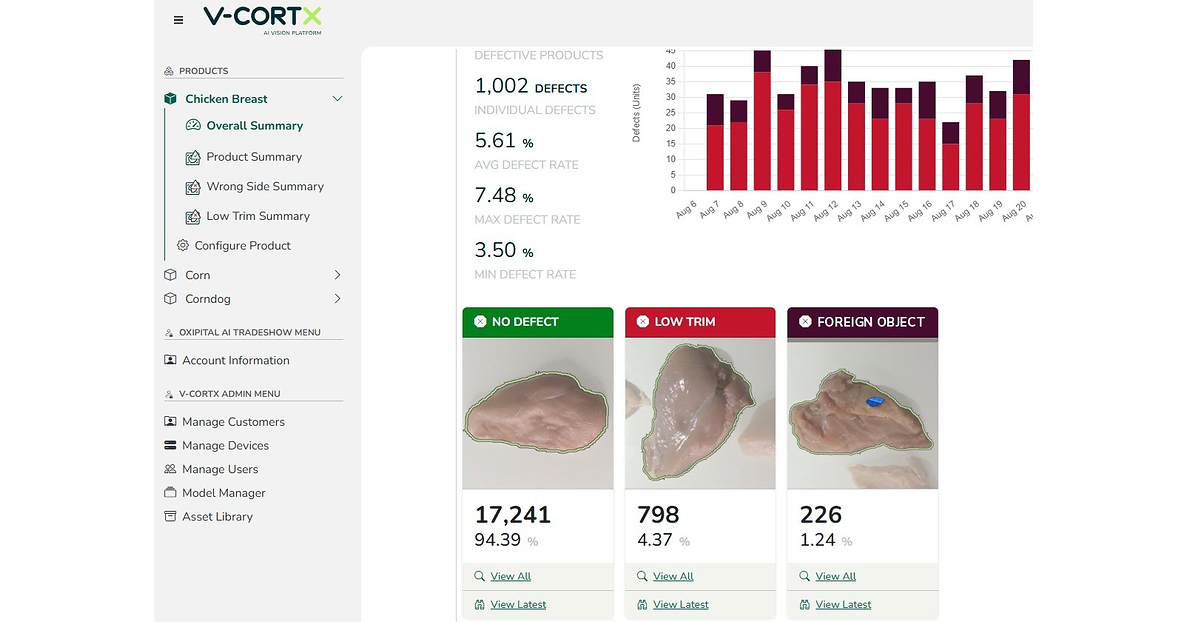
Oxipital AI launched Foreign Material Detection, an AI vision capability operating on food production lines using its existing OX and VX hardware and V-CORTX platform. The company reports detection accuracy of up to 99% in production environments, with automated line responses, contaminant classification, and audit logging; camera-based inspection may miss items not visible or resolvable at line speed.
Analysis
The investable signal is not the launch itself but whether Oxipital AI can convert a safety feature into a broader platform foothold: bundling inspection, robotics and contaminant detection could reduce integration friction and make replacement of a single-purpose inspection vendor more attractive. If validated at scale, this pressures machine-vision specialists such as Cognex and could strengthen automation incumbents’ case for owning the control layer; however, no customer wins, pricing, deployment economics or independent performance data are disclosed, so this is not yet evidence of material revenue displacement.
For food producers, the economic value is asymmetric: fewer missed contaminants may limit recall and compliance exposure, while false positives can erode throughput and labor productivity. The claimed accuracy is qualified, and camera visibility leaves blind spots; buyers will care more about false-positive rates, detection by contaminant type, line-speed impact and validated recall reduction than peak accuracy. Automated stops also create operational risk if classification or control integration is unreliable.
Near term (days to weeks), the trade signal is weak; the trade-show debut is a lead-generation catalyst, not a financial proof point. Over 1–3 months, monitor named customer deployments and independent validation. Over 6–18 months, broader adoption could support machine-vision and line-control spending, but creates no clear public-equity beneficiary from the supplied information. Contrarian angle: the product may reduce incident costs without producing enough measurable savings to justify incremental capex, especially where existing inspection systems are adequate. A thesis of adoption weakens if trials show persistent false stops, limited detection coverage, or no customer expansion beyond pilots.
AllMind Terminal
AI-powered research, real-time alerts, and portfolio analytics for institutional investors.
Request TrialMarket Sentiment
Overall Sentiment
mildly positive
Sentiment Score
0.30
Key Decisions for Investors
- No immediate position: Oxipital AI is the only named company and the supplied data provides no public-company identity, revenue contribution, customer references or pricing to underwrite a direct trade.
- Treat Cognex and automation-control vendors as watchlist exposures, not launch beneficiaries. Reassess only after evidence of competitive displacement, customer adoption or incremental orders; do not infer a material impact from the announcement alone.
- Track 1–3 month evidence: customer names and line counts, independently measured false-positive and miss rates at operating speed, installation time, and whether deployments expand from pilots to multiple plants. A failure on these measures would falsify the platform-adoption thesis.
- For food-producer exposure, look for measurable reductions in stoppages, waste, recall incidents or insurance costs against implementation expense before assigning a margin or valuation benefit.
More News
- Why did CoreWeave stock get crushed this week? Look to this corner of the debt market for clues
- AI stock sell-off ramps up over debt-fueled data center spending fears: ‘Full-blown crisis of confidence'
- Dow falls 189 points as AI stocks slide and oil prices surge
- Wall Street Anxiety Spreads as AI Rout Meets $110 Oil Shock
- Wall Street's fear gauge is ripping. Traders see it going even higher
- All the news about the iPhone Duo