
Oracle: Backlog Burden Implies More Capex Pains
Source: seekingalpha.com
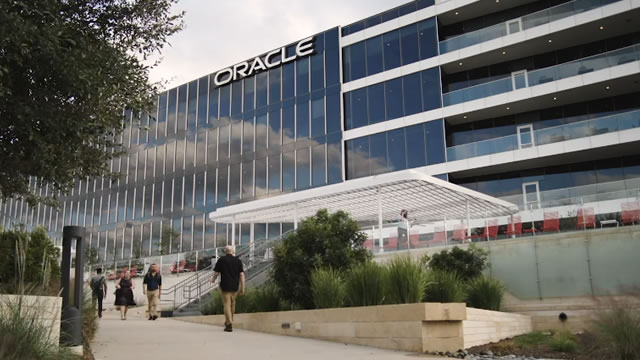
Oracle's $664B backlog, up 45.9% year over year, supports substantial cloud-infrastructure growth but requires outsized capital expenditures that could pressure near-term free cash flow, leverage metrics, and net income. As new capacity comes online, the company is reporting strong cloud infrastructure and applications revenue growth alongside higher margins. The article argues the recent selloff has left Oracle valued at 18.5x P/E and a 0.67x three-year PEG, implying upside toward a $291.70 long-term price target.
Analysis
The key underwriting question is not demand but conversion economics: ORCL must turn contracted AI capacity into revenue quickly enough to prevent capex, lease liabilities and working-capital needs from outrunning operating cash flow. That creates an asymmetric next 1-3 quarter setup: successful capacity deployment can drive a sharp upward revision to cloud gross-margin and free-cash-flow expectations, while delays in GPU delivery, data-center energization or customer ramp schedules would expose negative free-cash-flow optics and multiple compression despite intact demand.
ORCL is increasingly a financing-and-execution proxy for enterprise AI infrastructure rather than a conventional software compounder. Its competitive advantage is willingness to offer dedicated capacity and commercial flexibility where hyperscalers are constrained; the second-order benefit accrues to NVIDIA (NVDA), Broadcom (AVGO), networking vendors and data-center power/cooling suppliers. Conversely, the risk is that large customers use ORCL as temporary overflow capacity, making renewals and utilization less durable once Microsoft (MSFT), Amazon (AMZN) and Google (GOOGL) add supply.
Consensus appears too focused on the headline valuation discount and too little on capital intensity. A lower earnings multiple is justified if depreciation, interest expense and stock-based compensation rise faster than cloud contribution profit; it is unjustified if management demonstrates sustained utilization and cash conversion. Falsification points: cloud growth decelerating before newly commissioned capacity is absorbed, a material increase in lease/financing obligations, or FY free cash flow failing to recover as capex normalizes over the next 6-18 months.
AllMind Terminal
AI-powered research, real-time alerts, and portfolio analytics for institutional investors.
Request TrialMarket Sentiment
Overall Sentiment
mildly positive
Sentiment Score
0.38
Ticker Sentiment
Key Decisions for Investors
- Maintain a tactical long ORCL only after the next earnings release confirms cloud growth and provides explicit capacity-utilization or booked-revenue conversion metrics; target a 10-15% re-rating over 3-6 months, with a stop if management cuts cloud growth guidance or materially raises capex/lease-financing expectations.
- Prefer a relative-value position: long ORCL / short IGV in equal dollar amounts for 3-6 months. ORCL has an AI-infrastructure earnings catalyst that broad software lacks; exit if ORCL cloud margins fail to expand or if long-duration software valuation multiples re-rate higher on falling rates.
- Use NVDA or AVGO as cleaner beneficiaries of ORCL capacity build-out, but do not add solely on ORCL commentary. Set an alert for evidence of delayed data-center commissioning or lower accelerator procurement; that would weaken the supplier read-through before it is visible in ORCL revenue.
- Avoid underwriting a long position to a published long-term price target without missing inputs on capex, depreciation, financing mix and backlog cancellation terms. Treat these disclosures as the gating data for sizing rather than assuming contracted demand converts one-for-one into high-margin revenue.
More News
- Oracle Has Committed Hundreds of Billions to AI Data Centers. These 2 Industrial Stocks Will Power Them.
- Will worries about AI Doom end the AI Boom? BCA answers
- Could Oracle's Debt Load Derail Its AI Cloud Ambitions?
- Oracle to pay dividends next month; Here's how much 100 ORCL shares will earn
- History Says You Should Know These 3 Things Before Buying Apple Stock (AAPL)
- Trump vows to create an ‘AI Force’ and nods to justice system after rejecting calls to slow down industry. ‘Rather, we will cherish it’