
Hebbia Alternatives: A Workflow-Based Buyer’s Guide
A source-based guide to Hebbia alternatives for document review, public-markets coverage, banking deliverables, and financial data, with a reproducible trial checklist.

Published August 24, 2026 · Updated August 30, 2026
In this article
Hebbia remains a strong choice when the job is to reason across a large private document set. An alternative becomes more relevant when the job starts somewhere else: a public-company coverage list, licensed broker research, a recurring data pipeline, or a finished banking deliverable. There is no defensible universal winner without running the same work in every product, so this guide maps those jobs to a shortlist and gives you a trial you can reproduce.
How this comparison was built
This is a documented comparison based on public sources, checked on August 30, 2026. We reviewed current product, security, integration, and pricing pages; we did not operate a current account for every product below. We therefore do not publish scores, speed claims, accuracy percentages, or a numbered ranking.
We build one of the products included, and we publish this article. That is a material conflict, not a footnote. Product claims about other vendors link to their own pages, and the decision table includes cases where keeping Hebbia is the sensible outcome. No company paid to appear.
The comparison uses four questions that can be checked during procurement:
- What source universe is available before an analyst uploads anything?
- Is the recurring object a document set, a company, a deal, or a financial model?
- What evidence survives into the output?
- Which permission and data subscriptions must the buyer supply?
The short list by workflow
| Decision | Best fit to evaluate | Why it belongs on the list | Boundary to test | Evidence and pricing, checked Aug. 30 |
|---|---|---|---|---|
| Keep large private data rooms searchable and cited | Hebbia | Matrix is built for multi-step work over large document corpora, with visible actions and citations | Confirm the exact connectors, output workflow, and rollout scope your team receives | No rate card; request a demo |
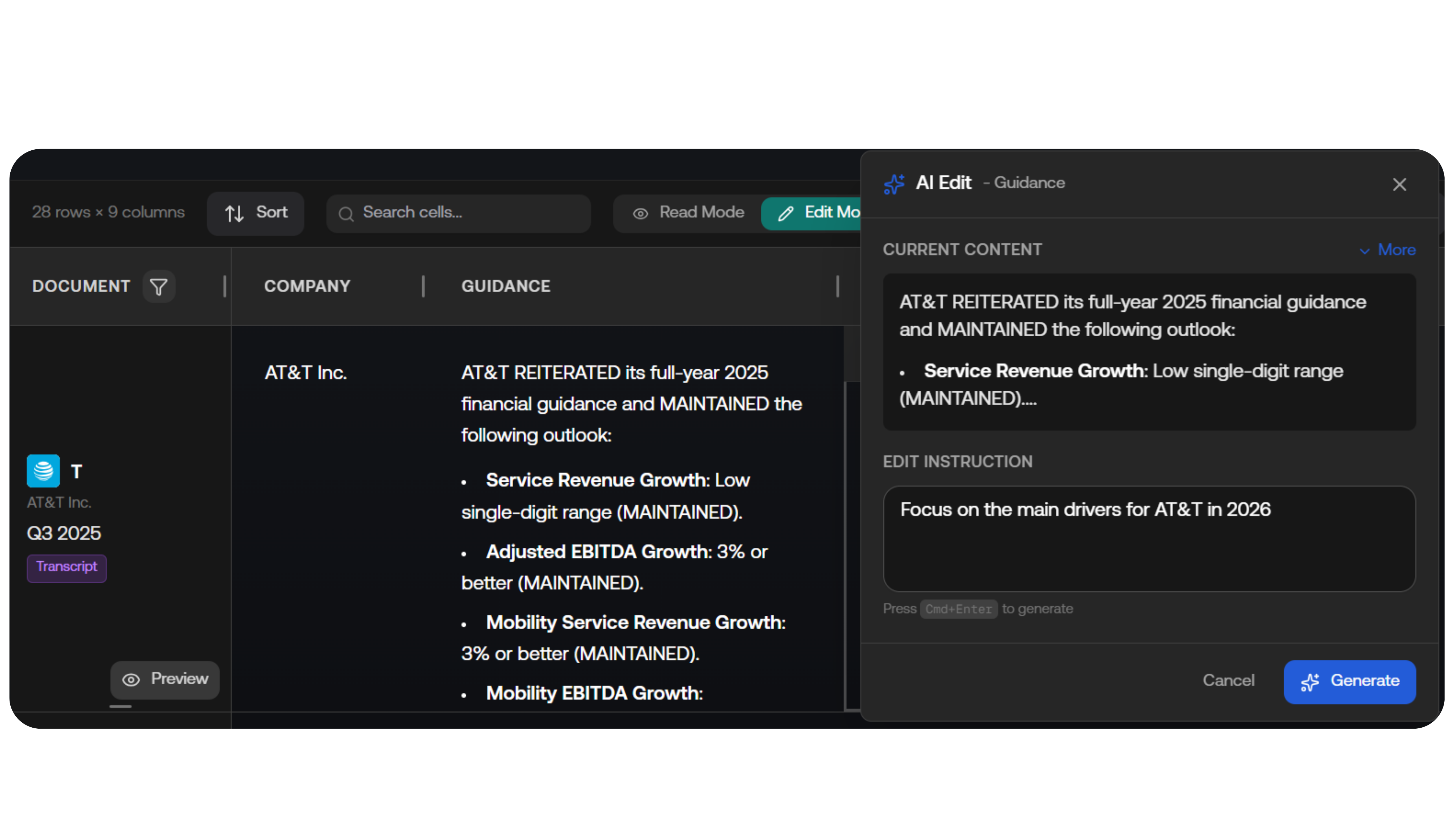
| Maintain public-company coverage with filings, market data, and internal sources connected | AllMind | The recurring object is a company in a financial ontology; Grids apply questions across ticker lists, and the result can land as an Excel model with live formulas, a deck from 20+ investment-bank templates, or a Word memo | No self-serve plan; meaningful internal-data depth requires implementation work | Quote based |
| Search licensed research and a large expert-transcript library | AlphaSense | Its content library and Generative Grid suit research-led discovery across many documents | Check which internal repositories and entitlements are included in your tier | Quote based |
| Turn diligence into decks, models, and bank-formatted work | Rogo | The product is oriented around deal-team output rather than a persistent coverage grid | Test your house template and data-room workflow, not a canned demo | Quote based |
| Build a repeatable extraction pipeline over supplied PDFs | V7 Go | Configurable document workflows can turn recurring files into structured properties and downstream documents | The buyer supplies the corpus and should test exception handling | Quote based |
| Feed source-linked financial data into models | Daloopa | Structured fundamentals and Excel model updates solve a data-maintenance problem | It complements document reasoning rather than replacing a private data room | Free sample data; paid tiers quoted |
| Research public companies without enterprise procurement | Fiscal.ai | Self-serve fundamentals and an AI copilot lower the trial barrier | No private data-room or entitled-research substitute | Published self-serve plans |
This table is a routing aid, not a league table. A private-credit team can reasonably keep Hebbia and add a financial-data layer. A long-only equity team may never need the private-document depth that justified Hebbia in the first place.
When keeping Hebbia is the better decision
Hebbia describes Matrix as a spreadsheet-like interface for work across a near-unlimited document corpus. Its current product page emphasizes multi-step tasks, multimodal files, visible actions, and citations. Those are relevant strengths for a PE or credit team working through a data room, a set of credit agreements, or manager documents. Hebbia’s private-credit examples are more informative for that buyer than a generic feature checklist.
The product also moved beyond the earlier “documents in, grid out” description. Max, introduced on July 30, 2026, is intended to create reports, presentations, models, and dashboards from a firm’s material. Matrix 2.0, announced August 26, adds multi-source workflows that can move toward models, memos, decks, and email while preserving human approval between steps. Hebbia did not publish a rollout schedule or comparative performance data in that announcement, so a buyer should verify availability in its own proposal.
Staying also avoids a migration that alternatives pages tend to ignore. Existing prompts, projects, access rules, and analyst habits have value. If the current team is getting reliable cited work from private corpora, a replacement needs to beat the incumbent on a real task by enough to repay that rebuild.
The question becomes different when analysts repeatedly leave Matrix to obtain consensus data, maintain a coverage universe, or finish work in another system. That is where the alternatives separate.
For public-markets coverage: AllMind or AlphaSense
AllMind and AlphaSense both extend beyond files that a user uploads, but their centers of gravity differ.
AllMind, our own product, is the strongest first pilot when work revolves around an ongoing public-company coverage process. We license 6,800+ premium data sources from 100+ providers and partners, including S&P Global and Capital IQ data, FactSet data such as Revere, LSEG, MSCI, and exchange data such as CME. Estimates, filings, broker research, Expert Insights, and alternative data are also in that data corpus, which customer systems can extend. Our ontology connects companies and related entities, and Grids apply the same question across ticker lists. That combination is useful when each row must carry both documentary evidence and structured financial context into recurring monitoring or reports.
Hebbia remains the stronger first test for a large, private corpus such as a data room or set of credit agreements, especially when Matrix's visible cell-by-cell document analysis is the desired working surface. Our tradeoff is procurement and integration: we offer no self-serve plan, and connecting a warehouse or proprietary research is a data project rather than a signup flow.
AlphaSense starts with a large licensed content universe. Generative Grid applies prompts across document sets, and Expert Insights is a substantial transcript library following the Tegus acquisition. It is the more natural trial when the desk’s bottleneck is finding what brokers, experts, news sources, and filings say. A buyer should still confirm which internal repositories, content entitlements, and output features are in the quoted tier.
Neither description establishes that one product is more accurate. Accuracy depends on the source set, task, citation standard, and what counts as a failed cell. The trial later in this article makes those conditions explicit.
For a finished deliverable: Rogo
Rogo is worth evaluating when the output, rather than the corpus, is the pain point. Its positioning is built around financial institutions producing decks, models, memos, and other deal work. That is a different procurement question from “Which product can search the most documents?”
Give the trial team one live template with real formatting constraints, one approved data room, and one set of review comments. Measure the number of unsupported claims and manual corrections in the final artifact. A polished sample deck built from vendor-selected material does not answer that question. Hebbia’s new output direction narrows this distinction, which is precisely why the test should use current product access instead of last year’s category labels.
For extraction pipelines or model data: V7 Go, Daloopa, and Fiscal.ai
These products should not be presented as interchangeable Hebbia clones.
V7 Go is a workflow builder for repeated document processing. It fits when the same fields need to be extracted from CIMs, DDQs, LPAs, forms, or other supplied files and then passed into a downstream process. The failure mode to inspect is not conversational fluency; it is how the pipeline reports missing, ambiguous, or malformed inputs.
Daloopa focuses on source-linked financial data and model updates. It can close the gap between a document workflow and an Excel model, but it does not replace the need to reason across a private agreement set. Buying both a document product and a data layer can be rational if each removes a different manual join.
Fiscal.ai is the lower-friction route for public-company fundamentals and research. Its self-serve model makes it easy to test, but a self-serve public-markets product is not a substitute for enterprise permissions, entitled content, or a private data room. It belongs here because some buyers discover that their actual need was public-company data, not enterprise document infrastructure.
A public-source task, not a product test
To make the trial concrete, we extracted the following facts from Whirlpool Corporation’s fiscal 2025 Form 10-K. This work was performed against the public filing, not by running each vendor. It establishes a known-answer set that a credit analyst can use in a fair product trial.
| Question | Verified answer from the filing |
|---|---|
| Revolving facility | $3.5 billion Fifth Amended and Restated Long-Term Credit Agreement |
| Maturity | May 3, 2027 |
| Financial covenant | Four-quarter interest-coverage ratio of at least 3.0, tested quarterly |
| Year-end compliance | Whirlpool states it was in compliance at December 31, 2025 |
| Revolver drawn at year end | $250 million |
| Fiscal 2025 net sales | $15.524 billion, versus $16.607 billion in fiscal 2024 |
The source is Whirlpool’s Form 10-K filed February 11, 2026, especially Note 6 and the liquidity discussion. A product run should cite the passage behind each answer, preserve units, and distinguish “not disclosed” from “not found.”
The useful comparison starts after the first row. Can the same questions run across 25 issuers without manual file selection? Does a later 10-Q flag changed answers? Can a structured fundamentals value sit beside the filing-derived number with the discrepancy explained? Those are different capabilities, and the result will reveal whether the team needs a document reader, a coverage system, or both.
A 12-task trial you can reproduce
Use your own licensed sources and two representative analysts. Keep the prompt, documents, time window, and pass conditions identical. Do not ask the vendor team to choose the showcase task.
| Area | Task | Pass condition |
|---|---|---|
| Document reasoning | Extract the six Whirlpool answers above | Every answer matches the known set and opens to the relevant passage |
| Scale | Run the same questions across 25 issuers | Failed and missing cells are visible; no silent substitutions |
| Change detection | Add the next quarterly filing | Changed answers are identifiable without rebuilding the project |
| Tables | Extract one segment table with units and periods | Totals reconcile or the difference is explained |
| Calls | Compare one management topic across two calls | Quotes retain speaker, date, and source context |
| Private material | Query a CIM, agreement, and accounts together | Answers stay within the permitted room and cite the right document |
| Structured data | Compare one filing value with a fundamentals feed | Both values retain source and period; differences are surfaced |
| Internal data | Add a position or exposure field | Join logic is documented and raw permissions do not widen |
| Entitlements | Test with and without broker-research access | Restricted material stays blocked and the attempt is logged |
| Export | Move the result into Excel or the required deliverable | Values, source links, and identifiers survive the export |
| Exceptions | Insert an ambiguous and a missing document | The system asks, marks, or fails visibly instead of guessing |
| Operations | Run the agreed batch unattended | Elapsed time, failed items, and retry behavior are recorded |
Before the trial, agree on which failures are material. A beautifully written answer with the wrong period should not pass. A blank cell with an explicit reason may be acceptable. Publish neither a score nor an “accuracy” percentage unless the denominator and judgment process are available for inspection.
Pricing: compare the whole workflow, not a rumored seat price
Hebbia’s pricing page offers a demo rather than a public rate card. AllMind, AlphaSense, Rogo, V7 Go, and paid Daloopa plans are also quote based. Third-party seat estimates circulate, but they are not vendor prices and age quickly. The separate AI research tools pricing guide labels those estimates and dates the underlying sources.
Ask every shortlisted vendor for the same three-year cost frame:
- platform, seat, storage, document-volume, and model-usage charges;
- required market-data or research subscriptions;
- implementation, security review, support, and renewal terms;
- the cost of the second system analysts still need to finish the job.
The last line matters. A lower seat price does not save money if the desk still exports every result into a terminal, a separate search tool, and a manually maintained model.
Claims the public record does not settle
Public materials do not establish comparable accuracy, latency, citation-completeness, or total cost across these products. We also could not verify which Matrix 2.0 and Max features every Hebbia customer can use today, because the announcements do not publish a detailed availability matrix. Several vendors disclose integrations without disclosing which contract tier enables them.
Those gaps are not reasons to reject a product. They are the questions the pilot and order form need to answer.
If your team is considering a switch, start by writing down the source universe and one output that currently requires a manual join. Keep Hebbia in the trial when private-document work is central. Add only the alternatives that attack the actual bottleneck, then run the 12 tasks under the same conditions. We can run that evaluation against a public-company coverage workflow through the research challenge, with the inputs and pass conditions agreed before the demo.