
Democratic Momentum Builds as Early Voting Begins in Several States
Source: Bloomberg
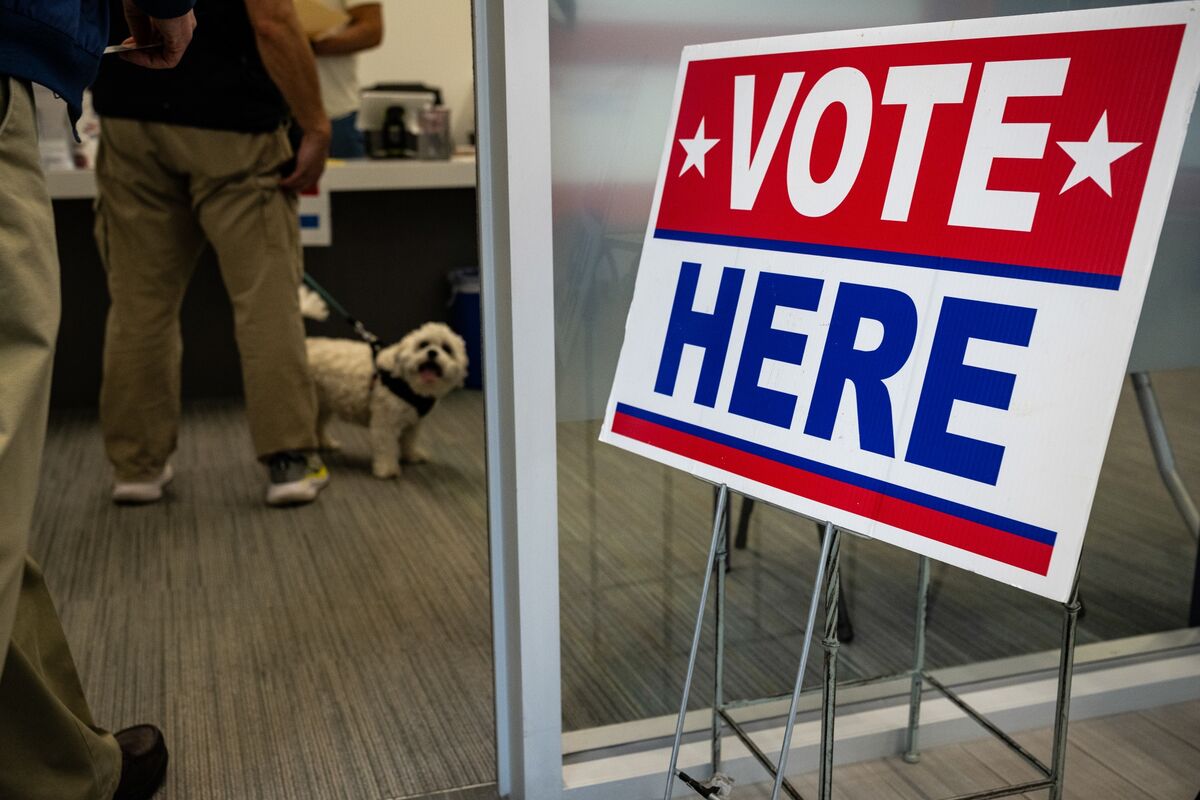
Early voting has begun in several U.S. states, with polling indicating Democrats may be matching the momentum seen in the 2018 midterm election cycle. The article also flags Warren Buffett stepping aside and rising draft fears in Russia, but provides no quantitative financial details or specific market implications.
Analysis
The market implication is less about broad index direction than a reduced probability of a clean policy regime shift. If Democratic turnout resilience narrows the expected legislative margin, sectors relying on large, partisan fiscal packages should lose some embedded optionality: defense contractors (ITA), traditional energy (XLE), and Medicare Advantage (UNH, HUM) could face higher headline volatility, while renewable developers and utilities (ICLN, NEE) gain only if control of both chambers becomes credibly contestable.
The more actionable near-term channel is rates and fiscal expectations. A closer-than-expected result would modestly reduce odds of immediate tax-cut extensions and deregulatory initiatives, favoring long-duration growth relative to domestically cyclical small caps; however, this effect is likely second-order versus inflation and payroll data. Markets typically wait for state-level early-vote composition, turnout relative to registration, and polling-error evidence before repricing election outcomes, making current narrative-driven moves low conviction.
Consensus risk is that investors treat turnout signals as transferable across states and demographics. Early-vote data are not votes banked unless party registration, age mix, and mode-switch behavior are benchmarked against prior cycles; a seemingly favorable participation trend can reverse on Election Day. The thesis is falsified if polling averages widen materially in the opposite direction or if betting-market probabilities and Treasury term premium fail to respond after multiple state-level turnout releases.
AllMind Terminal
AI-powered research, real-time alerts, and portfolio analytics for institutional investors.
Request TrialMarket Sentiment
Overall Sentiment
mixed
Sentiment Score
0.10
Key Decisions for Investors
- No directional index trade on this signal alone; keep election exposure expressed through diversified sector hedges until state-level turnout composition and polling-error data provide confirmation over the next 2-6 weeks.
- Watch relative performance of IWM versus QQQ: a sustained IWM/QQQ breakdown following improved odds of divided government would support a 1-3 month long QQQ / short IWM pair, with exit if the ratio recovers above its pre-election-news level.
- Maintain alerts on UNH, HUM and XLE for policy-driven volatility rather than initiate positions. A material change in Senate-control probabilities is the necessary catalyst for reassessing reimbursement, tax, and permitting risk.
- For portfolios with meaningful domestic-cyclical exposure, consider a small 1-3 month XLF put-spread hedge only if Treasury yields rise alongside election uncertainty; absent a rates confirmation, political headlines alone do not justify paying elevated implied volatility.
More News
- Trump signs sweeping Russia sanctions over Ukraine war
- Trump says U.S. to build a 'large Military presence' in Greenland as part of a security deal with it and Denmark
- Analysis-Russia sanctions bill gives Trump sweeping new tariff powers
- As Houthis grab Bab al-Mandeb, US appears willing to watch from sidelines
- Greer to Join Bessent in Talks With Chinese Officials on Sunday
- Carney Pursues EU Partnership, Investment Boom to Reduce US Dependence