
EvoMap Open-Sources AutoResearch, Giving AI Agents a Way to Test Their Own Research Ideas
Source: PR Newswire
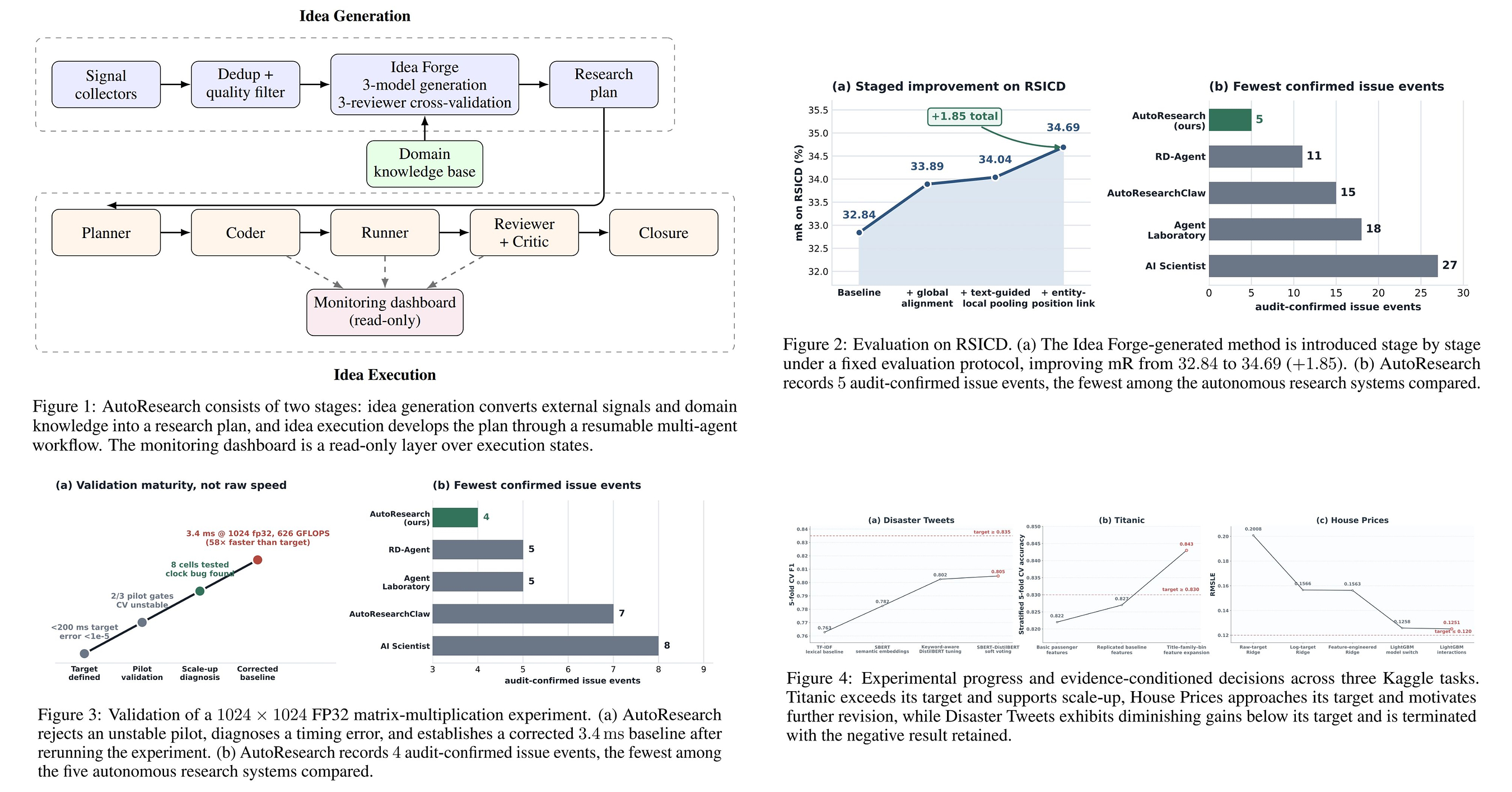
EvoMap open-sourced AutoResearch, a system for AI agents to turn research hypotheses into executable experiments with defined success criteria and persistent workspaces. In tests tied to a Django issue, it improved scores from 2/7 to 7/7 on new-feature tests while keeping 203/203 regression tests, and on RSICD raised mean Recall from 32.84 to 34.69. The initiative is positioned as a step toward more autonomous “AI4AI” research loops, though it is not presented as a company earnings or market-moving event.
Analysis
This is more a proof-of-concept for closed-loop AI R&D than an immediately monetizable product event. The market implication is that value creation migrates away from the application layer and toward the infrastructure that can run, observe, and secure long agentic workflows: GPUs, cloud execution, experiment tracking, and governance controls. In the near term, the release is likely additive to compute demand but dilutive to the moat of standalone "AI scientist" tooling, because the core workflow is being pushed toward open-source commoditization.
Second-order, the interesting beneficiary set is not just the obvious chip vendors but also hyperscalers and security platforms. Autonomous code execution and persistent workspaces increase the need for sandboxing, secrets management, audit trails, and policy enforcement, which should create a tailwind for enterprise security budgets if adoption broadens. Conversely, smaller dev-tools and AI workflow startups are more exposed to feature compression if frontier models and cloud platforms internalize the same loop.
Contrarian view: the consensus may overread benchmark gains as evidence of durable ROI. The real constraint is not hypothesis generation, it is the cost of failure, oversight, and dataset/task brittleness when moved from curated benchmarks to messy enterprise environments. Falsifiers over the next 1-3 months are simple: no measurable increase in cloud/compute usage from agentic workloads, or native implementations from MSFT/GOOGL/AMZN that make the open-source layer a distribution channel rather than a moat.
AllMind Terminal
AI-powered research, real-time alerts, and portfolio analytics for institutional investors.
Request TrialMarket Sentiment
Overall Sentiment
mildly positive
Sentiment Score
0.20
Key Decisions for Investors
- Pair trade over 3-6 months: long SMH (or NVDA if single-name) / short IGV on the view that agentic R&D increases compute intensity faster than it monetizes software-layer orchestration; risk/reward favors the long leg if AI iteration cycles drive incremental GPU demand, but cover if hyperscaler capex commentary rolls over.
- Maintain a bias to buy MSFT, AMZN, or GOOGL on 3-5% pullbacks rather than chase the open-source headline; these are the platforms most likely to capture usage if autonomous research becomes a real enterprise workflow over the next 6-18 months.
- Watch PANW, CRWD, and ZS for a medium-term security-spend catalyst tied to agentic code execution and persistent research environments; initiate only if there is evidence of enterprise deployment, since the current announcement is not yet a revenue driver.
- Avoid paying up for small-cap AI-agent/software names on this news; the open-source release raises the probability of feature commoditization and multiple compression if the research loop becomes a standard platform capability.
- Set a falsification alert: if hyperscaler capex or GPU utilization does not inflect in the next 1-2 quarters, the 'AI4AI' thesis is likely staying academic and should not be underwritten as a broad sector tailwind.
More News
- AI Capex, Gamble or Jackpot?: Market Snapshot
- ‘I told you so’: China’s chip sector is making breakthroughs—and U.S. export controls are the reasons why
- CoreWeave credit default swaps hit distress levels as investors sour on AI debt
- The IPO drought is driving private equity-owned companies to the debt market to pay investors
- Hybe shares jump 10% as K-pop sensation BTS' tour lifts earnings hopes
- Treasuries Soar as Tech Slump Threatens Growth
From AllMind Research
- Anthropic IPO Preview: Valuation, Timing, and What to Watch
- Shein After the IPO: Venue, Valuation, and What Must Be Proved
- What AI Research Tools Should a Small Hedge Fund Buy First?
- State of M&A and Private Markets, June 2026: A $4.9 Trillion Rebound, Underwritten on Money That Never Got Cheaper
- Run Cost-Controlled Financial Research in AllMind Agent Studio