
Supermicro levert nu NVIDIA Vera Rubin NVL72-racks
Source: PR Newswire
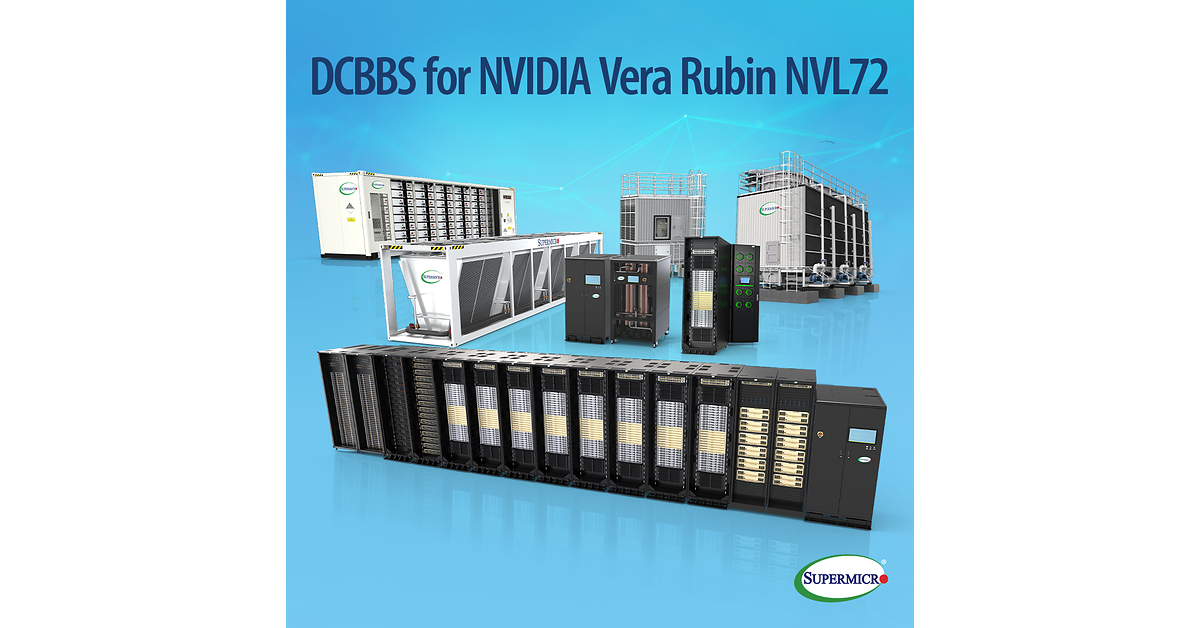
Supermicro said it is now shipping NVIDIA Vera Rubin NVL72 racks integrated with its Data Center Building Block Solutions and direct-liquid-cooling stack. Each liquid-cooled NVL72 rack contains 72 Rubin GPUs and 36 Vera CPUs, delivers 20.7 TB of HBM4 memory and 216 TB/s of scale-up bandwidth. Its 16-rack Scalable Unit blueprint supports 1,152 GPUs and 331 TB of HBM4, targeting AI data-center deployments from 5 MW to gigawatt scale; the announcement strengthens Supermicro's positioning in turnkey, liquid-cooled AI infrastructure.
Analysis
This is strategically more important for SMCI than NVDA: it attempts to shift SMCI from a low-margin server assembler toward a deployment integrator owning the thermal, power, validation and field-service bottleneck. If customers accept a single accountable vendor for liquid-cooled clusters, attach rates on internally supplied cooling and integration can lift gross margin and reduce revenue volatility versus component-only rack sales. The key caveat is that this remains a vendor announcement, not evidence of booked volume, accepted pricing, or margin accretion.
Near term, the announcement can reinforce SMCI's AI-infrastructure multiple and improve its positioning versus Dell (DELL), Hewlett Packard Enterprise (HPE) and system integrators, but Rubin revenue is unlikely to be material until customers complete facility power, water and permitting work. The 1-3 month catalyst is whether SMCI discloses design wins, backlog conversion or incremental manufacturing capacity alongside Rubin qualification; the 6-18 month payoff depends on whether liquid cooling becomes sufficiently standardized that customers retain SMCI's end-to-end stack rather than dual-source cooling from Vertiv (VRT), Schneider (SBGSY) or CoolIT/Asetek suppliers.
The non-obvious constraint is not GPU availability but data-center commissioning. Turnkey racks may pull forward SMCI revenue recognition only if customers have grid interconnection, cooling-water and construction capacity; otherwise, inventory and working-capital needs rise ahead of installation, creating downside to cash conversion. NVDA benefits mainly through lower deployment friction and a broader addressable market for high-density systems, but its incremental economics are diluted because the GPU vendor already captures the highest-value portion of the bill of materials.
Consensus may over-credit SMCI for vertical integration without testing reliability and liability economics. Field failures, leak-related warranty provisions, or customer preference for separately sourced facility cooling could erase integration-margin gains; conversely, independently confirmed deployment cycle-time reductions would justify a more durable premium versus DELL/HPE.
AllMind Terminal
AI-powered research, real-time alerts, and portfolio analytics for institutional investors.
Request TrialMarket Sentiment
Overall Sentiment
strongly positive
Sentiment Score
0.58
Ticker Sentiment
Key Decisions for Investors
- Maintain NVDA as the cleaner structural AI exposure; do not add solely on this release. Reassess after Rubin customer availability and hyperscaler capex guidance, with the thesis weakened by material deployment delays or a reduction in next-generation system demand.
- Put SMCI on a 1-3 month catalyst watch rather than chase the initial reaction. Upgrade only if the next earnings release quantifies Rubin/DCBBS backlog, cooling attach rate, gross-margin uplift and operating-cash-flow conversion; absent those disclosures, the announcement has limited valuation support.
- Conditional pair trade: long SMCI / short DELL or HPE after verified Rubin design-win disclosures, targeting a 10-15% relative move over 3-6 months. Stop if SMCI guides gross margin lower, reports rising inventory/receivables, or fails to convert announced systems into revenue.
- Monitor VRT as a second-order beneficiary of high-density AI buildouts, but avoid assuming SMCI displaces facility-cooling vendors: large sites will often preserve multi-vendor redundancy. A widening SMCI-VRT performance gap without evidence of cooling verticalization would favor VRT as the lower execution-risk exposure.
More News
- Trump Versus Xi: How Their High-Stakes Summits Compare
- Trump praises US-China friendship at state dinner with Xi Jinping
- Trump-Xi summit: Here’s what’s on the agenda, and why it matters
- Nscale wants a $35 billion valuation. Nvidia is helping foot the bill
- Why Fervo Energy Stock Is Up Today
- The U.S. and China are quietly talking AI guardrails—even as Trump publicly rejects them