
E Tech Group to Present on Scaling Lab Automation for Regulated Production at ISPE Boston 2026
Source: PR Newswire
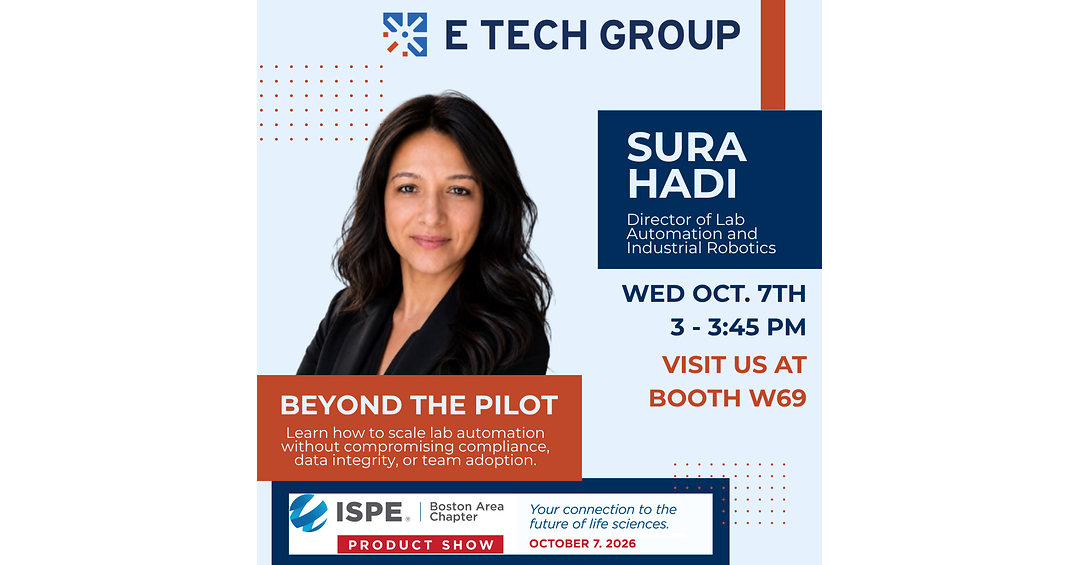
E Tech Group announced that Laboratory Automation and Industrial Robotics Director Sura Hadi will present at the ISPE Boston Area Chapter 2026 Product Show on October 7, focusing on scaling laboratory automation from pilots into regulated production. The session will address systems integration, validation, data integrity, compliance, and ownership requirements across instruments, LIMS, ELN, scheduling, and enterprise platforms. This is a promotional event announcement with no disclosed financial impact or material operating update.
Analysis
This is not a ROK-specific demand catalyst; it is low-signal channel marketing from a certified partner. The more relevant read-through is that life-sciences customers are shifting automation spend from discrete hardware pilots toward validated integration, data-governance and lifecycle-services work. That mix generally carries longer sales cycles and more project execution risk, while increasing customer switching costs once controls, LIMS/ELN interfaces and audit trails are embedded.
For ROK, any benefit is indirect: partner-led deployments can reinforce the installed-base ecosystem, but systems integrators retain a meaningful portion of the higher-value engineering and validation spend. The near-term economic beneficiary is more likely private integrators and specialized laboratory software vendors than ROK’s reported revenue base. Public proxies with more direct exposure to regulated informatics and lab workflow complexity include WAT, TMO and DHR, though the article supplies no evidence of awarded programs, customer budgets or product pull-through.
Over the next 6-18 months, FDA and global data-integrity scrutiny could make validated automation a defensive capex category for large biopharma, particularly where QC-lab throughput constrains batch release. The counterpoint is that biopharma cost controls can delay broad enterprise integration even when pilot-level ROI is compelling; projects become vulnerable at the validation, ownership and change-control stage. Treat this as a watch item, not a tradable event, until ROK or peers identify life-sciences orders, software attach-rate improvement, or services backlog growth.
AllMind Terminal
AI-powered research, real-time alerts, and portfolio analytics for institutional investors.
Request TrialMarket Sentiment
Overall Sentiment
neutral
Sentiment Score
0.05
Ticker Sentiment
Key Decisions for Investors
- No event-driven trade in ROK: the October conference has no disclosed contract value, customer commitment or guidance implication; avoid attributing partner marketing activity to ROK revenue.
- Maintain a 1-3 month alert on ROK earnings for life-sciences order growth, software/services mix and partner-channel commentary. A material acceleration in recurring software or lifecycle-services attach would support a higher-quality growth mix; absence of that disclosure falsifies the read-through.
- Monitor DHR, TMO and WAT for QC-lab automation, informatics and bioprocess backlog commentary over the next two earnings cycles. Consider relative longs only if management quantifies sustained regulated-lab demand while biopharma customer capex stabilizes.
- For a structural automation thesis, prefer waiting for independently disclosed validated-production deployments or FDA-driven remediation programs. The key downside trigger is renewed biotech capex cuts or project cancellations, which would hit integration-heavy spending before essential consumables.
More News
- SEBI Allows Portfolio Managers to Invest Overseas, Short Equity Options
- Trump, Xi Address AI, Taiwan During State Visit
- Oracle Japan shares surge 7% after record fiscal first quarter, bucking selloff of U.S. parent
- China's Xi urges U.S. to cooperate on AI
- Trump Hosts China’s Xi With Trade, AI, Taiwan in Focus
- Trump praises US-China friendship at state dinner with Xi Jinping