
Give an Hour Releases New Veteran MILE Case Study Showing Early Impact of Mental Health Training in a Veteran-Serving Organization
Source: PR Newswire
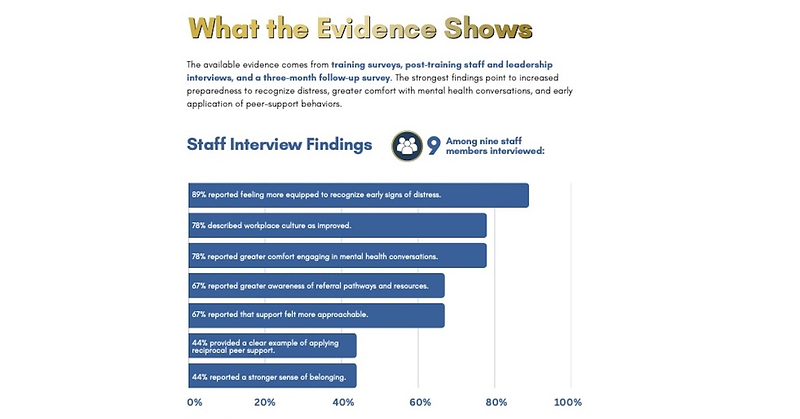
A Give an Hour and University of Phoenix case study found early signs that Veteran MILE mental-health training was being applied at Montana nonprofit Adaptive Performance Center. Among nine interviewed staff, 89% felt better equipped to recognize distress and 78% were more comfortable discussing mental health; at three months, 82% of 17 respondents reported using reciprocal peer-support benefits in everyday life. The study is preliminary and does not establish long-term outcomes or replication; Give an Hour and APC plan to develop peer-support groups and continue evaluation.
Analysis
The investable signal is not the reported participant feedback; it is whether Veteran MILE can become a repeatable, paid program embedded in employer and veteran-serving workflows. If validated at scale, this could expand budgets for workforce mental-health training and peer-support infrastructure, while positioning community-based programs as complements to EAPs and clinical care—not demonstrated replacements. That distinction matters: claims of avoided clinical costs or improved retention are not supported here.
The evidence is preliminary and especially vulnerable to selection effects: one organization with an established veteran-wellness culture, small interview and follow-up samples, and self-reported outcomes. The next phase should test whether skills persist, referrals occur appropriately, and outcomes replicate across less-ready organizations. A poorly bounded peer-support model could also create confidentiality, escalation, and staff-burden risks, undermining adoption.
Near term (days), this is a low-materiality announcement with no clear public-equity catalyst. Over 1–3 months, watch for independent evaluation, named employer contracts, program pricing, and evidence of repeat deployments. Over 6–18 months, the key question is whether adoption translates into recurring revenue or measurable employer outcomes. The contrarian read: the communication emphasizes promising activity measures, but the commercial and veteran-level outcome evidence remains absent. No direct trade is warranted on this release alone.
AllMind Terminal
AI-powered research, real-time alerts, and portfolio analytics for institutional investors.
Request TrialMarket Sentiment
Overall Sentiment
mildly positive
Sentiment Score
0.25
Key Decisions for Investors
- No position based on this announcement: the organizations and case study do not establish a material, investable public-company exposure.
- Set an alert for multi-site replication and independently measured outcomes—especially sustained skill use, appropriate referral behavior, staff retention, and veteran-level well-being.
- Treat employer mental-health training and peer-support vendors as a watchlist theme, not a near-term long: verify paid deployments, renewal rates, program economics, and whether adoption adds to rather than displaces EAP or clinical-care spending.
- Falsification trigger: follow-up research shows skills do not persist, referrals are not appropriate, or implementation raises staff burden or safety concerns; that would weaken the case for broader employer adoption.
More News
- Apollo-backed dental firm vVardis seeks up to $229 million in US IPO
- Moderna raises 2026 outlook as CEO says newer vaccines are gaining traction
- Jefferies raises Inovio stock price target on regulatory win
- Truist raises Vericel stock price target on MACI growth momentum
- Hims & Hers stock climbs on direct partnership with Eli Lilly for obesity drugs
- IRTC Investigation Notice: SueWallSt Notifies Investors of Pending Investigation Into iRhythm Technologies, Inc. (IRTC)