
CloserLook.AI, Launches the CloserLook Health Band for your loved ones.
Source: PRWeb
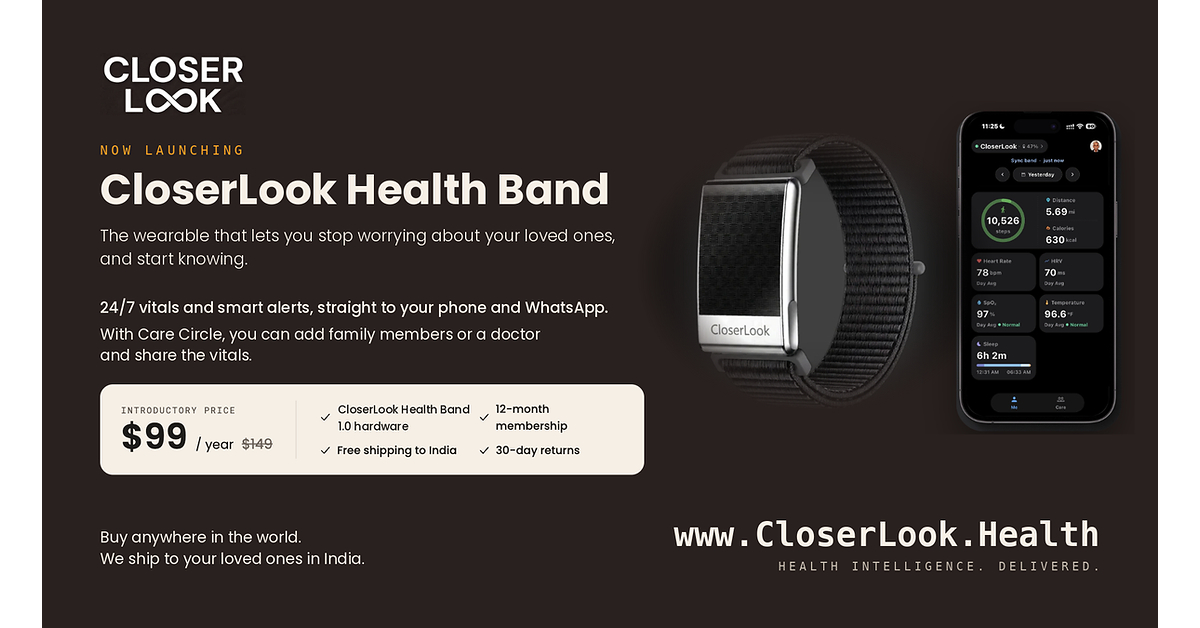
CloserLook.AI launched the CloserLook Health Band, an AI-enabled wearable and care platform for continuous health monitoring of aging loved ones. The product includes hardware, a 12-month platform membership, shipping and a 30-day return policy for an introductory $99 annual subscription, initially shipping in select regions. The company emphasizes smart alerts, Care Circle sharing and WhatsApp updates, but the wellness device is not intended to diagnose, treat or prevent disease.
Analysis
This is not investable as a standalone catalyst: the issuer is private, commercial availability is limited, and the stated price point implies that scale economics—not launch publicity—will determine viability. At roughly $99 of first-year revenue including hardware, shipping, software, and returns, the model likely requires either very low bill-of-materials cost, materially higher renewal pricing, or enterprise reimbursement to avoid negative unit economics. The key diligence items are sensor scope/accuracy, gross margin after fulfillment, paid conversion after year one, and whether any monitoring claims trigger regulatory scrutiny.
The more relevant public-market read-through is modestly favorable for incumbent elder-care and remote-monitoring ecosystems, but only if consumer adoption validates a willingness to pay for non-clinical care coordination. Alphabet (GOOGL) and Apple (AAPL) retain distribution and device-integration advantages; Best Buy (BBY), through healthcare/aging-in-place exposure, could benefit indirectly if consumer demand broadens. Conversely, fragmented single-purpose wearables face elevated customer-acquisition costs because the product is being positioned as a trusted care service rather than a discretionary fitness device.
Over the next 1-3 months, no material revenue impact on listed names is likely. Over 6-18 months, the structural catalyst would be payer, provider, or senior-living procurement: that channel could lower CAC and support recurring revenue, but it also shifts the competitive set toward validated remote-patient-monitoring vendors and raises privacy, data-security, and workflow-integration requirements. The contrarian view is that WhatsApp-enabled family coordination may improve engagement, yet it does not solve the core clinical problem of false alerts; high alert fatigue or returns would quickly impair retention and enterprise credibility.
AllMind Terminal
AI-powered research, real-time alerts, and portfolio analytics for institutional investors.
Request TrialMarket Sentiment
Overall Sentiment
mildly positive
Sentiment Score
0.35
Key Decisions for Investors
- No directional trade on this announcement; treat it as an early consumer-demand data point rather than a catalyst for AAPL, GOOGL, or BBY.
- Set a diligence alert for disclosed renewal pricing, shipment volumes, return rates, and enterprise contracts over the next 2-4 quarters. A meaningful provider/payer agreement would be a stronger signal than direct-to-consumer launch metrics.
- Maintain preference for AAPL over subscale wearable challengers on any broader elder-care wearable enthusiasm: installed base, health-data ecosystem, and pricing power create a substantially better path to monetization. Reassess if consumer wearable demand weakens or Apple health-related regulatory restrictions intensify.
- For BBY, monitor whether aging-in-place services or device attach rates appear in quarterly disclosures; absent measurable service-revenue acceleration, do not attribute valuation upside to this category.
More News
- Anthropic warns government attitudes may hurt customer ties, IPO prospectus shows: Reuters
- Broadcom, Amazon Test Limits of Investor Demand for AI Buildout
- Stocks remain under the thrall of higher yields and higher oil. Here's what's ahead
- FAA says Boeing 737 Max software glitch not a flight-safety issue
- Your health insurance premiums may take a big jump in 2027 — here's why
- September Jobs Miss Shocks Markets