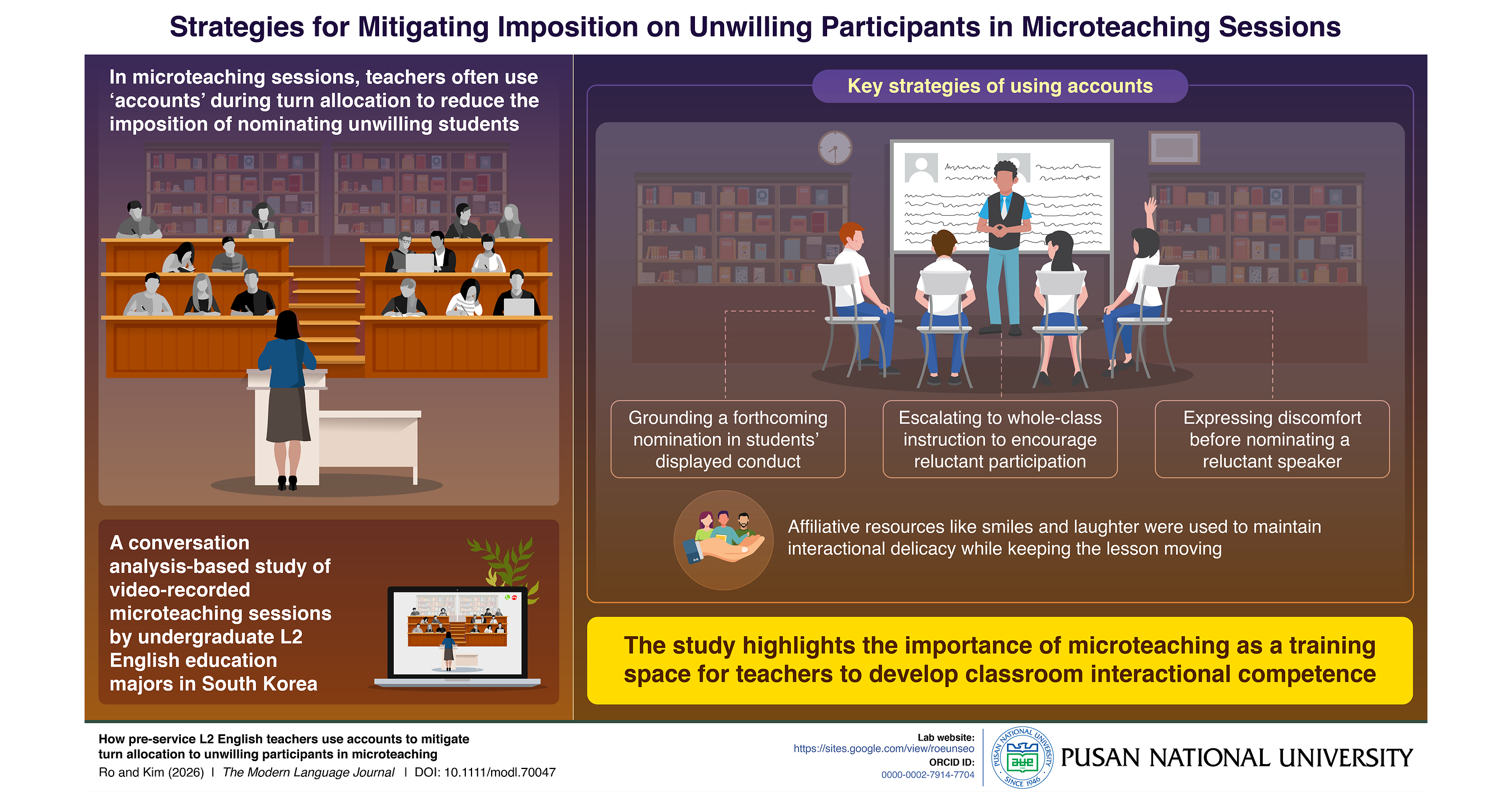
A Pusan National University study (Modern Language Journal, Mar 2, 2026) analyzes how pre-service L2 English teachers use “accounts” and gradual turn allocation tactics—grounding nominations in student cues (e.g., “comment face”), expressing pre-nomination discomfort, and escalating from invitations to direct nominations—to manage reluctant participation. The research is focused on conversation-analysis methods and teacher-education implications, with no financial metrics or corporate market-moving effects reported.
This is not a direct market event; the only investable takeaway is that the monetizable part of “teacher quality” sits far upstream from public equity P&Ls. If there is any spillover, it is into long-cycle teacher-training content, classroom analytics, and coaching tools, but the revenue pool is small, procurement is slow, and the willingness-to-pay is usually absorbed by universities rather than scaled software budgets.
The second-order winner is likely not a traditional ed-tech content vendor but any platform that can turn soft-skill feedback into measurable workflow value: speech analytics, AI lesson review, or classroom-engagement scoring. Even there, the adoption hurdle is high because institutions tend to classify this as pedagogy, not software ROI, so the near-term effect on ARR, margins, or multiples should be negligible.
Contrarian view: the consensus may overstate this as “AI in education” validation. The paper actually reinforces that human nuance and relational signaling matter, which makes automation less substitutable than bulls might assume. Absent a policy mandate, curriculum standardization, or a procurement cycle that explicitly budgets for participation-analysis tools, this remains an academic signal with no clear earnings catalyst over the next 1-3 months or even 6-18 months.
AI-powered research, real-time alerts, and portfolio analytics for institutional investors.
Request TrialOverall Sentiment
neutral
Sentiment Score
0.10
