
StimCardio's NeuroPulse Study Reports Substantial Reduction in Recurrent Atrial Fibrillation Events Via Non-Invasive Wearable Neuromodulation Following Ablation
Source: PR Newswire
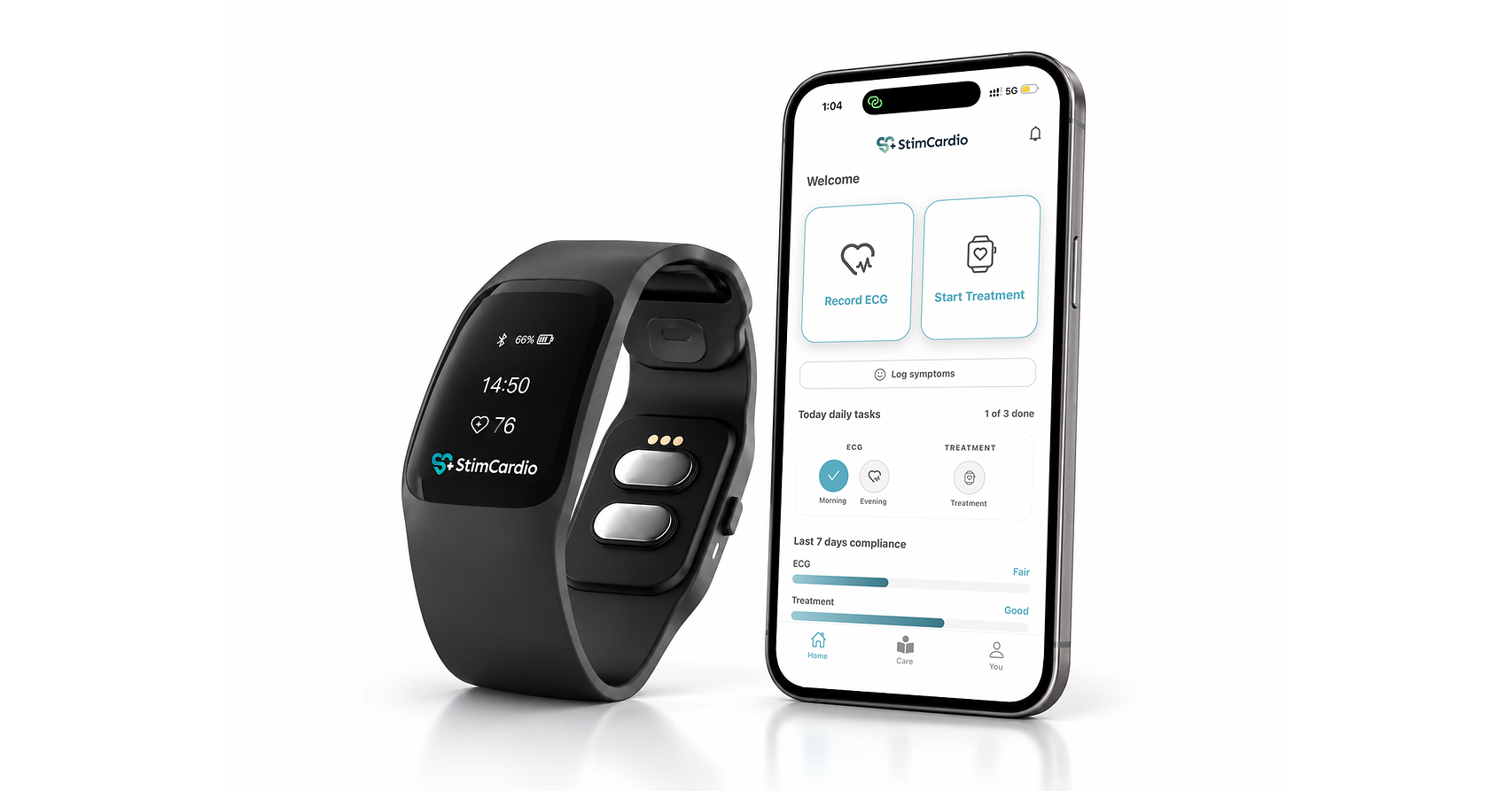
StimCardio's 77-patient randomized NeuroPulse pilot showed 90.0% freedom from atrial arrhythmias at six months with non-invasive median nerve stimulation versus 80.8% with sham following AF ablation. The active-treatment group had 12 recurrent arrhythmia events versus 28 for sham in the post-blanking sensitivity analysis (p=0.025), with no device- or treatment-related serious adverse events. The six-month freedom-from-arrhythmia difference was not statistically significant, and the company plans a larger pivotal trial for its investigational Rhyvive wrist-worn neuromodulation device.
Analysis
This is not yet investable for public-equity exposure: StimCardio is private, and the result does not establish a commercially meaningful efficacy claim because the clinically intuitive patient-level recurrence endpoint was not statistically significant. The more relevant signal is strategic rather than financial: if a pivotal study confirms benefit, post-procedure recurrence could become an addressable recurring-revenue layer around AF ablation rather than a reason to replace catheter platforms.
The read-through for Boston Scientific (BSX), Johnson & Johnson (JNJ), Medtronic (MDT), and Abbott (ABT) is modestly positive over 6-18 months. A home-based adjunct that reduces repeat procedures could initially appear dilutive to procedure volumes, but it likely expands physician confidence in treating more marginal AF patients and makes ablation platforms more valuable within an integrated care pathway; the platform owner with the strongest EP workflow, monitoring, and contracting footprint would be best positioned to capture that economics. Pure-play rhythm-monitoring vendors, including iRhythm (IRTC), could benefit if payer coverage requires objective longitudinal rhythm documentation, although reimbursement may favor lower-cost intermittent monitoring rather than premium patches.
The consensus risk is treating a peer-reviewed pilot and a late-breaking presentation as validation of a new device category. The key gating items are durability through 12 months, reproducibility across centers and AF subtypes, adherence to prescribed stimulation, FDA pathway clarity, and a reimbursement code that supports physician oversight. Without a clearly powered pivotal endpoint and evidence that avoided recurrence offsets device and monitoring cost, adoption is likely limited to academic EP centers rather than broad commercial penetration.
AllMind Terminal
AI-powered research, real-time alerts, and portfolio analytics for institutional investors.
Request TrialMarket Sentiment
Overall Sentiment
moderately positive
Sentiment Score
0.58
Key Decisions for Investors
- No direct position on the announcement; do not extrapolate a private-company pilot into revenue estimates for BSX, JNJ, MDT, ABT, or IRTC before pivotal-study design, enrollment, and reimbursement strategy are disclosed.
- Maintain BSX as the preferred large-cap EP exposure over MDT on a 6-18 month horizon: its PFA/EP franchise has greater upside from an expanding ablation care pathway, while the risk is any evidence that adjunct therapy reduces repeat-ablation utilization without increasing new-patient treatment. Reassess if EP procedure-growth guidance decelerates by more than 300 bps.
- Set an event-driven watch on IRTC rather than initiating: consider a long only if a pivotal protocol mandates continuous ECG assessment or if commercial partnerships identify patch monitoring as the compliance/outcomes infrastructure. Falsifier: use of implantable-loop or consumer wearable data eliminates the need for reimbursed patch monitoring.
- For healthcare-device portfolios, monitor pivotal enrollment and FDA designation over the next 12-24 months; a statistically robust 12-month recurrence reduction of at least 8-10 percentage points, paired with a credible payment pathway, would create a more actionable long opportunity in strategic partners or a future IPO rather than in incumbent ablation manufacturers.
More News
- Chinese biopharma stocks jump as U.S. weighs keeping door open to drug deals
- Here are the 3 big things we're watching in the stock market this week
- Tech leads shares higher in Asia, oil eases
- China slows humanoid robot IPO rush as hype outruns reality
- Porsche could face another 4,000 job cuts, Handelsblatt reports
- Why is Telix Pharmaceuticals stock sliding today?