
ShortDot Reveals 80 Short, Memorable gTLD Strings Across 40 ICANN Applications
Source: Newswire
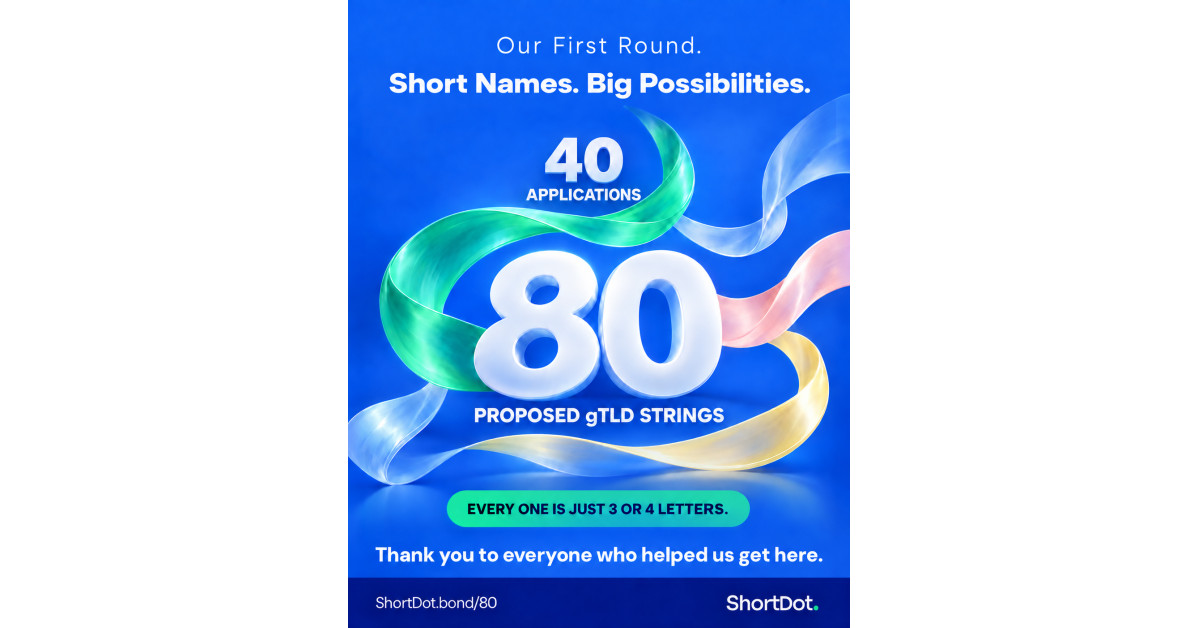
ShortDot submitted 40 applications to ICANN's 2026 New gTLD Program, comprising 40 primary strings and 40 designated replacement strings, including proposed extensions such as .agi, .api, .hub and .zen. The registry operator, which manages more than 4 million domains and works with over 400 registrar partners, is seeking to expand its portfolio of short generic domain extensions. The applications remain subject to ICANN evaluation and delegation, and the proposed TLDs are not yet available for registration.
Analysis
This is not currently investable public-equity information: ShortDot is private, the assets have no confirmed delegation economics, and an application portfolio is not evidence of demand or pricing power. The relevant market mechanism is a likely increase in contention for commercially intuitive strings, which raises auction and objection costs before any recurring registry revenue exists. ICANN process duration also makes this a multi-year optionality event rather than a near-term earnings catalyst.
The more relevant second-order effect is on incumbent registry operators and registrar distribution. If short generic extensions gain adoption, they could marginally dilute renewal and new-registration demand for legacy generic TLDs operated by Verisign (VRSN) and Identity Digital, while expanding transaction volume for registrars such as GoDaddy (GDDY) and Tucows (TCX). In practice, consumer awareness, SEO neutrality, abuse controls, and registrar promotion determine outcomes far more than string quality; most prior new-TLD launches have produced weak premium-name economics outside a narrow set of categories.
Over 1-3 months, monitor ICANN application disclosures, contention sets, and any auction/delegation timetable rather than extrapolating from claimed domain-management scale. Over 6-18 months after delegation, the falsification test for a disruptive thesis is straightforward: if registrations do not reach meaningful renewal cohorts and registrar shelf placement, the extensions remain marketing inventory rather than a competitive threat. No broad public-market trade is warranted on this announcement alone.
AllMind Terminal
AI-powered research, real-time alerts, and portfolio analytics for institutional investors.
Request TrialMarket Sentiment
Overall Sentiment
mildly positive
Sentiment Score
0.25
Key Decisions for Investors
- No immediate position: do not trade VRSN, GDDY, or TCX on an unapproved private-registry application portfolio; the financial linkage is too indirect and the timeline is uncertain.
- Create a 12-24 month watchlist for VRSN: reassess only if ICANN identifies high-value contention outcomes and delegated short generic TLDs show sustained paid registrations and renewal rates sufficient to affect .com net-add expectations. A material downward revision to VRSN registration/renewal guidance would be the actionable trigger.
- Monitor GDDY and TCX registrar merchandising data after any delegations. Long GDDY versus short VRSN is a potential structural pair only if registrars receive demonstrably higher attach-rate or premium-registration economics while .com net additions weaken; absent those data, avoid the pair.
- Treat any secondary-market enthusiasm around proposed strings as an alert for auction-cost escalation, not validation of registry value. Higher winning-bid costs reduce prospective operator IRRs and can make even popular strings economically unattractive.
More News
- US Senate crypto bill collapses in blow to industry
- BlackRock’s Fink, Blackstone’s Gray Back Carney’s Canada Investment Push
- Two camps have emerged in the debate over AI safety and regulation
- Exclusive-Malaysia talks to rival airlines as it monitors AirAsia’s financial health, sources say
- AWS says it can't restore service to Bahrain, UAE facilities 6 months after Iran strikes
- Australia’s Reliance Worldwide agrees to Brookfield’s $2.9 billion buyout bid
From AllMind Research
- Anthropic IPO Preview: Valuation, Timing, and What to Watch
- Shein After the IPO: Venue, Valuation, and What Must Be Proved
- What AI Research Tools Should a Small Hedge Fund Buy First?
- State of Public Markets, June 2026: Higher for Longer Meets the AI Supercycle
- AI Research Tools With Exact Source Citations