
CloudZero launches AI Signals to put finance leaders back in control of AI spend
Source: PR Newswire
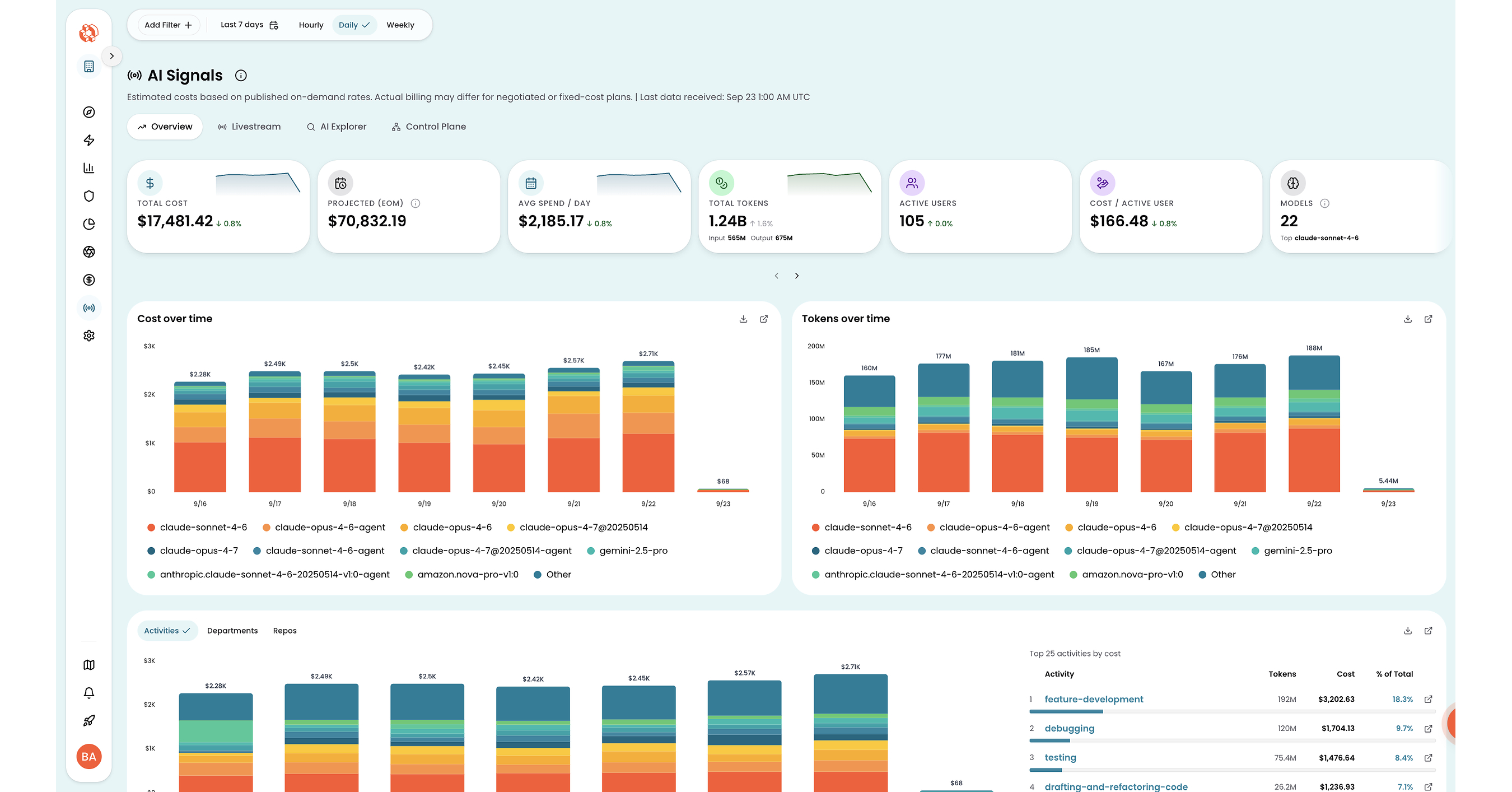
CloudZero launched AI Signals, a real-time AI cost-management platform that attributes spending by individual, team, model and 35+ business activities across providers including OpenAI, Anthropic, Google, AWS Bedrock and Fireworks. The product adds an Overview dashboard and Monitors alerts, including examples such as a 3.4x week-over-week increase in Claude Sonnet spending and $900 of weekly GPT-5 marketing spend at 6x its trailing average. The launch addresses a growing enterprise cost-control need as McKinsey estimates AI spending rises nearly fourfold during scaling and 93% of organizations exceed AI budgets.
Analysis
This is strategically constructive for the AI-finops category but not a near-term earnings event for the named public companies. The relevant mechanism is that granular attribution lowers the organizational friction to expanding AI budgets: finance can approve high-ROI use cases while cutting waste, which should increase utilization of inference providers over a 6-18 month horizon. The offset is provider-level pricing pressure, as customers armed with activity-level cost data can more quickly route workloads toward lower-cost models, cached inference, or open-source alternatives; this is modestly negative for premium-model revenue per token but supportive of total workload volume.
For GOOG, better enterprise observability may help Gemini/Vertex win workloads where procurement demands auditable unit economics, particularly against closed-model vendors that cannot demonstrate lower cost per business outcome. However, the direct revenue contribution is immaterial and CloudZero's multi-provider architecture reduces vendor lock-in rather than creating it. COIN, KVYO, NU, and RPD may gain operating leverage at the margin if AI spend shifts from broad experimentation toward measurable automation, but none has disclosed enough AI-cost intensity for this launch to alter estimates.
The contrarian point is that stronger cost governance can initially suppress reported AI consumption: the first 1-3 months after deployment often expose duplicate seats, oversized models, and uncontrolled agent loops. A broad inference-spend slowdown would therefore not necessarily signal weakening AI adoption; it could represent optimization before a second-wave volume ramp. No directional equity trade is justified from this release alone, and the key falsifier of the optimization thesis would be enterprise AI vendors reporting sustained seat and inference expansion without any offsetting gross-margin pressure.
AllMind Terminal
AI-powered research, real-time alerts, and portfolio analytics for institutional investors.
Request TrialMarket Sentiment
Overall Sentiment
moderately positive
Sentiment Score
0.42
Ticker Sentiment
Key Decisions for Investors
- No immediate position in COIN, KVYO, NU, or RPD: treat the customer association as non-material until management quantifies AI-driven opex savings, support-cost reduction, or incremental revenue in quarterly disclosures.
- Maintain GOOG as the liquid public proxy for enterprise AI cost-governance adoption, but add only on evidence that Vertex/Gemini consumption growth outpaces cloud revenue expectations over the next 1-2 earnings cycles; exit a tactical overweight if Cloud growth decelerates while AI capex continues rising, indicating margin dilution without monetization.
- Monitor Datadog (DDOG), ServiceNow (NOW), and Snowflake (SNOW) for analogous AI governance/FinOps product adoption: an enterprise shift from experimentation to governed production workloads would favor platforms embedded in observability, workflow approvals, and data governance over point tools. Require disclosed AI-product ARR, net retention, or consumption acceleration before initiating.
- Set an industry alert for materially lower enterprise inference pricing or rising mentions of model-routing and caching in provider earnings calls. That would favor cloud platforms with scale economics such as GOOG while challenging pure premium-model monetization, but the timing and revenue allocation data are currently insufficient for a pair trade.
More News
- Meta's standoff with Amazon over Muse could be a sign of things to come
- Why ASEAN’s coming digital economy trade agreement deserves your attention
- Wall Street falls as oil prices, Treasury yields rise
- Meta is having a ChatGPT moment with Muse. What is it and what makes it so special
- A rare Microsoft bear warms up to the stock. Here's what changed their mind
- Trump calls AI oversight a ‘globalist scheme’ as Amodei and Altman head to the UN to ask for it
From AllMind Research
- Anthropic IPO Preview: Valuation, Timing, and What to Watch
- Shein After the IPO: Venue, Valuation, and What Must Be Proved
- What AI Research Tools Should a Small Hedge Fund Buy First?
- Run Cost-Controlled Financial Research in AllMind Agent Studio
- State of Public Markets, June 2026: Higher for Longer Meets the AI Supercycle