
Hanwha Power Receives ABS Approval in Principle for 1,700 TEU Battery-Powered Containership Design
Source: PR Newswire
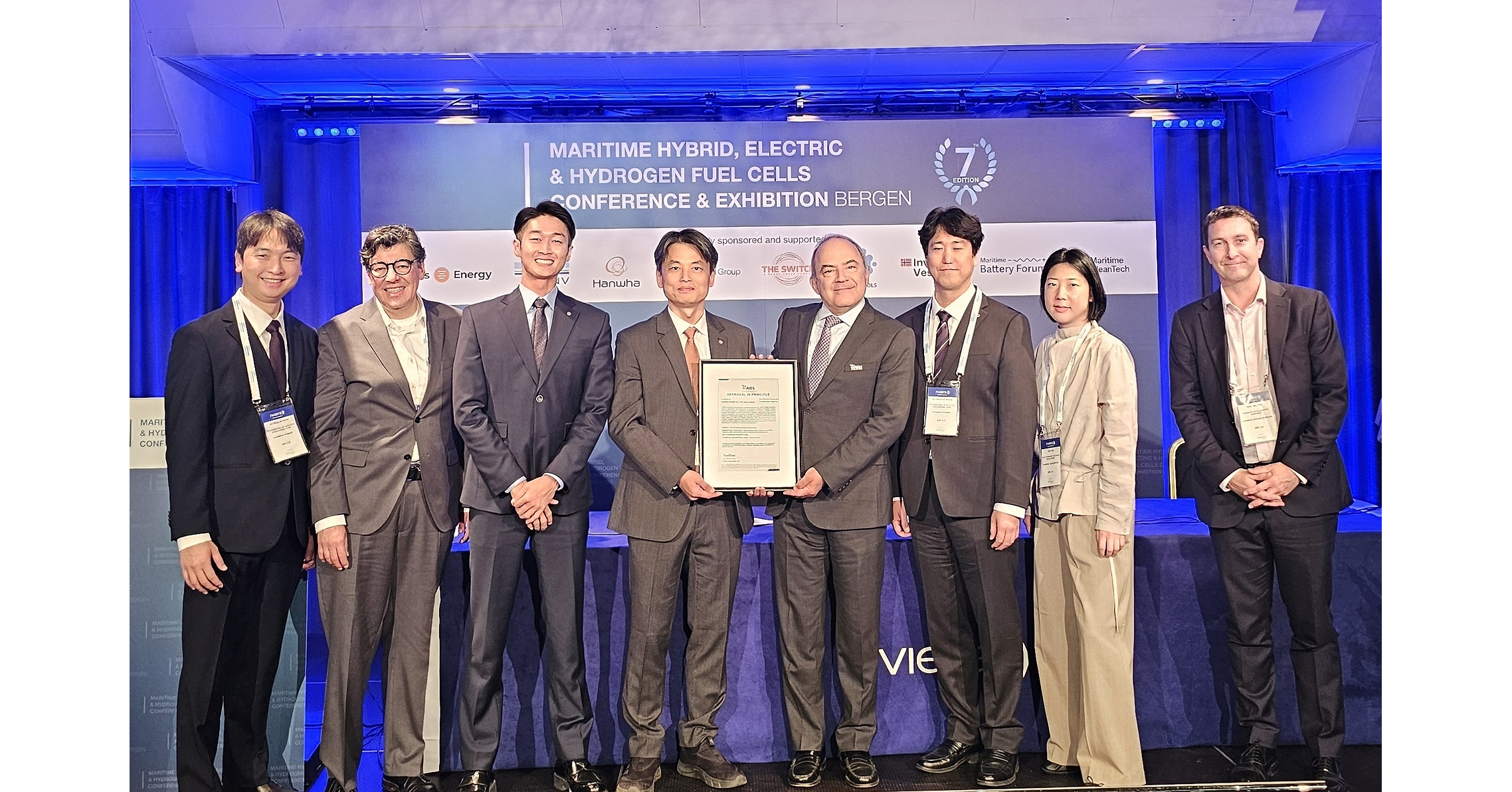
Hanwha Power received ABS Approval in Principle for a 1,700 TEU fully electric containership design with approximately 151 MWh of containerized battery storage, intended to enable zero-direct-emission operation using port charging. The company also completed the basic design for a 1,000 TEU battery-powered vessel and plans to expand its electric-propulsion portfolio for regional maritime transport; the announcement marks a technology and market-development milestone, with no financial results or market reaction reported.
Analysis
Signal quality: ABS Approval in Principle reduces design-certification uncertainty, not construction, operating-cost, or customer-demand risk. With no vessel order, financing commitment, or route economics disclosed, the announcement has little basis for near-term earnings revisions at Hanwha Power; treat it as capability validation rather than a commercial inflection.
Second-order effects: The plausible beachhead is short, predictable regional routes where vessels can recharge on schedule. Adoption depends on the all-in cost and availability of high-capacity port charging, grid upgrades, battery replacement, and battery-life performance—not just propulsion design. If containerized batteries prove operationally practical, demand could accrue to marine electrical integrators, battery suppliers, and port-power providers, while incumbent propulsion vendors face substitution pressure on those routes. Conversely, battery mass, degraded cargo economics, or charging downtime could erase fuel and emissions benefits. ABS approval alone does not resolve these trade-offs.
Timing and contrarian view: Immediate market impact should be limited. Over 1–3 months, watch for named shipowner, shipyard, or port partners and a funded demonstration; over 6–18 months, actual orders and route-level utilization would matter. The optimistic framing may overstate how quickly a certified concept becomes bankable fleet deployment. A firm order with disclosed route economics would change that assessment.
AllMind Terminal
AI-powered research, real-time alerts, and portfolio analytics for institutional investors.
Request TrialMarket Sentiment
Overall Sentiment
mildly positive
Sentiment Score
0.30
Key Decisions for Investors
- No event-driven position in Hanwha Power or battery suppliers on this announcement alone; the commercial evidence is insufficient and no supplied ticker mapping supports a direct security recommendation.
- Add marine electrification and port-power suppliers to a watchlist, but require a funded vessel order, charging-infrastructure commitments, and credible lifecycle-cost data before expressing a long thesis.
- Track customer announcements and any disclosed vessel utilization, battery degradation, charging time, and cargo-capacity trade-offs. These are the key tests of whether the concept can scale beyond short, fixed routes.
- Falsify the adoption thesis if demonstrations show material cargo-capacity loss, unreliable charging access, or unfavorable operating economics; upgrade it only if repeat orders and route-level performance validate commercial viability.
More News
- AI Doubts Spread Cracks in Equities, Credit Markets: Evening Briefing Americas
- Apple’s $2,000 iPhone Duo Debuts With Limited Supply
- Are global oil reserves sufficient to withstand renewed US-Iran war?
- Boeing 777 freighter output halted for two months over supplier row
- Exclusive-Boeing supplier dispute has halted 777 freighter production for two months, sources say
- OpenAI Trims Target Value & Volvo Cars Cuts 2,500 Jobs