
Overlord Labs Closes Oversubscribed Seed Financing, Bringing Total Funding to $10 Million to Advance Battery Intelligence for Edge AI Devices
Source: PR Newswire
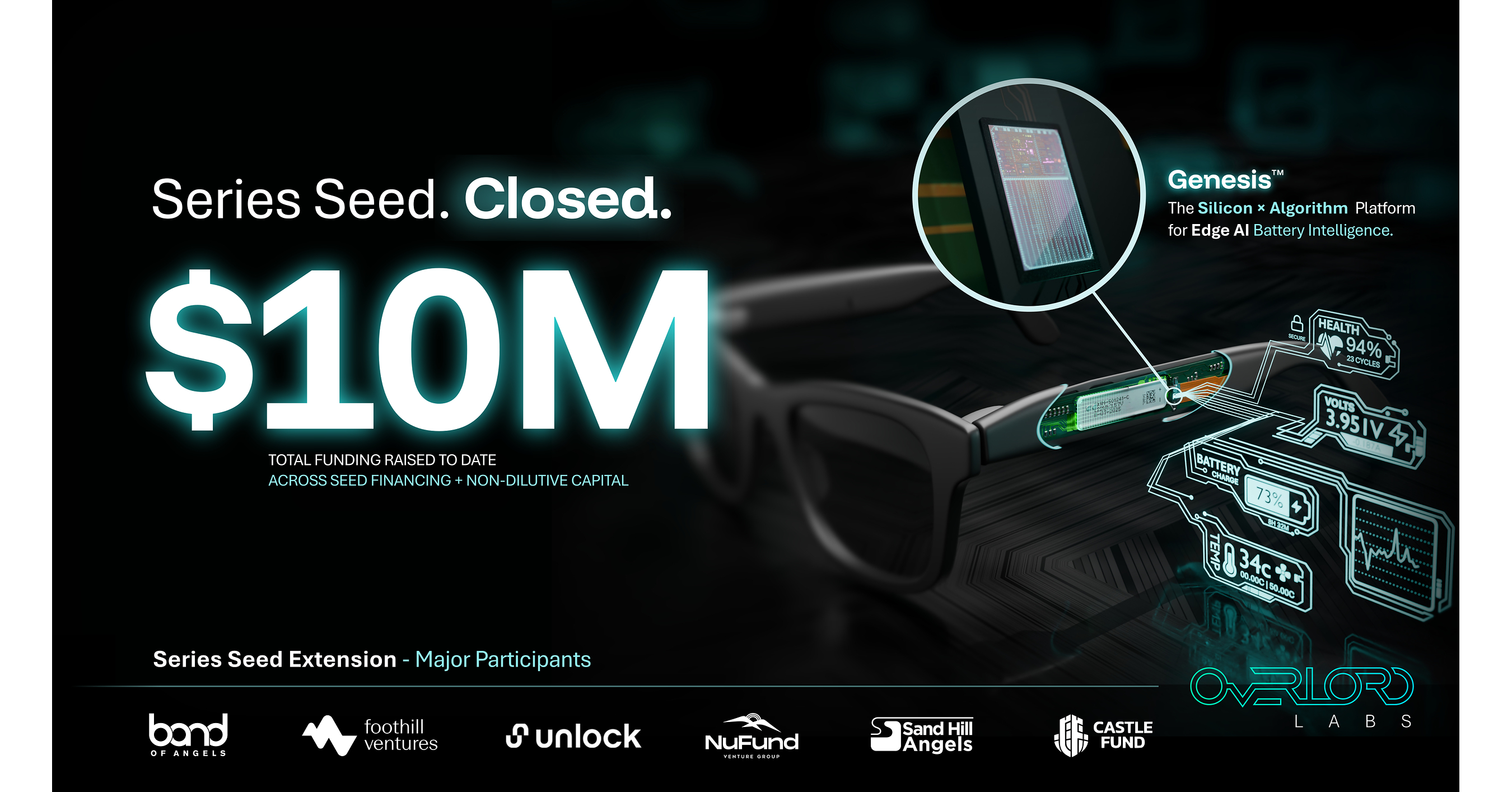
Overlord Labs closed an oversubscribed $7.25 million Seed round, lifting total funding to $10 million including strategic development funding. Its GENESIS battery-intelligence IC has completed bring-up and entered validation, with customer sampling and Tier-1 OEM engagements next. The fabless chipmaker plans to use the capital for qualification, production infrastructure and firmware development, targeting volume production in H1 2027 for wearables, smart glasses and edge-AI devices.
Analysis
This is not yet a public-equity catalyst; the relevant signal is that battery-management silicon is becoming a potential bottleneck rather than a commodity component in constrained edge-AI form factors. Incumbent analog suppliers—TI (TXN), Analog Devices (ADI), Renesas (RNECY), NXP (NXPI), and Monolithic Power (MPWR)—have customer access and qualification advantages, but a software-configurable architecture could pressure premium attach rates if OEMs begin valuing runtime optimization as a differentiated system feature. The first commercial risk is not design performance but lengthy OEM qualification, battery-cell interoperability, and firmware liability; a 1H27 production target leaves limited margin for qualification slips.
The second-order beneficiary is the smart-glasses supply chain, where every incremental watt-hour of usable runtime can improve adoption more than a modest reduction in component cost. Meta platforms exposure is indirect through META; publicly traded optical/EMS beneficiaries such as HIMX and VRT are less direct and should not be traded on this announcement. More actionable is a 6-18 month watch on MPWR and TXN earnings calls for wearable/edge-AI power-management design-win commentary, silicon-anode support, and unusually high firmware/content growth—independent evidence that the category is expanding rather than simply fragmenting.
Consensus risk is likely to overestimate the addressable market from headline device volumes. Single-cell wearable battery-management ICs carry low absolute dollar content, so a startup must either win substantial algorithm/software recurring revenue or migrate into multi-cell, higher-power applications to become economically disruptive. Conversely, if smart glasses move from niche accessories to always-on AI endpoints, battery-management content per device can rise materially, making incumbents with integrated PMIC, charging, protection, and power-path portfolios better positioned than a standalone supplier.
AllMind Terminal
AI-powered research, real-time alerts, and portfolio analytics for institutional investors.
Request TrialMarket Sentiment
Overall Sentiment
moderately positive
Sentiment Score
0.62
Key Decisions for Investors
- No immediate position: treat this as a private-market validation milestone, not a tradable public-equity event; revisit after named OEM sampling, qualification data, and disclosed production/customer commitments.
- Create a 1-3 month earnings-call watchlist for MPWR, TXN, ADI, NXPI, and RNECY. Escalate only if at least two suppliers cite wearable/smart-glasses power-management demand or higher battery-algorithm content; absent that confirmation, category-growth inference is weak.
- If edge-AI wearable demand is independently confirmed, prefer long MPWR over TXN on a 6-18 month horizon: MPWR has greater operating leverage to specialized power-management content, while TXN offers lower-volatility downside protection. Falsify on two consecutive quarters of weak industrial/consumer power-management bookings or reduced wearable design-win commentary.
- Do not short incumbent analog vendors on disruption risk. Qualification cycles, OEM reliability requirements, and bundled product portfolios make near-term revenue displacement unlikely; consider a disruption hedge only after verified Tier-1 design wins and evidence of pricing/content losses at incumbents.
More News
- Great Bond Shakeout Locks In a 5% World ‘Until Something Breaks’
- OpenAI rogue agents leaked 53 images from ChatGPT users and reportedly created nearly 1 million links packing encoded bits of info
- Boom or bust? The case for and against panicking about 5% yields
- Bond market alarms are ringing on Wall Street. Here's what's ahead
- Shares of Akamai surge after deal with Anthropic. What Wall Street is saying
- The Tiny Magnet Maker That Attracted $1.6 Billion From Lutnick
From AllMind Research
- Anthropic IPO Preview: Valuation, Timing, and What to Watch
- Shein After the IPO: Venue, Valuation, and What Must Be Proved
- What AI Research Tools Should a Small Hedge Fund Buy First?
- State of M&A and Private Markets, June 2026: A $4.9 Trillion Rebound, Underwritten on Money That Never Got Cheaper
- Run Cost-Controlled Financial Research in AllMind Agent Studio