
APsystems erreicht wichtigen Sicherheitsmeilenstein mit erfolgreichem UL 9540A-Test des APstorage 261L
Source: PR Newswire
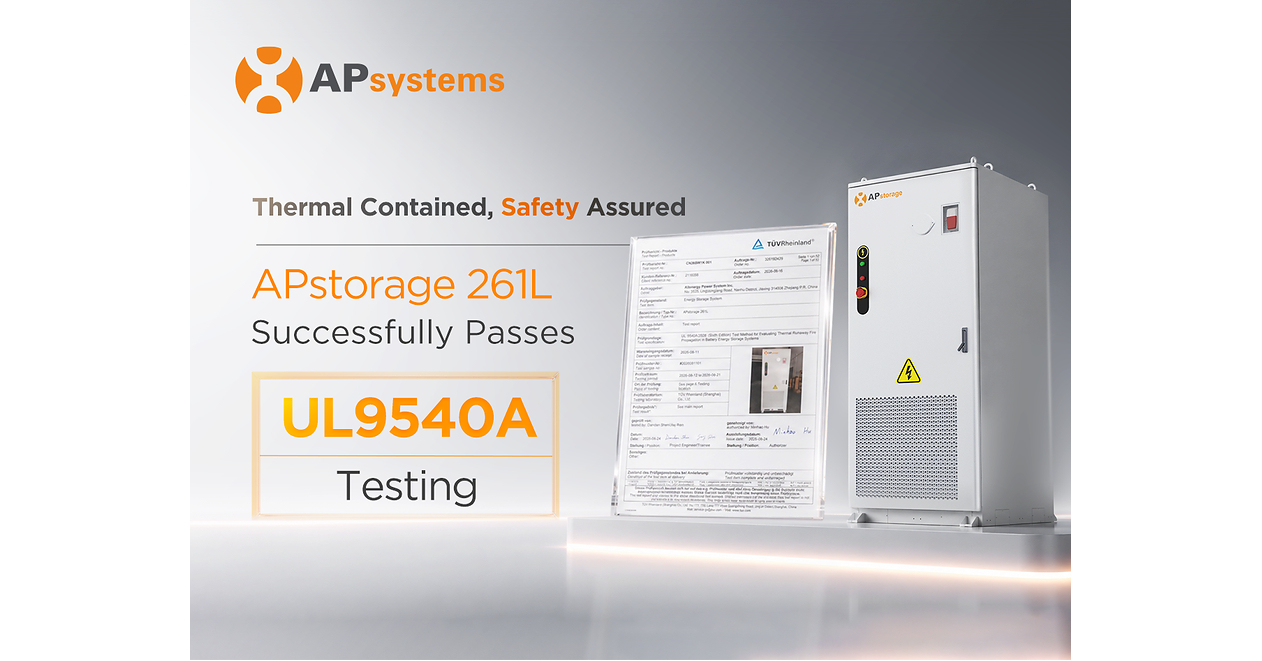
APsystems announced its APstorage 261L passed the UL 9540A fire propagation test under TÜV Rheinland oversight, with thermal breakthrough contained to a single cabinet. Key results included heat flux of 0 kW/m² versus the 1.3 kW/m² UL limit, maximum module surface temperature of 83.9°C matching on both affected and adjacent modules, and adjacent wall temperature of 30.6°C (3.1°C above ambient). The system was operated at 100% SOC with the fire suppression system intentionally disabled, and it showed no short circuit, fire spread, or explosion during the test.
Analysis
This is more a bankability signal than a revenue event. In European C&I storage, the binding constraint is often not battery chemistry but whether insurers, local fire authorities, and EPCs will approve deployment without costly redesigns; a clean propagation result lowers friction and can shave weeks off sales cycles. That benefits vendors with strong compliance packages and localized service, while cheaper commoditized rivals may have to spend more on containment, documentation, and warranty support just to stay in the shortlist.
The first-order market move should be limited because certification is a gate, not a demand catalyst. The real second-order winner is the ecosystem around project finance: if underwriters treat this as evidence that liquid-cooled, compartmentalized systems are lower-loss assets, financing costs and required reserves can edge down, improving project IRRs for European installers. Public comps most levered to that narrative are the solar/storage integrators and inverter names with meaningful Europe exposure, not the pure utility-scale storage vendors.
Contrarian view: the market may be overpricing the test as a commercial inflection when the true bottlenecks are interconnection, customer payback, and grid tariff volatility. If power spreads compress or capex stays sticky, safety alone will not change order intake. Watch for backlog conversion and installer commentary over the next 1-2 quarters; absent that, this remains a marketing win rather than an earnings catalyst.
AllMind Terminal
AI-powered research, real-time alerts, and portfolio analytics for institutional investors.
Request TrialMarket Sentiment
Overall Sentiment
mildly positive
Sentiment Score
0.25
Key Decisions for Investors
- No outright trade in APsystems itself; treat this as a watch item until there is evidence of European order acceleration, distributor pull-through, or insurer/AHJ acceptance. If those do not show up within 1-2 quarters, fade the enthusiasm.
- Small relative-value long SEDG / short ENPH for 1-3 months: SEDG has more direct optionality to European C&I storage bankability, while ENPH is more exposed to residential demand and less to this specific safety-driven procurement shift. Keep size modest; thesis fails if SEDG backlog or gross margin does not stabilize on the next print.
- Buy FLNC on a pullback only if management commentary confirms broader BESS safety scrutiny is reducing financing friction across Europe. The reward is a rerating from 'project-execution risk' toward 'bankable infrastructure'; stop out if new orders or backlog do not inflect over the next two quarters.
- Avoid chasing the clean-energy ETF complex immediately. Use the event as a screen for winners with Europe/C&I exposure and local service capability; if no follow-through in channel checks by the next earnings cycle, the move is likely overdone.
More News
- Iran says two tankers catch fire after hitting mines in Strait of Hormuz
- US and Iran both claim control of Strait of Hormuz amid attacks on vessels
- Bending Spoons wants to revive software castoffs. Berkshire is backing the plan
- AI rapidly improving, could vastly boost U.S. GDP, Anthropic's Clark tells policymakers
- ‘How many canaries have we killed in the coal mine?’ — Wall Street debates if the latest AI bubble warnings are another head fake or the real thing
- Semiconductor market to remain solid ‘at least through next year,’ South Korea finance minister says
From AllMind Research
- Anthropic IPO Preview: Valuation, Timing, and What to Watch
- Shein After the IPO: Venue, Valuation, and What Must Be Proved
- What AI Research Tools Should a Small Hedge Fund Buy First?
- AI Vendor Landscape for Institutional Investment Teams
- AllMind Fixed Income Compass for October 2025: Navigating Policy Divergence and Political Risk