
Global Hydraulic Fluid Market to Reach USD 11.91 Billion by 2034 as Construction, Bio-Based Fluids and Aftermarket Demand Strengthen, says Maximize Market Research
Source: PR Newswire
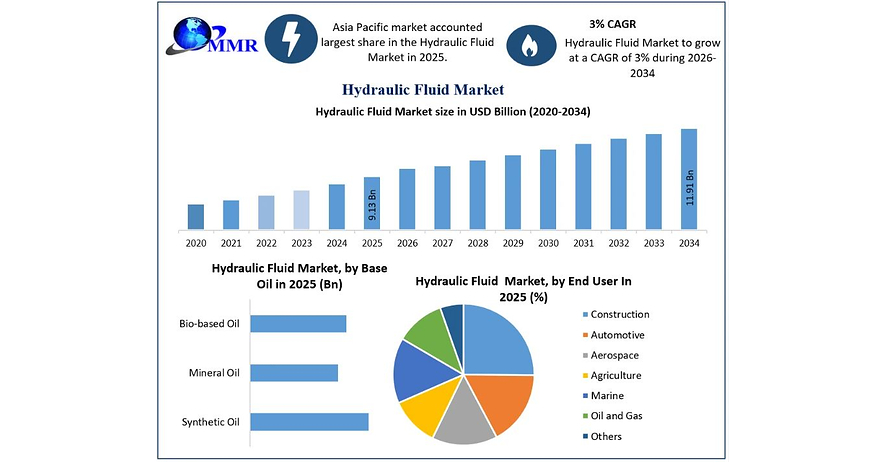
The global hydraulic fluid market is forecast to expand from $9.13 billion in 2025 to $11.91 billion by 2034, a 3% CAGR, supported by construction, industrialization, mining and agricultural mechanization. Bio-based oils led with a 36% share in 2025, while construction accounted for 21% of end-use demand, aftermarket sales represented 56%, and Asia Pacific held a 29% regional share. Growth is increasingly centered on biodegradable, synthetic, fire-resistant and energy-efficient formulations, including LANXESS's July 2026 local production of Reolube fire-resistant fluids in Gujarat, India.
Analysis
This is not an earnings-relevant demand signal for SHEL, BP, CVX, TTE, PSX or VVV: hydraulic fluids are a small, low-growth subset of their lubricant portfolios, and the cited market forecast is not independently verifiable. The investable read-through is instead mix: fire-resistant, synthetic and environmentally acceptable fluids carry materially higher formulation and qualification barriers than commodity mineral oils, creating potential gross-margin resilience for specialty suppliers FPE3, LXS and KWR even if aggregate lubricant volumes remain subdued.
LXS's India production and HPCL distribution relationship could reduce freight, lead-time and working-capital requirements while improving access to industrial and aviation-adjacent customers. The second-order risk is that local blending ultimately commoditizes standard formulations; only products requiring OEM certification, safety approvals, or demonstrated equipment-life savings should sustain premium pricing. FPE3 is relatively better positioned if underground mining and high-risk industrial capex improve, while KWR has the strongest potential exposure to aftermarket service economics rather than new-equipment cycles.
Near term, there is no reason to chase a price reaction to a third-party market-study release. Over 1-3 months, monitor India industrial-production and construction-equipment data, plus disclosed lubricant volume/margin commentary from LXS and FPE3. Over 6-18 months, the thesis becomes credible only if specialty-lubricant mix rises faster than raw-material costs; it is falsified by flat-to-down segment EBIT margins despite volume growth, or by OEMs shifting toward lower-fluid-use electrified equipment and centralized maintenance programs that lengthen replacement intervals.
AllMind Terminal
AI-powered research, real-time alerts, and portfolio analytics for institutional investors.
Request TrialMarket Sentiment
Overall Sentiment
mildly positive
Sentiment Score
0.30
Ticker Sentiment
Key Decisions for Investors
- No immediate directional trade in SHEL, BP, CVX, TTE, PSX or VVV; the addressable revenue increment is too small to overcome crude, refining and broader lubricant-cycle volatility.
- Place FPE3 on a 1-3 month long watchlist: initiate only after results show specialty/mining lubricant volume growth and stable or expanding segment margin despite base-oil costs. Target a 10-15% upside on mix-driven multiple expansion; exit if segment margin contracts by more than 100bp or mining order indicators weaken.
- Monitor LXS for confirmation that Indian production converts into incremental specialty sales rather than price-led share gains. A long is warranted only following disclosed utilization, local-sales growth, or margin evidence; the key risk is lower-margin localization and weak Indian industrial demand.
- Consider a small FPE3 long / broad European chemicals short basket hedge (for example BAS or DOW) only after earnings confirmation: the intended exposure is specialty aftermarket pricing power versus cyclical chemical spreads, not a broad lubricant-volume bet. Close if the relative spread fails to improve through the next two reporting periods.
More News
- ‘You need to clean up the mess your generation has left’: Volkswagen’s guilty boomer gets real about sustainability, China—and his spam folder
- US job growth slows as unemployment rises before midterm elections
- Trump says Iran war could end after U.S. elections as Hormuz tensions persist
- States, cities sue U.S. agencies over weaker vehicle fuel economy rules
- The next weak link in Europe’s bond market? UBS has a new short position
- G7 Leaders’ Statement on global energy security and market stability