
Alaska Airlines Expands Seattle-Area Network With Paine Field Growth
Source: zacks.com
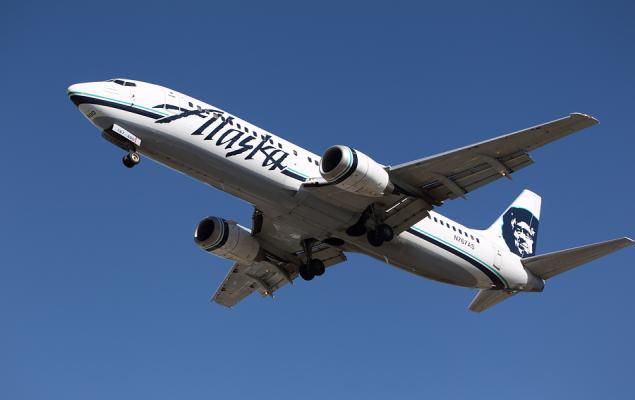
Alaska Airlines plans to increase seating capacity at Seattle/Everett's Paine Field by 50% through summer 2027, including a new twice-daily Horizon Air route to San Jose beginning in spring 2027. The carrier will also operate twice-daily service to Los Angeles using Boeing 737s and to Portland, while adding capacity to San Diego and San Francisco. Separately, Alaska will add three daily Honolulu-Kahului round trips from Oct. 3, 2026, supporting inter-island passenger and cargo demand.
Analysis
The economic value of incremental Paine Field capacity depends less on seat growth than on whether ALK can divert higher-yield North Seattle corporate and affluent leisure traffic from Seattle-Tacoma without diluting system yields. Convenience can support a fare premium and improve loyalty economics, but the near-term capacity adds also raise the risk of local fare competition with Delta (DAL) at Seattle-Tacoma and with Southwest (LUV) on West Coast short-haul routes. The principal second-order beneficiary is Horizon Air utilization: more short-stage flying can improve fixed-cost absorption, provided pilot availability and maintenance reliability do not constrain the schedule.
This is not yet a material earnings catalyst: the rollout spans multiple quarters and the most differentiated new route begins in 2027, leaving limited basis for a near-term estimate revision. The key 1-3 month signal is management disclosure on Paine Field load factors, unit revenue versus Seattle-Tacoma, and incremental aircraft/crew spending; capacity-led growth that trails system RASM would imply margin dilution. Over 6-18 months, success would strengthen ALK's Seattle network moat and feed its broader West Coast loyalty franchise, while failure would expose the fixed costs of operating a fragmented dual-airport network.
The contrarian point is that Boeing (BA) has little direct earnings sensitivity: aircraft deployment is more likely a fleet-allocation decision than evidence of incremental 737 demand. Likewise, the article's references to SHIP, SNDR and QBTS are promotional/non-operational to the airline development and provide no investable read-through.
AllMind Terminal
AI-powered research, real-time alerts, and portfolio analytics for institutional investors.
Request TrialMarket Sentiment
Overall Sentiment
mildly positive
Sentiment Score
0.36
Ticker Sentiment
Key Decisions for Investors
- No immediate directional trade in ALK; treat the announcement as a monitoring catalyst rather than an estimate-changing event. Reassess after the next earnings call if management quantifies Paine Field yield premium, load factors and incremental capex/lease obligations.
- Conditional 6-12 month long ALK / short JETS pair only if ALK guides to stable-or-higher unit revenue while adding this capacity; target a 10-15% relative return from network-driven margin resilience. Exit if ALK's RASM ex-fuel turns negative for two consecutive reported quarters or capacity growth materially exceeds guidance.
- Monitor DAL and LUV pricing on overlapping Seattle-West Coast markets over the next 1-3 months. A visible promotional-fare response would be a negative confirmation for ALK and argues against airline-sector longs, since short-haul capacity additions typically pressure yield before demand stimulation offsets it.
- Do not position in BA, SHIP, SNDR or QBTS on this item; there is no disclosed aircraft order, freight-volume linkage, trucking implication, or fundamental connection sufficient to support a trade.
More News
- One key part of the AI trade has decoupled from the rest. Why that is, and whether it can come back
- Raymond James reiterates Alaska Air stock rating on Investor Day preview
- Can Freeport-McMoRan's Growth Projects Drive the Next Expansion Wave?
- Rigetti, D-Wave, or IonQ: Which Quantum Stock Has the Best Shot at Survival?
- RCL's $3B Sandals Bet Sparks Market Buzz: Is the Stock a Buy?
- Micron vs. NVIDIA: 1 AI Stock to Buy Now and 1 to Watch
From AllMind Research
- Anthropic IPO Preview: Valuation, Timing, and What to Watch
- Shein After the IPO: Venue, Valuation, and What Must Be Proved
- What AI Research Tools Should a Small Hedge Fund Buy First?
- Weekly Update: Adding Live MBO Level 3 Data - Liquidity Heatmap, OFI Charts, and More
- Alternative Data Due Diligence for Institutional Investors