
Trump’s Meeting With New York’s Mamdani Becomes Another Closely-Watched Summit
Source: Bloomberg
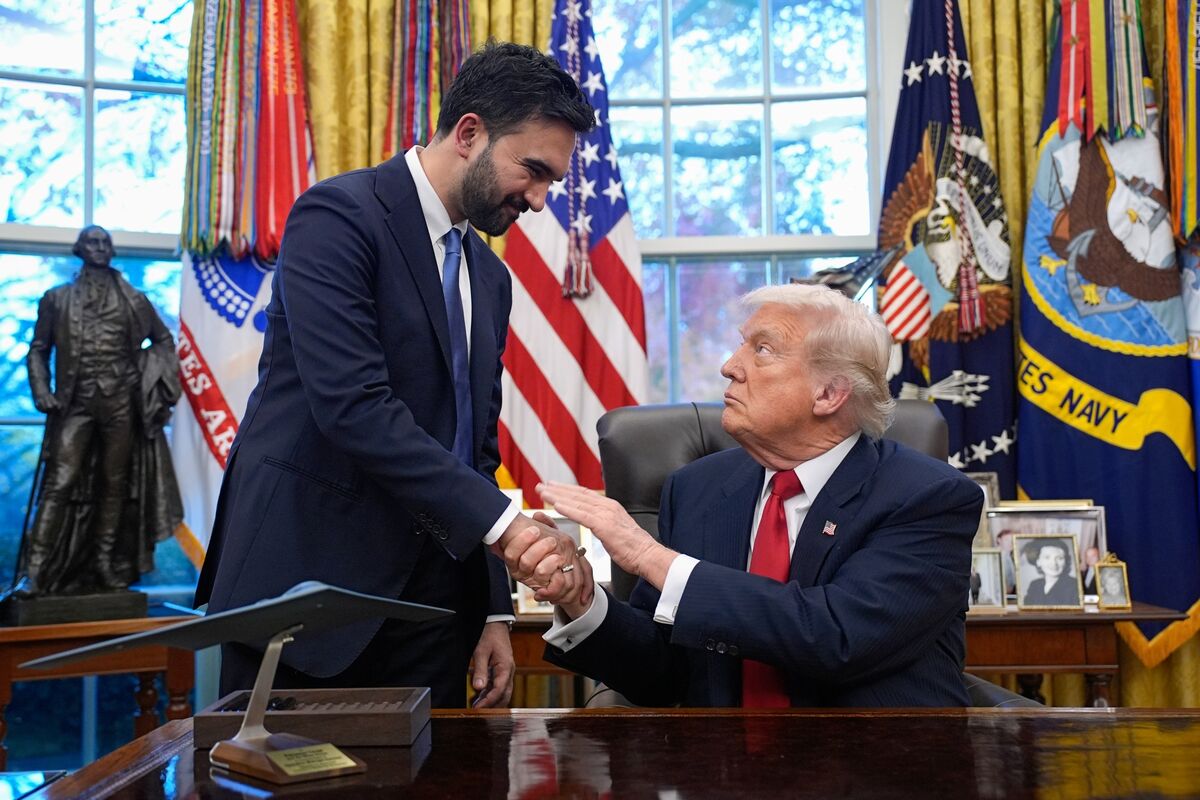
A closely watched meeting between President Trump and New York City Mayor Zohran Mamdani is framed against rising US midterm-election anxieties. The Trump team is seeking to portray Democratic candidates as aligned with Mamdani's democratic-socialist politics, underscoring a potentially central Republican campaign strategy rather than an immediate market-moving policy development.
Analysis
This is primarily a political-signaling event rather than an investable policy catalyst. With no identified fiscal package, regulatory action, or legislative timetable, the immediate market impact should be negligible; the relevant transmission channel is whether national messaging shifts toward redistributive housing, labor, tax, and affordability themes ahead of the midterms.
Over the next 1-3 months, monitor whether populist rhetoric translates into concrete proposals affecting rent regulation, high-income taxation, municipal financing, or financial-sector oversight. A durable affordability-focused campaign would modestly widen the valuation discount for residential REITs and landlord-exposed operators, while potentially supporting politically favored housing-supply beneficiaries; however, federal implementation risk remains low without legislative alignment.
The contrarian view is that highly publicized cross-party engagement can reduce, rather than increase, near-term probability of disruptive policy. Markets tend to price political labels more aggressively than legislative capacity. The actionable signal is not the meeting itself, but subsequent polling, candidate adoption of specific policy planks, and any shift in congressional-control probabilities that would alter the expected tax and regulatory regime over the 6-18 month horizon.
AllMind Terminal
AI-powered research, real-time alerts, and portfolio analytics for institutional investors.
Request TrialMarket Sentiment
Overall Sentiment
neutral
Sentiment Score
-0.05
Key Decisions for Investors
- No directional trade on the event alone; maintain existing US political-risk hedges rather than adding exposure until policy specifics or polling shifts emerge.
- Create an alert for rent-control or landlord-tax proposals gaining federal or state-level traction; if confirmed, evaluate a 3-6 month relative-value short in apartment REITs (AVB, EQR) versus homebuilders (DHI, LEN), contingent on geography and proposal scope.
- Monitor midterm probability markets and generic-ballot movement over the next 1-3 months. A sustained shift toward a legislative outcome that raises corporate-tax or regulatory risk would favor adding downside hedges through SPY or IWM puts rather than single-name political shorts.
- Treat a reversal in campaign rhetoric toward deficit reduction, deregulation, or housing-supply incentives as falsification of the landlord/financial-regulation risk thesis; avoid positioning before observable policy adoption.
More News
- Factbox-Key issues for this week’s Trump-Xi summit in Washington
- Brazil election: Lula and Flavio Bolsonaro tied in latest polls
- California tightens datacenter rules on water and power
- Trump-Xi Summit Puts Global AI Race in Focus
- Russia’s pro-Putin party set to win election as Ukraine exposes war’s growing reach into Moscow
- Trump’s approval rating hits record low amid Iran war, economy fallout
From AllMind Research
- Anthropic IPO Preview: Valuation, Timing, and What to Watch
- Shein After the IPO: Venue, Valuation, and What Must Be Proved
- What AI Research Tools Should a Small Hedge Fund Buy First?
- AI Financial Research Benchmarks: What the Scores Mean
- State of M&A and Private Markets, June 2026: A $4.9 Trillion Rebound, Underwritten on Money That Never Got Cheaper