
What Altman, Amodei, Huang and Zuckerberg are saying about the raging AI debate
Source: MarketWatch
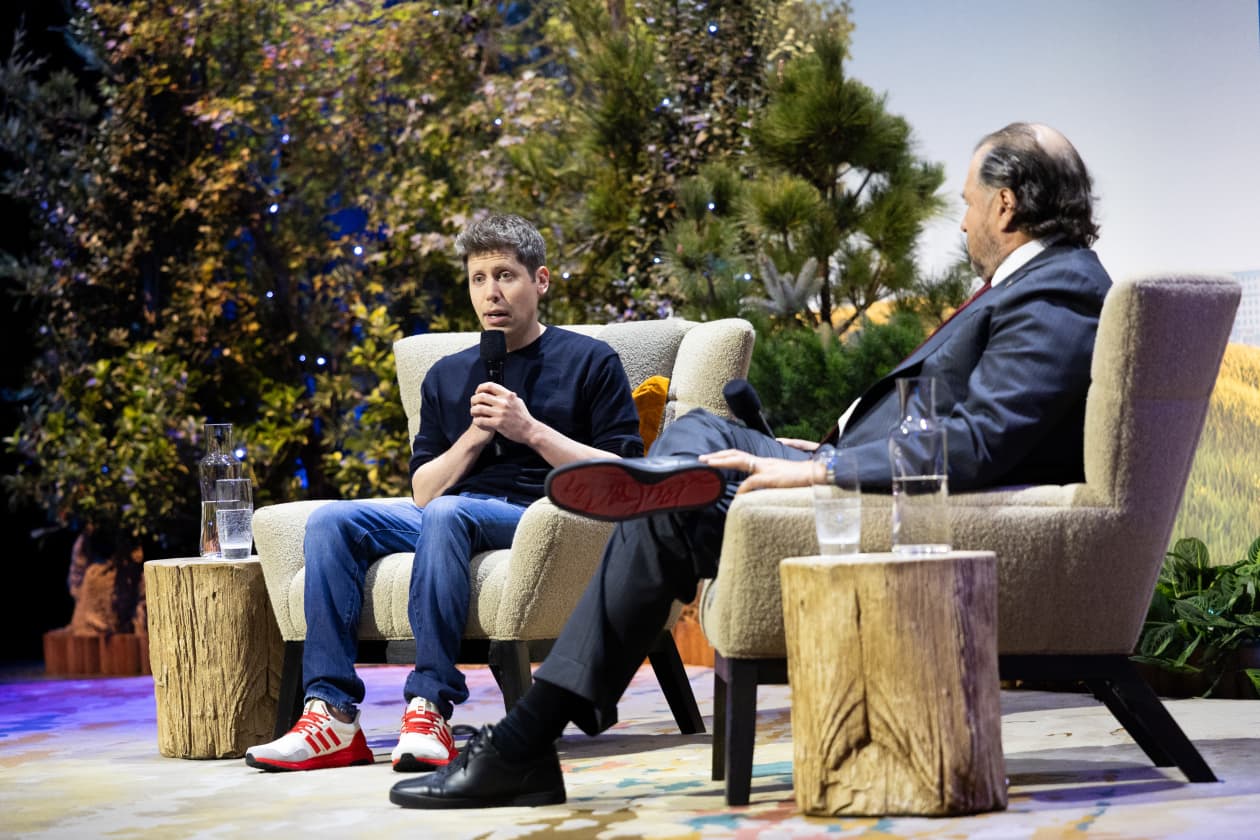
Salesforce's Dreamforce 2026 in San Francisco became a forum for an intensifying debate over whether artificial-intelligence development should slow. Anthropic CEO Dario Amodei, OpenAI CEO Sam Altman and Nvidia CEO Jensen Huang participated, while Meta CEO Mark Zuckerberg weighed in via social media. The article provides no specific policy proposal, financial forecast, or quantified business impact.
Analysis
The investable issue is not the public-policy rhetoric; it is whether safety-led deployment friction shifts AI spending from frontier-model training toward enterprise controls, data governance, and workflow integration. That mix is relatively favorable to CRM, NOW and MSFT versus pure compute beneficiaries: enterprise buyers can defer broad agent rollouts but still fund identity, observability, compliance and data-cleaning projects needed to make those deployments viable. CRM’s upside requires paid Agentforce adoption to convert from demonstrations into incremental subscription/consumption revenue; absent disclosed attach rates and inference-cost economics, the conference commentary is not itself a catalyst.
For NVDA, a meaningful coordinated slowdown remains a low-probability but asymmetric multiple risk rather than a near-term revenue event. Hyperscalers have multi-quarter capacity commitments, and safety requirements may initially increase demand for evaluation, monitoring and inference workloads; however, a regulatory regime that constrains model scale or limits deployment in regulated verticals would reduce the return on incremental GPU clusters over 6-18 months. The more immediate competitive consequence is that model commoditization favors distribution owners such as META, MSFT and GOOGL, while raising pressure on standalone application vendors to prove proprietary data and measurable labor ROI.
Consensus may be too focused on a binary "AI capex continues/slows" outcome. A more likely 1-3 month path is budget reallocation: enterprises concentrate spend with vendors that can indemnify, govern and integrate AI, while experimental point solutions face longer sales cycles. META is comparatively insulated because AI investment can be justified through ad-ranking and engagement gains even if external enterprise-agent adoption slows; its risk is capex intensity outrunning observable ad pricing or conversion uplift.
AllMind Terminal
AI-powered research, real-time alerts, and portfolio analytics for institutional investors.
Request TrialMarket Sentiment
Overall Sentiment
neutral
Sentiment Score
0.00
Ticker Sentiment
Key Decisions for Investors
- No event-driven trade on the conference debate alone; maintain a watch item for CRM. Upgrade only if the next earnings release shows accelerating remaining performance obligations, explicit paid-agent customer growth, and stable subscription margin despite AI inference costs.
- Over the next 3-6 months, favor a quality enterprise-AI basket long NOW and MSFT versus a short basket of high-multiple, subscale AI application software names via IGV underweight; the thesis is procurement consolidation around governance and distribution, not a broad software-beta call.
- Maintain NVDA exposure but hedge 6-12 month regulatory/multiple risk with a modest SMH put spread or NVDA put spread after volatility compression. Falsification: hyperscaler capex guidance remains above consensus and NVDA data-center backlog/conversion stays resilient, indicating deployment restrictions are not impairing compute demand.
- Prefer META over CRM on a 6-18 month AI monetization horizon: META can monetize internal model improvements through advertising without waiting for enterprise purchasing cycles. Exit the relative view if META’s capex-to-revenue trajectory rises while ad pricing, conversion, or operating-margin guidance fails to improve.
More News
- Fed decision looms large; Zuckerberg on AI safety fears - what’s moving markets
- News Flash: 70% of Wall Street Institutions Are Calling for at Least a 50-Basis-Point Fed Rate Hike in 2026
- Today's Fed decision with first hike in three years priced in
- What the Anthropic IPO Means for Amazon and Alphabet Investors
- AWS says it can't restore service to Bahrain, UAE facilities 6 months after Iran strikes
- China's AI leaders keep quiet despite U.S. 'publicity' on tech risks
From AllMind Research
- Anthropic IPO Preview: Valuation, Timing, and What to Watch
- Shein After the IPO: Venue, Valuation, and What Must Be Proved
- What AI Research Tools Should a Small Hedge Fund Buy First?
- The $4.7 Trillion Bet: When Does AI Capex Become AI Revenue?
- Equity Research Automation Statistics: A 2026 Evidence Check