
Truck Safety Coalition Releases Annual Deadliest Truck Crash States Report
Source: PRWeb
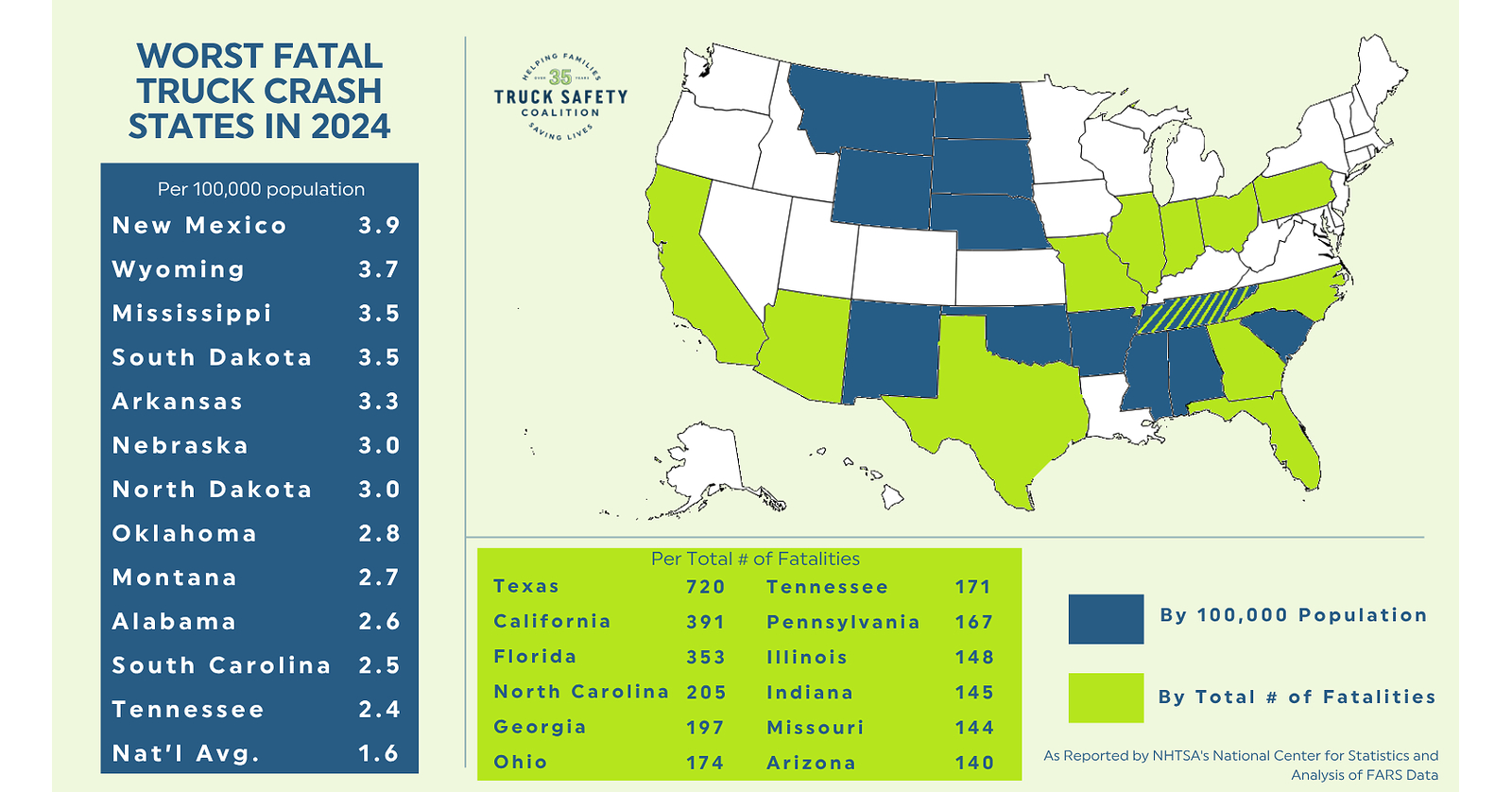
The Truck Safety Coalition reported more than 5,300 deaths and 160,000 injuries in large-truck crashes, with truck-crash deaths up 58% since 2009. Its report ranks New Mexico highest and Wyoming second for 2024 truck-crash fatalities per 100,000 residents. The coalition urged Congress and the Department of Transportation to pursue safety measures including ELD oversight, automatic emergency braking rules, carrier testing and driver-disqualification requirements.
Analysis
The report is an advocacy catalyst, not evidence that enforcement or operating costs are changing now. The key market transmission is policy: if Congress or USDOT advances the proposed measures, ELD audits, carrier-entry tests, post-crash testing enforcement, and AEB requirements could raise compliance costs and slow marginal capacity. That would tend to favor larger operators with compliance infrastructure over small, weakly capitalized carriers; any freight-rate benefit from capacity exiting would be conditional and could be offset by weaker demand.
Near term, the earnings signal for carriers and equipment suppliers is too weak to trade: the report itself does not change rules, and the AEB and legislative paths remain uncertain. Over 1–3 months, watch for committee action, USDOT rulemaking milestones, and enforcement guidance. Over 6–18 months, a finalized AEB rule could support incremental demand for braking and sensing systems, but fleet turnover makes the revenue ramp gradual.
Contrarian point: state fatalities per capita are a poor standalone measure of carrier or state-level risk; population denominator, rural mileage, traffic mix, and freight exposure can distort rankings. Do not infer that carriers operating in listed states are worse operators. The thesis weakens if proposals stall, implementation is delayed, or freight demand and utilization fall enough to overwhelm any capacity tightening.
AllMind Terminal
AI-powered research, real-time alerts, and portfolio analytics for institutional investors.
Request TrialMarket Sentiment
Overall Sentiment
mildly negative
Sentiment Score
-0.35
Key Decisions for Investors
- No immediate directional trade on the report. Treat it as a policy watch item; do not short trucking stocks solely on advocacy headlines.
- Monitor legislative progress on the SAFE Act and Mail Traffic Deaths Reporting Act, plus USDOT’s AEB rulemaking. Reassess only when there is a concrete vote, final rule, or implementation timetable.
- If enforcement requirements become binding, evaluate a relative long in larger, compliance-capable carriers versus smaller operators, but first verify carrier-level exposure, compliance costs, and capacity mix; these data are not supplied here.
- Track AEB supplier order commentary and rule timing before positioning. A delayed or weakened rule, or falling freight utilization that masks capacity effects, would argue against the expected beneficiaries.
More News
- Walmart’s Flipkart is quietly building a food delivery challenger in India
- Alibaba Backs Chinese Robovan Maker in $400 Million Fundraising
- ’Panic’ selling hits Indonesian markets on MSCI expulsion threat
- Qatar warns global energy shockwaves from Iran war have yet to peak
- MTR Bets $5 Billion on a Hong Kong City That Doesn’t Exist Yet
- FreightCar cuts 2026 outlook after removing tank car order
From AllMind Research
- Anthropic IPO Preview: Valuation, Timing, and What to Watch
- Shein After the IPO: Venue, Valuation, and What Must Be Proved
- What AI Research Tools Should a Small Hedge Fund Buy First?
- Document Search Enhancements, AI Enhancements, AI Actions, & Chat Export
- AI Vendor Landscape for Institutional Investment Teams