
Pure Identity / Monokee Names Joseph F. Miceli Jr. CEO to Lead Next Phase of International Growth
Source: PRWeb
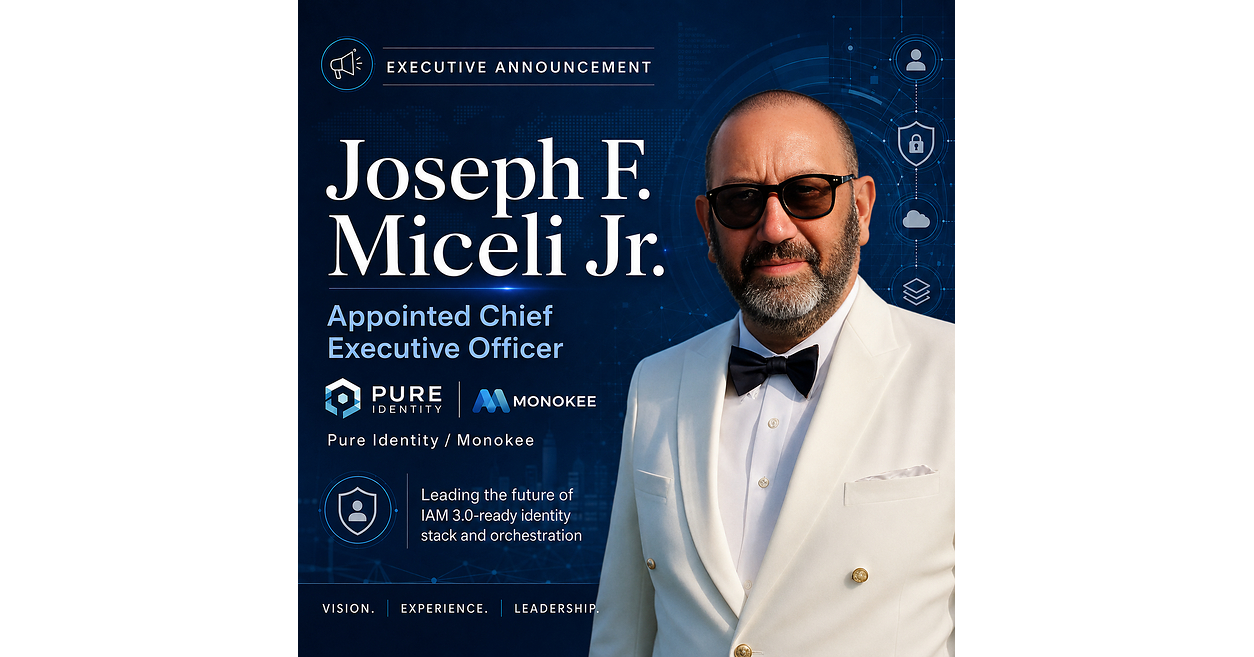
Pure Identity / Monokee appointed Joseph F. Miceli Jr. as CEO to lead global growth, AI and product strategy, partnerships, and adoption of its enterprise identity platform. The company is positioning its IAM 3.0 orchestration technology as a control layer for securing and governing human, machine, application, and AI identities across legacy, cloud, and hybrid systems. The announcement outlines strategic ambitions but provides no financial metrics, customer wins, or quantified guidance.
Analysis
This is not independently investable news: a private vendor’s CEO appointment and architectural claims provide no disclosed ARR, customer traction, retention, or funding data from which to infer a change in public-company fundamentals. The relevant read-through is that AI-agent and non-human identity (NHI) governance is becoming a sharper enterprise-budget category, but the announced “orchestration wrapper” model also validates incumbent platforms rather than implying displacement. Large installed-base vendors can package equivalent interoperability into existing contracts at lower procurement friction.
Near term (days to 1 month), there is no reason to trade public cybersecurity names on this release. Over 1-3 months, monitor whether customer conversations and earnings commentary at CyberArk (CYBR), Okta (OKTA), Microsoft (MSFT), and SailPoint (SAIL) show measurable NHI/agent-identity attach rates, especially paid governance modules rather than pilot activity. CYBR is best positioned if privileged credentials for AI agents become a board-level control requirement; MSFT has the strongest bundle advantage where Entra is already the identity plane, creating downside risk to standalone IAM pricing.
The contrarian point is that “AI identity” may initially expand implementation services and integration spending more than recurring software budgets. Enterprises with fragmented identity estates generally avoid rip-and-replace projects, but an orchestration layer can prolong legacy-directory and SIEM investments; this favors systems integrators such as ACN and IBM before it necessarily benefits pure-play IAM vendors. The thesis is falsified if CYBR/OKTA disclose accelerating net-new platform consolidation, material NHI ARR, or sustained expansion in remaining-performance-obligation growth without higher sales-cycle duration.
Over 6-18 months, the structural winner should be the vendor that owns policy enforcement and privileged access, not necessarily the vendor that claims to connect tools. AI agents create machine-scale permissions and audit requirements, which increase the value of credential vaulting, just-in-time access, and governance evidence. Watch regulatory enforcement or a high-profile agent-permission breach as the catalyst that converts experimentation into funded demand; absent that event, current AI-security valuation premiums remain vulnerable to multiple compression.
AllMind Terminal
AI-powered research, real-time alerts, and portfolio analytics for institutional investors.
Request TrialMarket Sentiment
Overall Sentiment
mildly positive
Sentiment Score
0.32
Key Decisions for Investors
- No immediate position based on this announcement; set an earnings-call alert for CYBR, OKTA, MSFT and SAIL for quantified NHI/AI-agent bookings, paid-module attach, and sales-cycle commentary over the next two reporting cycles.
- Maintain a 6-12 month relative preference for long CYBR versus short OKTA only after confirmation that CYBR’s NHI/privileged-access bookings accelerate while OKTA’s dollar-based retention or operating-margin guidance weakens. Falsify on OKTA reporting reaccelerating platform adoption and durable retention improvement, or CYBR showing material deal-cycle elongation.
- For a broader implementation-spend expression, consider a small 3-6 month long ACN basket versus equal-weight cybersecurity software only if enterprise CIO surveys show identity modernization budgets shifting toward integration services; do not initiate without that evidence, as ACN’s diversified revenue base dilutes the signal.
- Avoid chasing AI-security multiples until a public issuer quantifies AI-identity revenue. A concrete trigger for a CYBR add would be disclosed NHI-related ARR or RPO contribution sufficient to raise forward growth expectations; otherwise treat thematic commentary as non-monetized demand.
More News
- Mark Ruffalo says Paramount’s $111 billion Warner Bros. deal ‘Will stifle creativity, weaken free speech, and cost people their jobs’
- David Ellison says combined Paramount and Warner Bros. Discovery will be named Skydance
- Anthropic warns government attitudes may hurt customer ties, IPO prospectus shows: Reuters
- Stocks remain under the thrall of higher yields and higher oil. Here's what's ahead
- FAA says Boeing 737 Max software glitch not a flight-safety issue
- Broadcom, Amazon Test Limits of Investor Demand for AI Buildout
From AllMind Research
- Anthropic IPO Preview: Valuation, Timing, and What to Watch
- Shein After the IPO: Venue, Valuation, and What Must Be Proved
- What AI Research Tools Should a Small Hedge Fund Buy First?
- Reading Conviction in the Tape: What Level 3 Order Book Data Really Tells Discretionary PMs
- AI Tools for CFA Charterholders: An Evidence Standard