
Global Multiple Sclerosis Treatment Market to Grow at 5.8% CAGR, Reaching USD 44.45 Billion by 2034 as Advanced Therapies and Disease-Modifying Treatments Gain Momentum, Says Maximize Market Research
Source: PR Newswire
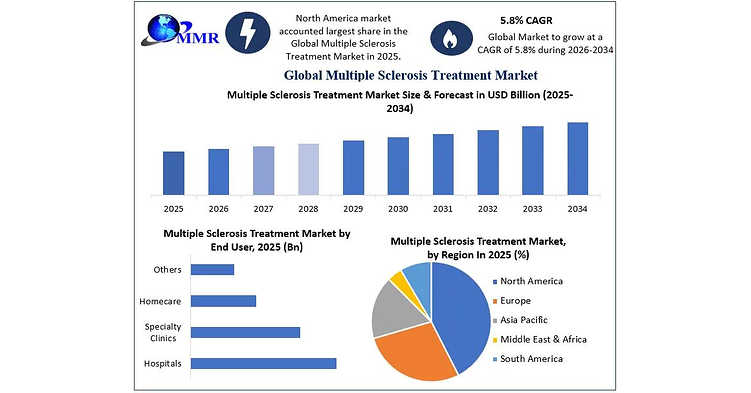
The global multiple sclerosis treatment market is projected to grow from $26.76 billion in 2025 to $44.45 billion by 2034, a 5.8% CAGR, driven by rising disease prevalence and adoption of disease-modifying therapies and high-efficacy biologics. Growth opportunities center on BTK inhibitors, B-cell-targeted drugs, remyelination, stem-cell approaches, precision medicine and digital monitoring, while high treatment costs, reimbursement gaps and limited specialist access remain key constraints. North America leads the market, with Asia-Pacific expected to post strong growth as healthcare access and diagnostic capacity improve.
Analysis
This is not a near-term earnings catalyst: a third-party market forecast does not change prescriptions, reimbursement, or consensus estimates. The investable issue is mix, not headline market growth. High-efficacy anti-CD20 therapies—principally Roche's Ocrevus and Novartis's Kesimpta—continue to pull treatment toward earlier use, pressuring legacy oral/interferon franchises at BIIB, TEVA, VTRS and SNY unless those companies can defend via price, persistence, or new indications.
Over the next 1-3 months, the relevant catalysts are prescription-share data, payer formulary decisions, and trial/regulatory updates for BTK inhibitors rather than aggregate market-size projections. Novartis has the cleanest listed exposure to a shift toward self-administered high-efficacy therapy, while BIIB's MS asset base faces a strategic tension: an MS stabilization narrative may support cash flows, but it does not resolve the need to offset mature-product erosion. The market's broad expansion can coexist with declining revenue for incumbents if biosimilars, generic oral therapies, and payer step-edits capture the incremental patient pool.
Contrarian view: progressive-MS and remyelination language is materially ahead of commercial reality. Neurologic repair endpoints require long, expensive trials and regulatory-grade functional evidence; failure risk is high, so assigning meaningful 6-18 month revenue to regenerative or cell-therapy programs is premature. The more durable second-order beneficiary is specialty distribution/infusion infrastructure, but ROP has limited pure-play MS sensitivity and is not actionable from this item alone.
Falsify the relative-value thesis if NVS reports sustained Kesimpta new-start share losses, material net-price deterioration, or BTK safety/regulatory setbacks; conversely, BIIB becomes more attractive if its MS franchise delivers unexpectedly stable net revenue and operating leverage despite mature-product competition.
AllMind Terminal
AI-powered research, real-time alerts, and portfolio analytics for institutional investors.
Request TrialMarket Sentiment
Overall Sentiment
mildly positive
Sentiment Score
0.32
Ticker Sentiment
Key Decisions for Investors
- No standalone directional trade on this release; treat it as low-impact marketing research rather than a revision-worthy fundamental data point.
- Maintain a 6-12 month long NVS / short BIIB relative-value watchlist, not an immediate recommendation: the thesis requires independently verified US new-start and persistence data showing continued migration to high-efficacy self-administered therapy. Size only after confirmation; target 10-15% relative return, with exit on two consecutive quarters of NVS share loss or BIIB MS revenue stabilization above guidance.
- Avoid adding to TEVA or VTRS on a generic 'MS market growth' premise over the next 12 months. Their likely exposure is to price-sensitive portions of the market, where volume growth can be outweighed by generic competition and payer-driven net-price pressure.
- For BIIB, monitor quarterly MS net revenue, Tysabri and Tecfidera erosion, and R&D spending discipline. A revenue decline materially worse than management guidance without offsetting cost action is the trigger for a tactical short; absent that evidence, do not force the trade.
More News
- FDA approves Eli Lilly's once-weekly insulin injection for type 2 diabetes
- Jefferies reiterates Sarepta Therapeutics stock rating on pipeline potential
- Trump, Xi Address AI, Taiwan During State Visit
- Oracle Japan shares surge 7% after record fiscal first quarter, bucking selloff of U.S. parent
- China's Xi urges U.S. to cooperate on AI
- Trump Hosts China’s Xi With Trade, AI, Taiwan in Focus
From AllMind Research
- Anthropic IPO Preview: Valuation, Timing, and What to Watch
- Shein After the IPO: Venue, Valuation, and What Must Be Proved
- What AI Research Tools Should a Small Hedge Fund Buy First?
- How to Write an Investment Memo with AI: A Decision-Record Template
- Best AI to Write Earnings Notes for Sell-Side Analysts