
ORVANA ANNOUNCES NEW STRATEGIC THREE-TIERED EXPLORATION PROGRAM FOR ITS TAGUAS PROJECT IN ARGENTINA
Source: PR Newswire
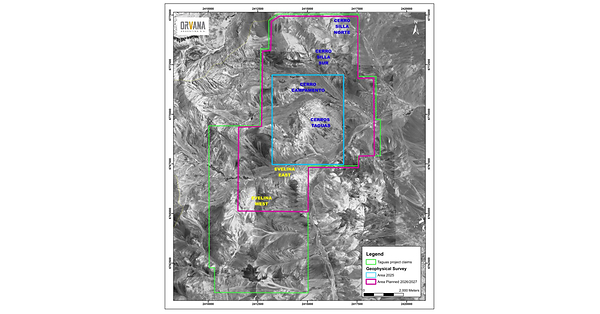
Orvana Minerals outlined a preliminary US$15 million FY2027 exploration program for its Taguas project in Argentina, including approximately 19,500 metres of drilling: 10,000 metres of oxide-resource infill drilling and 9,500 metres targeting a deep porphyry copper-gold system. The program also expands MT/IP geophysics and integrates the recently acquired Evelina property, aiming to upgrade inferred oxide resources and refine potential future development plans. Execution remains contingent on permits, contracting, service availability, market conditions and funding, with no assurance of resource conversion or discovery success.
Analysis
This is an exploration-capital-allocation event, not a near-term NAV event: the program creates a meaningful funding and execution overhang before it can create a resource re-rating. For ORV, the key question is whether operating cash flow from El Valle and the Don Mario ramp can absorb US$15M without equity issuance or incremental leverage. A funding gap would likely dominate any conference-driven liquidity uplift, particularly given the limited depth of the Canadian junior-mining shareholder base.
The oxide work has a potentially faster valuation pathway than the deep target because a higher-confidence resource can support an updated economic study and reduce the discount applied to Taguas. The deeper copper-gold thesis is higher convexity but should be valued as an out-of-the-money exploration option until assay results establish grade, continuity, metallurgy and economic depth. Investors should not capitalize a geophysical anomaly as a deposit; the most likely near-term outcome is elevated drilling/news volatility rather than a durable rerating.
Argentina is the non-obvious swing factor. San Juan is comparatively mining-friendly, but FX, import restrictions, permitting and access to drilling inputs can turn a nominally funded exploration plan into cost inflation and schedule slippage. Copper strength would increase strategic interest in a credible porphyry discovery, potentially benefiting ORV disproportionately versus gold-only juniors, but it also raises drilling-service costs and the hurdle for a buyer to underwrite infrastructure-heavy development.
Consensus may overvalue the investor-conference catalyst. Management access can improve awareness, but institutional interest is unlikely to persist absent a disclosed funding plan, first drilling mobilization, and assay evidence that links the oxide and deep systems into a scalable economic case. The cleaner catalyst sequence over 1-6 months is financing clarity and permits; the material value inflection is likely 6-18 months away, contingent on resource conversion or exceptional deep intercepts.
AllMind Terminal
AI-powered research, real-time alerts, and portfolio analytics for institutional investors.
Request TrialMarket Sentiment
Overall Sentiment
mildly positive
Sentiment Score
0.28
Ticker Sentiment
Key Decisions for Investors
- Maintain ORV as watchlist/hold rather than initiate on conference liquidity alone. Reassess after the next financial disclosure confirms unrestricted cash, operating cash flow and committed funding sufficient to cover the US$15M program; an equity raise at a material discount would invalidate a near-term long thesis.
- For high-risk resource-capital exposure, initiate only in tranches after permits and drilling mobilization are confirmed, with a 6-12 month horizon. Size as an exploration option, not a producing-miner position; take risk off into any sharp pre-assay rerating because assay timing and results, not presentations, drive the payoff.
- Use a relative screen rather than a direct pair immediately: ORV should outperform gold-focused junior explorers only if it demonstrates fundable copper-gold scale at depth. If early deep holes are weak or delayed, rotate exposure toward diversified copper producers such as LUN or HBM, which retain copper upside with operating cash-flow support.
- Set explicit falsifiers: reduce or avoid ORV if cash funding requires dilutive equity, the program budget rises materially above US$15M, permits slip beyond the planned field season, or infill drilling fails to improve resource confidence sufficiently to support an updated economic study.
More News
- Taiwan benchmark Taiex rises to record intraday high as tech stocks advance
- AMD joins the $1 trillion club as chip rally surges - our AI Strategy saw it early
- Jamie Dimon says hyperscaler AI spending could hit $1 trillion next year
- Factbox-Key issues for this week’s Trump-Xi summit in Washington
- Latest Oil Market News and Analysis for Sept. 22
- World Leaders Converge on United Nations General Assembly
From AllMind Research
- Anthropic IPO Preview: Valuation, Timing, and What to Watch
- Shein After the IPO: Venue, Valuation, and What Must Be Proved
- What AI Research Tools Should a Small Hedge Fund Buy First?
- Weekly Update: In-App Tutorials, Futures Data, and Watchlist Enhancements
- AI Tools for Independent Research Firms: A Publishing System