
COST Q4 Earnings Beat Estimates on Sales and Digital Strength
Source: zacks.com
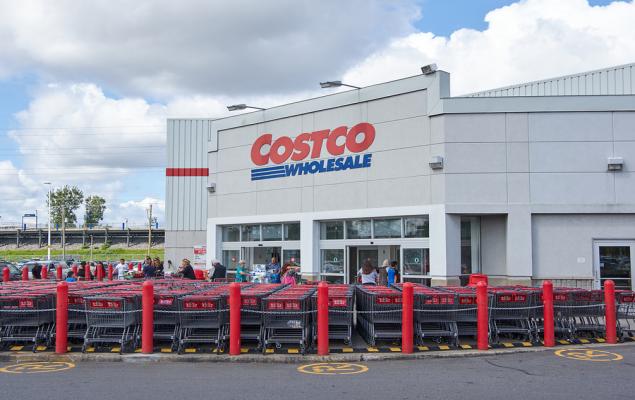
Costco reported fiscal Q4 adjusted EPS of $6.60, up 12.4% year over year and above the $6.48 consensus, while revenue rose 11.1% to $95.72 billion versus $94.82 billion expected. Comparable sales increased 9.4% (6.7% excluding gasoline and FX), supported by 3.3% traffic growth and a 5.9% increase in average ticket; digitally enabled comparable sales climbed 19.5%. Operating income increased 13.8% to $3.80 billion despite an 11bp reported gross-margin decline, and Costco plans net 28 new warehouses plus roughly $7.5 billion of fiscal 2027 capex.
Analysis
The investable signal is not the headline beat but evidence that Costco can convert digital engagement into incremental high-ticket categories without materially diluting its cost structure. That raises the probability of sustained sales density and better fixed-cost absorption over the next 12-18 months, supporting a premium multiple despite elevated growth-investment spending. The key verification point is whether core merchandise margin continues to expand while digital mix rises; a reversal would indicate delivery economics and fulfillment leakage are consuming the apparent productivity gains.
Costco's expanding delivery ecosystem is strategically more valuable to DASH and UBER as a customer-acquisition and order-frequency lever than to CART, whose historical grocery-delivery positioning faces incremental channel conflict. This is unlikely to move DASH or UBER near-term earnings, but 1-3 months of order-volume disclosures, promotion intensity, and grocery gross-order-value commentary could establish whether warehouse-club demand is additive rather than cannibalistic. CART is the clearest relative loser if Costco routes more same-day volume to competing platforms, particularly if Instacart must fund incentives to retain order share.
The contrarian point is that broad consumer strength is overstated by nominal ticket growth and discretionary categories sensitive to commodity and tariff effects. Costco's low-margin model leaves little room for an adverse mix shift, while accelerated unit expansion creates execution risk if new warehouses mature below plan. For TGT, ROST and DG, Costco's momentum is not read-through demand strength: it may instead reflect ongoing share capture from mid-market general merchandise, with TGT most exposed in home, beauty and small-electrics categories.
Near-term, COST can outperform on estimate revisions, but upside is likely capped if the market treats tariff-related benefits and gas-inflated revenue as recurring. Over the next two quarters, watch adjusted traffic, ex-fuel ticket growth, membership monetization, and incremental operating margin; sub-3% traffic or core-margin contraction would falsify the premium-growth thesis. A sustained rise in promotional activity at TGT or worsening CART take-rate/transaction trends would strengthen the relative-share-loss case.
AllMind Terminal
AI-powered research, real-time alerts, and portfolio analytics for institutional investors.
Request TrialMarket Sentiment
Overall Sentiment
moderately positive
Sentiment Score
0.62
Ticker Sentiment
Key Decisions for Investors
- Maintain a tactical long COST for the next 1-3 months only on post-earnings weakness; target mid-single-digit relative outperformance versus XRT as estimate revisions catch up. Risk is asymmetric at a premium valuation: exit if next monthly sales release shows adjusted traffic below 3% or core margin deterioration.
- Initiate a 3-6 month pair trade: long COST / short TGT, sized beta-neutral. The thesis is share transfer in discretionary staples and home-related categories; target 8-12% relative return, with a stop if TGT demonstrates two consecutive quarters of positive traffic and gross-margin expansion while Costco's ex-fuel comparable growth decelerates below 4%.
- Place CART on a negative catalyst watch rather than shorting immediately. Escalate to a short or long CART put spread only if the company discloses slower transaction growth, higher incentive spend, or lost retailer economics attributable to warehouse-club delivery competition; absent those data, competitive impact is too small for a standalone position.
- Monitor DASH and UBER grocery/order-frequency disclosures over the next two earnings cycles; do not chase on this development alone. A measurable acceleration in grocery GOV with stable contribution margins would support adding to the stronger execution vehicle, likely DASH, while margin dilution would invalidate the partnership upside.
More News
- Costco just reported strong earnings. Goldman Sachs sees a sharp move higher for the stock
- Costco Beat on Earnings. About $0.15 a Share of It Was a One-Time Tariff Refund.
- Costco receives $184M in tariff refunds, says most will go toward lower prices
- Costco tops Wall Street estimates as digital sales surge
- Memory Inflation Is Hitting Costco's Electronics Business, and It Triggered a $152 Million Charge
- JPMorgan cuts Costco stock price target on valuation reset